 United States Rossini, The Barber of Seville: Soloists, Chorus, Dance Corps and Orchestra of San Francisco Opera / Benjamin Manis (conductor). War Memorial Opera House, San Francisco, 28.5 and 3.6.2026. (HS)
Second time was the charm (almost literally) for San Francisco Opera’s The Barber of Seville. This revival of the company’s inventive staging, first seen in 2013, offered an opportunity to compare approaches by the two casts who alternated in the main roles.
The 10-performance run opened on 28 May, and the second cast stepped in on 3 June. The differences were striking and, yes, the above-mentioned charm was the prime distinction. The A team had the bigger voices, led by an impressive U.S. debut by Russian-born mezzo-soprano Maria Kataeva as Rosina. But the B team captured Rossini’s fizziness and played off each other with impeccable timing, not only in their singing but with the essential comedy.
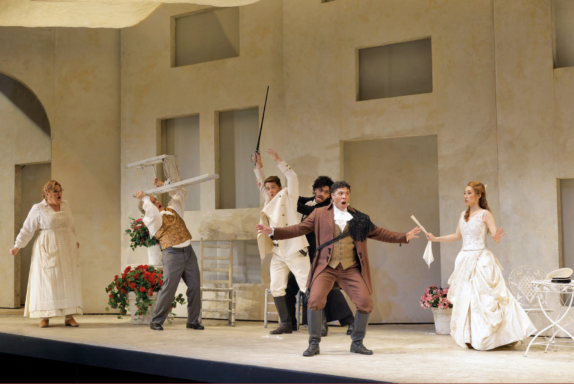
A co-production with Lithuanian National Opera and Ballet Theatre, the staging was a big hit when it debuted here and in its 2015 revival. Spanish director Emilio Sagi injected his native culture into the proceedings every time Rossini’s music suggested it. A troupe of six dancers dressed in full Flamenco garb appeared during the overture, dancing around a giant bust of Rossini and gesturing as a series of white building façades rolled into place diagonally along a slightly raised and raked platform. The dancers reappeared from time to time, rather like a mute Greek chorus to enhance or at least elaborate on the moment, and they posed as street people in outdoor scenes.
Arguably, the dancing was the best aspect this time around. The four women and four men, athletic and sinewy, added much-needed life and exuberance to the experience when opening night seemed stymied on the ‘fizzy’ front. Leaden timing from the casts and in the comic routines involving sets and props fell flat. It didn’t help that Benjamin Manis, who conducted a respectable Carmen here in 2024, never quite got Rossini’s frothy score bouncing merrily.
None of the eight singers in the four principal roles (counting both casts) would qualify as Rossini ‘royalty’ in today’s opera world. In my experience, lesser-known artists often produce a more realistic version of the characters and the music in many familiar operas, and that is what happened here.
The A-team cast took a while to settle in, but they got better in the second act. That rather matched the staging, which started off all black-and-white but added more color with every scene. The final celebration had plenty of flourish: it seemed that the whole town had shown up to celebrate Rosina and Count Almaviva’s marriage. Dancers flamenco-ed, including some of the principals during the finale. The band that serenaded Rosina in the opening scene returned, and the walls of the War Memorial glowed with colors.
In the 100-minute Act I, the musical aspects wandered astray in one way or another. Tempos felt deliberate in the opening measures of the overture, which softened any sense of brio. As Lindoro/Count Almaviva, Levy Sekgapane’s high tenor registered as slim and reedy and Josh Hopkins’s supple baritone was fine, but where was Figaro’s bossy attitude? Even Kataeva, as dazzling as she was, got overly loud whenever she reached for a high note. Renato Girolami (who was so good as the flamboyant Dulcamara in 2023’s Elixir of Love here) just seemed perpetually angry as Doctor Bartolo, showing none of the character’s licentiousness.
And let’s not talk about all the smudgy coloratura and rapid patter singing that did not enunciate (thank heavens for supertitles). The good news for the A team was that Sekgapane’s tenor mellowed in Act II. He found some moments of glory in the final scene, with impressive renderings of the series of flamboyant arias including ‘Cessa di più resistere’ and the cabaletta ‘Ah il più lieto’.
Coloratura was not a problem for the B team. Neither was attitude. Baritone Justin Austin reveled in Figaro’s egotistical aspects and lavished polished lyrical singing on the music. He commanded the stage without seeming to try and connected easily with all the characters. His ‘Largo al factotum’ had wit and showmanship that fit both the music and the setting, and his increasing stress gave the Act II trio ‘Ah! qual colpo!’ just the right amount of tension.
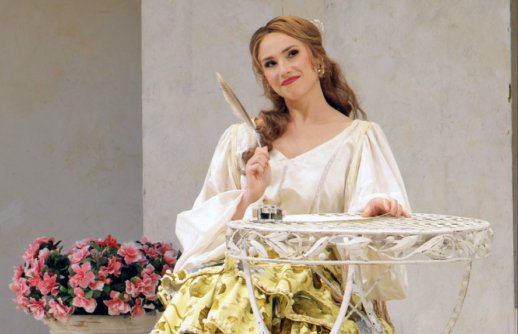
Mezzo-soprano Hongni Wu’s Rosina, wispy like the teenager the role is, unfurled ‘Una voce poco fa’ with endlessly varied details both vocally and comedically. She made a perfect match with Jack Swanson’s Lindoro/Count, a role he has sung at the Metropolitan Opera, Santa Fe and the Rossini Opera Festival in Pesaro. Bass-baritone Patrick Carfizzi (who shared the role of Dulcamara here in 2022’s Elixir) gave Bartolo moments that swung between wiliness and anger, like a real human with some complexity.
The comprimario singers rose to the occasion, especially agile bass Riccardo Fassi as the shifty music teacher Don Basilio. His ‘La calunnia è un venticello’ was even better with the second cast, and his interactions all around were sharper. Among the smaller roles, mostly filled by Adler fellows, baritone Olivier Zerouali gave the opening scene a solid start as the bandleader Fiorello, and baritone Gabriel Natal-Báez created an Ambrogio (Bartolo’s servant) replete with comic attitude. His scene trying to seduce veteran mezzo-soprano Catherine Cook’s elderly Berta as she sang ‘Il vecchiotto cerca moglie’ was a miniature masterpiece.
Manis’s conducting sometimes let the orchestra overwhelm the somewhat lighter voices of the second cast, and there were too many occasions when the orchestral unity frayed. But the bubbling personalities of the second cast seemed to engender livelier music from the pit. When everything came together, it all became irresistible.
Harvey Steiman
Featured Image: [Second cast, l-r] Catherine Cook (Berta), Patrick Carfizzi (Doctor Bartolo), Jack Swanson (Count Almaviva), Riccardo Fassi (Don Basilio), Justin Austin (Figaro) and Hongni Wu (Rosina) © Cory Weaver
Production:
Director – Emilio Sagi
Sets – Llorenç Corbella
Costumes – Pepa Ojanguren
Lighting – Gary Marder
Original Choreographer – Nuria Castejón
Revival Choreographer – Colm Seery
Chorus director – John Keene
Cast:
Figaro – Joshua Hopkins / Justin Austin
Rosina – Maria Kataeva / Hongni Wu
Count Almaviva – Levy Sekgapane / Jack Swanson
Doctor Bartolo – Renato Girolami / Patrick Carfizzi
Don Basilio – Riccardo Fassi
Berta – Catherine Cook
Fiorello – Olivier Zerouali
Ambrogio – Gabriel Natal-Báez
An officer – Thomas Kinch
Notary – Andrew Truett
Just saw the B cast at the June 6th matinee. They appeared to work together fine to me with Hongni Wu mugging at the appropriate times, great fun. I enjoyed the Don Basilio part as well and this review thought that he worked better with the B cast.
Having seen numerous productions of Barber, this stood out and had so many pleasant surprises. From the staging to the vocal gymnastics, it was above and beyond anything I have previously seen.. Brava cast and crew.