
 United States R. Schumann: Joshua Bell, Irène Duval (violins), Blythe Teh Engstroem (viola), Steven Isserlis (cello), Jeremy Denk (piano). 92NY, New York, 7 & 9.7.2026. (ES-S)
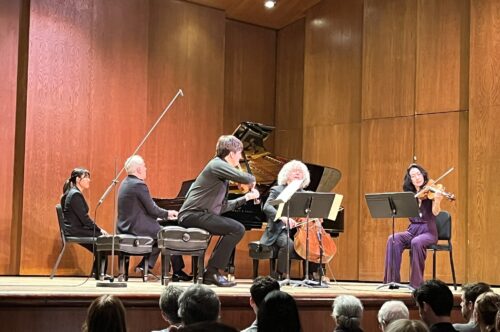
Robert Schumann –Violin Sonata No.1 in A minor, Op.105; Piano Trio No.1 in D minor, Op.63; Adagio and Allegro for Cello and Piano, Op.70; Piano Quintet in E-flat major, Op.44; Fantasiestücke for Piano Trio, Op.88; Piano Trio No.3 in G minor, Op.110; Romances for Violin and Piano, Op.94; Piano Quartet in E-flat major, Op.47
A year after their two-part exploration of Fauré’s chamber music, the same group of musicians returned to 92NY for another concentrated immersion, this time devoted to Robert Schumann. Together, the concerts offered a wide-ranging view of Schumann’s chamber output, placing familiar landmarks in conversation with works heard far less often.
Schumann’s piano works and Lieder remain the regions of his output most immediately associated with his private, psychologically volatile world. The symphonies project his imagination on a larger public scale, but his chamber music occupies a more complex middle ground: less instantly identifiable, perhaps, but no less revealing. In these works, inwardness is reframed as exchange, argument and shared momentum, drawing on Beethoven’s models of development and, at least occasionally, on Mendelssohn’s polish and fluency.
The first evening moved toward the Piano Quintet, Op.44, arguably Schumann’s most celebrated and immediately gratifying chamber work; the second offered a more elusive counterpart, culminating in the Piano Quartet, Op.47. Taken together, the two performances gave the undertaking a clear shape without letting the lesser-known works disappear in the shadow of the masterpieces.
The Piano Quintet and the Piano Quartet served as the anchors, though they fulfilled different dramatic functions. In the Quintet, Schumann writes on an expansive scale, driven by sweep, propulsion and open-hearted brilliance. The Quartet, also in E-flat major, speaks in a somewhat different register: less dazzling on the surface, more closely woven and more dependent on the subtle chemistry of the ensemble.
The interpretive cohesion was all the more striking given that these musicians do not appear together as a regular ensemble. Across both works, entries were alert, dynamics finely judged and individual profiles emerged without weakening the collective argument.
The Quintet benefited from an interpretation that kept its exuberance in motion. In the opening movement, Denk provided the forward momentum, keeping the piano’s repeated chords buoyant and rhythmically alive. Yet the presence of a string quartet mattered just as much: Bell’s first violin line could soar while remaining fully integrated, as Irène Duval, Blythe Teh Engstroem and Isserlis made the answering phrases sound like real replies not accompaniment. In the second movement, the players resisted the temptation to overstate the music’s pathos. The tread was firm but not ponderous, and the contrasting episodes opened naturally, offering consolation free of sentimentality. The Scherzo’s rushing scales were articulated with clarity and lightness. In the finale, the five musicians gathered energy while preserving contrapuntal definition; Schumann’s return of earlier material came across not as a formal device dutifully underlined but as a release.
The Piano Quartet’s leaner textures gave particular prominence to Blythe Teh Engstroem’s viola, whose lines emerged with unusual warmth and clarity and not just as connective tissue between Bell’s violin and Isserlis’s cello. In the opening movement, the performers allowed the music’s lyricism to unfold patiently, with Denk keeping the piano writing supple and clear. The Andante cantabile had a natural songfulness, shaped with tenderness, while the Scherzo brought a lighter, more pointed articulation than in the Quintet. The performance made the Quartet feel like the Quintet’s more finely argued counterpart, not merely its quieter sibling.
The two piano trios included here moved into darker territory. Op.63 carried the greater urgency. In the first movement, Denk gave bite to the piano’s surging figuration while Bell and Isserlis kept the string lines taut. The second movement had a dancing lilt, with imitative phrases passed lightly and precisely among the players. The tragic lament initiated by the violin in the slow movement was followed by a confident, fiery finale, true to Schumann’s marking.
The G-minor Trio, Op.110, written four years later, proved in some ways more intriguing. Its drama came through abrupt shifts of mood and character. In the Ziemlich langsam, Bell and Isserlis shaped the interweaving violin and cello lines with care, bringing lyrical ease to the calmer sections and sharper dramatic alertness to the turbulent middle. The third movement drew much of its character from persistent accenting, while the finale emphasized good-natured humor, more buoyant than mischievous.
The shorter works revealed another side of the composer’s inventiveness. In the Adagio and Allegro, Isserlis shaped the opening with especially generous lyrical breadth, while Denk’s piano line sustained the reverie and gave it a quiet pulse. In the Allegro, the performance added sparkle, lift and wit to the expected Romantic effusion.
The Three Romances, played by Irène Duval and Denk, came closest to the world of song. Duval gave the melodic lines an unaffected simplicity that never turned plain. Denk was attentive to the harmonic turns underneath, allowing the pieces to carry more emotional weight than their modest scale might suggest.
The Fantasiestücke had just the right mercurial quality, its brief pieces moving between lyricism, playfulness and tension. The finest moments came in the ‘Duet’ segment where Duval and Isserlis combined fervor and melancholy with supple ease while Denk kept the piano part crisp.
Overall, what made the two performances persuasive was their refusal to become a dutiful survey. The result was less a complete portrait than a reminder of how varied, searching and alive Schumann’s chamber music can sound in the right hands.
Edward Sava-Segal