
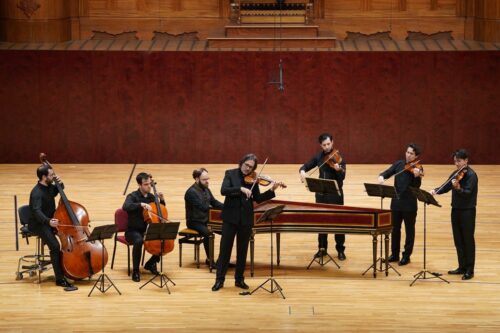
 United Kingdom Beethoven, Dvořák, R. Schumann: Leonidas Kavakos (violin), Kirill Gerstein (piano), The ApollΩn Ensemble: Alexandros Sakarellos (violin), Ilias Livieratos (viola), Timotheos Petrin (cello). Wigmore Hall, London, 2.7.2026. (CSa)
Beethoven – String Trio in G, Op.9 No.1
Dvořák – Terzetto in C, Op.74
Robert Schumann – Piano Quintet in E-flat, Op.44
Greece may have failed to qualify for this year’s FIFA World Cup, and neither Stefanos Tsitsipas nor Maria Sakkari reached the 2026 quarter-finals at Wimbledon, but the celebrated Greek violinist Leonidas Kavakos and members of his ApollΩn Ensemble did not disappoint recently at the Wigmore Hall – The UK’s Centre Court for chamber music – in an innovative recital of early Beethoven, Dvořák and Robert Schumann.
The group’s exploration of Beethoven’s String Trio in G major, composed by the 27-year-old in 1797, carefully conserved its clean classical structure, yet bestowed it with the Romantic warmth and emotional power of a mid-19th century work. The slow introduction to the first movement created an almost symphonic air of expectancy, before a lively, contrapuntally intricate Allegro con brio demonstrated the Ensemble’s rare virtuosity and established a perfect balance between Kavakos’s violin, Ilias Livieratos’s viola and Timotheos Petrin’s cello. The Adagio movement witnessed a joyfully argumentative, almost operatic dialogue between the instruments, while Beethoven’s teasing Scherzo was executed with carefully studied unpredictability. After an exhilarating energetic Presto, the Ensemble, reconstituted, returned to the platform to play Dvořák’s Terzetto in C.
Composed some 90 years after the Beethoven Trio, Dvořák’s work offers a richly melodic yet intimate musical conversation between two violins and was faithfully provided here by Kavakos and Alexandros Sakarellos with Ilias Livieratos on viola. The opening movement unfolded with exemplary restraint before blossoming into a lyrical Allegro. This in turn gave way to a serene and expansive second movement Larghetto. In the colourful Scherzo, the two violins struck up a lively folk-inflected exchange, skilfully mediated by the viola. The finale, marked Tema con variazioni (Theme with variations) was allowed to flow naturally, and moved through a range of emotions from gently expressive song to increasingly brilliant exchanges between the musicians.
The second half featured one work: Robert Schumann’s high octane Piano Quintet in E-flat, Op.44. Joined by Russian-American pianist Kirill Gerstein. Part intimate chamber work and part grand piano concerto, Gerstein burst into the exhilarating exchanges between the strings with sparkling energy. After a triumphant first movement, the measured dignity of the solemn In modo d’una marcia was beautifully contrasted with moments of exquisite tenderness. All lingering fragments of sadness were swept away in a Scherzo distinguished by an astonishing display of rhythmic vitality and high-precision playing, and the concluding movement – an irrepressible Allegro was expressed with all the passion, craftsmanship and communicative power that one has come to expect from instrumentalists at the top of their game. The ovation from the Wigmore Hall audience may have lacked the roar of a World Cup or Centre Court crowd, yet in its warmth and enthusiasm, was every bit as sincere.
Chris Sallon