 Sweden Beethoven, Fidelio: Soloists of Läckö Opera, Läckö Chamber Orchestra / Simon Kim Phipps (conductor), Läckö Castle courtyard, 10.7.2026. (NS)
Production:
Director – Lisa Charlotte Friederich
Movement instructor – Lars Bethke
Costume and Set design – Elin Hallberg
Lighting design – Christian Dahlqvist
Translation – Catarina Gnosspelius
Cast:
Leonore – Julia Sporsén
Florestan – Kjetil Støa
Don Pizarro – Andreas Landin
Rocco – Markus Schwartz
Marzelline – Agnes Auer
Jaquino – Viktor Johansson
Don Fernando – Michael Schmidberger
Guards – Clifford Lewis, Johan Gummesson, Nils-Gabriel Berg
Citizens, Prisoners – Local choir singers
There can be few more atmospheric settings for Fidelio than a castle courtyard. This summer is the first production of Beethoven’s only opera at Läckö Castle, but clearly a lot of thought has gone into the performance. The setting is an unspecified near-present time, with a clear message that the themes of Fidelio are still very relevant over two centuries after its premiere.
Catarina Gnosspelius’s Swedish translation of the libretto feels fresh and timeless, and Elin Hallberg makes skilful use of minimal props and the backdrop of the castle to create a believable set. Hallberg’s costumes are generally excellent, picking up the colours of the castle and with subtle distinctions between the different roles.
The three prison guards Clifford Lewis, Johan Gummesson and Nils-Gabriel Berg gave an impressive portrayal of the soul-destroying experience of working for a tyrant, and the pent-up rage when they turn on Pizarro. Lewis and Gummesson also had moving solos as First and Second Prisoner.
The chorus of prisoners and citizens was recruited from local choirs and gave moving performances of ‘O welche Lust’ and the final scene. The direction and costumes emphasised Pizarro’s policy of erasing the individuality of his prisoners, making the choruses all the more poignant.
Viktor Johansson skilfully portrayed the facets of Jacquino’s character, both his baffled jealousy towards the blossoming relationship of Marzelline and Fidelio (Leonore in disguise), and his enthusiasm in toadying to Pizarro. The whining tone of his complaints to Marzelline could not disguise his clear and expressive tenor.
Andreas Landin acted the role of Don Pizarro with chilling vigour. He projected menace and obsession with his power and position. The contrast between Pizarro’s speaking voice (that of a prissy bureaucrat) and his bloodthirsty singing was like opening a window into Pizarro’s soul.
Markus Schwartz was always engaging and sympathetic as Rocco, with a charming father-daughter relationship with Marzelline. His ‘Hat man nicht auch Gold beineben’ showed off his comic skills, but he also convincingly showed the moral development of his character through the opera. His beautifully clear baritone was wonderfully nuanced as Rocco’s qualms at his orders grew and humanity warred with self-preservation.
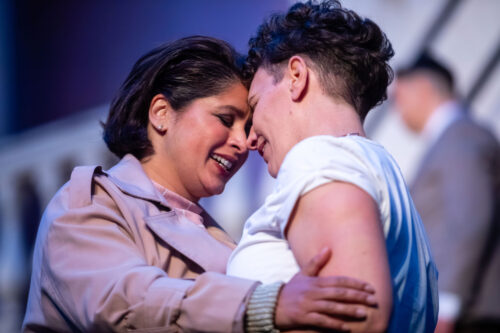
Agnes Auer was superb as Marzelline, demonstrating an expressive soprano comfortable on the high notes already in her first aria ‘O wär ich schon mit dir vereint’. Director Lisa Charlotte Friederich gives Marzelline added importance by having Fidelio genuinely reciprocate their feelings. She also discovers Leonore’s mission already in Act I, but despite knowing that she is a woman and married, still loves her and decides to support her. Auer wordlessly acted her decision with conviction and had great stage presence.
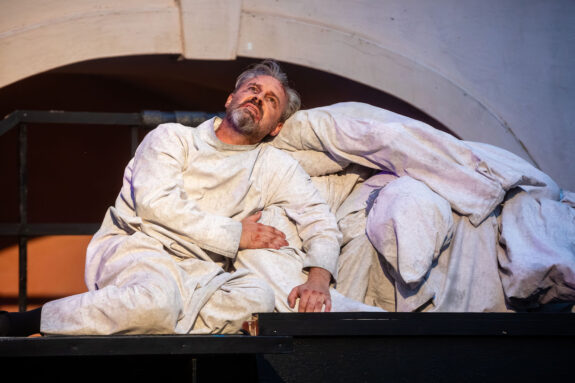
Kjetil Støa’s acting as Florestan was incredibly moving, with a searing intensity to ‘Gott! Welch dunkel hier!’ and a very human response his rescue. The duet ‘O namenlose Freude!’ with Leonore was vocally impressive but even more impressive in how convincingly Støa and Julia Sporsén acted the complex whirlwind of their characters’ feelings. Støa’s tenor had brilliance but also a hard edge, perhaps reflective of the incredible strain of Florestan’s two years of isolation. That said, in ‘In des Lebens Frühlingstagen’ his duet with the solo oboe (played beautifully on stage by Siobhan Losciale, who was dressed as Florestan’s vision of Leonore) was sublime.
Sporsén was compelling both as Fidelio and as Leonore. From her first entrance she convincingly portrayed Fidelio as a young man with warmth and openness – no wonder Marzelline has fallen for ‘him’ and Rocco is so impressed! Her dramatic soprano worked well in ensemble scenes and had terrific impact in ‘Abscheulicher!’ where she took the high notes with confidence. ‘Komm, Hoffnung’ was both vocally expressive and grippingly acted as a wordless Marzelline discovers that Leonore is a woman and sees her picture of Florestan. In the chilling dungeon scene in Act Sporsén’s singing was heart-wrenching, matching the powerful staging.
Lisa Charlotte Friederich made some bold choices in this production, such as the more complex relationship between Leonore and Marzelline. For me it worked, giving Marzelline more agency and fitting well with the casting. Friederich pulls no punches in depicting the brutality of Pizarro’s prison and what it does to people. The opening of Act II was horrifying and brilliant at the same time, as prison staff made a pile of body bags on the stage from which Florestan later emerged. The orchestra’s sinister playing in this scene only heightened the impact. The details were also impressive, from Rocco and Fidelio’s reaction to the stench when entering the dungeon to the relationships between the characters.
This summer is the 22nd and final Läckö Opera production with Simon Kim Phipps as conductor. Through these years the Läckö Chamber Orchestra has developed a sound that is remarkable for such a small ensemble playing in quite Spartan conditions. Under Phipps’s baton they had power to match the impressive dramatic voices of the cast, but also a sublime beauty of line in the ‘Canon Quartet’. It was a privilege to hear Phipps bowing out with Beethoven, and I look forward to returning next summer to this very special opera company.
Niklas Smith
Playing until 1 August. In half of the performances Leonore/Fidelio is sung by Helena Sá Cavalcante Schuback and Florestan by Markus Bjørlykke. For more information click here.
Featured Image: Florestan (Kjetil Støa) in the dungeon © Daniel Strandroth