 United Kingdom Shakespeare’s Love’s Labour’s Lost and Much Ado About Nothing (adapted by Tom Littler for Guildford Shakespeare Company/Orange Tree Theatre): Braboeuf Manor, Guildford, Surrey 11.7.2026. (BF) *****
On a blistering hot afternoon – fortunately the evening was breezier – in the grounds of Braboeuf Manor in Guildford (formerly the College of Law, with all its memories for many alumni solicitors of England & Wales), two combined theatre companies gave their audience a truly moving, engaging, funny, sad, intelligently reworked version of two of Shakespeare’s romantic comedies rolled into one. You can see either one of them separately, but together they are a really special delight. The whole thing has charm in bucketfuls.
Tom Littler’s production is not the first to update these two Shakespearean comedies, nor the first to put them on together, most notably done by the Royal Shakespeare Company in 2014 when the plays were set before and after World War I. There is indeed a scholarly argument that Shakespeare actually intended Much Ado to be a sequel piece to Love’s Labour’s Lost, and maybe even call it Love’s Labour’s Won. But this version is the first to make the two into a seamless whole, with the same characters in each, showing them in this case before World War II in 1939 (Love’s Labour) and then after it in 1945 (Much Ado).
This works extremely well. Love’s Labour is a sunny play, involving four aristocrats forswearing the company of women for three years of study and fasting, only to fall like ninepins when a princess and her three attractive ladies arrive. There is amiable humour, a lot of wordplay and somewhat pedantic wit, love letters are misdelivered to comic effect. The shadow on their happiness comes at the end of the play when the death of the princess’ father means the women have to leave for home for a year’s mourning.
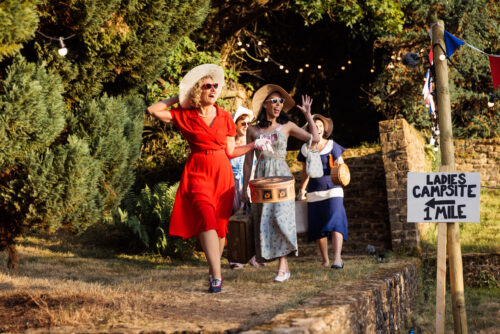
Placing this in the idyllic setting of a country pub by the river in the summer of 1939 allows Littler to have his four men as upper-class chaps in blazers come to mess about in boats and his four women as upper-class sporting types come for fishing and shooting who are then directed to the women’s campsite a mile away. The village constable, the curate and the Latin-spouting schoolmaster fit right in with this scenario. The shadow at the end, presaged by the sound of an aircraft overhead, is of course the outbreak of war, causing everyone to depart for an indefinite period and an unknown future.
Much Ado is the reverse: much darker – there is romance but Beatrice and Benedick have history, Don John plots to cause misery, Hero is publicly humiliated. Then at the end the sun comes up, wrongs are righted, couples are united and happiness is restored.
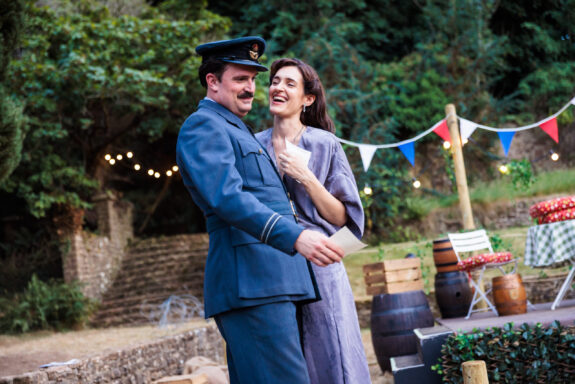
Littler’s version of this one is set in the same country pub by the river, in the summer of 1945. The same four men and four women, all in uniform now, return to the scene of their carefree past, all now affected by the six years’ trauma they have undergone. The new bitter edge to Beatrice and Benedick’s verbal sparring can be attributed to their long separation (maybe Benedick is not a good letter-writer), John Longaville’s malicious nastiness and Claudio’s extreme punishment of Hero could well be a result of PTSD. Fortunately, there is still plenty of fun to be had and plenty of absurdity, from the benign plot to bring Benedick and Beatrice together, to the exposure of Longaville’s plot by the bumbling Watch led by Dogberry, now proudly a captain, perhaps in the Home Guard. The pairs of lovers are reunited and all ends happily.
Littler has had to take a few liberties with the text to achieve all this, including changing or amalgamating some of the names, so for example Berowne and Lord Longaville in the first play and Benedick and Don John in the second each become one man, Benedick Berowne and John Longaville, and the Princess of France in the first play takes over the role and functions of Don Leonato in the second, with Leonata as her first name. He has excised a few minor characters, simplified some of the subplots, removed the obscure 16th-century political references, and generally made it all easier to follow.
James Sheldon plays Benedick as a somewhat bemused commitment-phobe, witty and charming with an expressive use of eyebrows. Phoebe Pryce as Beatrice movingly charts the character’s progress from a witty confident young woman to a disappointed and hardened one. Chirag Benedict Lobo plays Claudio, starting as a carefree young man to lashing out cruelly against his apparent betrayal, doubling as the comic vicar. Joëlle Brabban doubles as the sassy page Moth and a movingly unsuspecting Hero. Matt Pinches demonstrates his versatility again with a comic turn as Dull Dogberry and also playing the villain of the piece John Longaville.
The production makes the most of the outdoor setting, which supports much comic business if not slapstick, with boats, fishing rods, a beer pump, a dinner gong and the like. It’s all tremendous fun.
The production is at Braboeuf Manor until 25 July, then moves to OT on the Hill, Thomas’ College, Queen’s Rd, Richmond 31 July – 22 August. For more information click here.
See them both: if you are lucky, when you go, the weather will be a little cooler!
Barbara Ford
Featured Image: Beatrice and Benedick finally find their happy ending in Much Ado about Nothing (James Sheldon, Phoebe Pryce)
Cast:
Hero / Moth – Joëlle Brabban
Margaret / Jaquenetta – Sally Cheng
Leonata – Sarah Gobran
Costard/Borachio – Jeremy Lloyd
Claudio Dumain – Chirag Benedict Lobo
Prince of Navarre / Don Pedro – Owen Oakshott
John Longaville / Dull Dogberry – Matt Pinches
Beatrice/Rosaline – Phoebe Pryce
Benedick Berowne – James Sheldon
Don Armado / Friar Boyet – Robin Simpson
Creatives:
Director Tom Littler
Associate Director – Millie Gaston
Composer – Matthew Floyd Jones
Movement director & Choreographer – Asha Jennings-Grant
Set & Costume designer – Neil Irish
Assistant designer – Anett Black
Sound designer – Matt Eaton
Fight director – Philip d’Orléans