 United Kingdom Garsington Opera 2026 [4] – Gerald Barry, The Importance of Being Earnest: Soloists, Philharmonia Orchestra / Douglas Boyd (conductor). Garsington Opera at Wormsley, 10.7.2026. (CR)
Gerald Barry’s adaptation of Oscar Wilde’s much-loved play has already become something of a modern operatic classic on the opera stage, receiving its fourth staging since its concert premiere at Los Angeles in 2011 in a new production by Jack Furness for Garsington. The opera lifts the lid from the tensions and conflicts simmering underneath the polite veneer of the late Victorian play with its often fast, almost shouting, stuttering delivery of many of its famous jokes and bons mots.
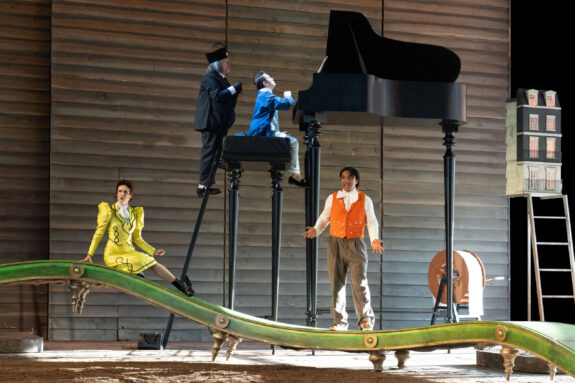
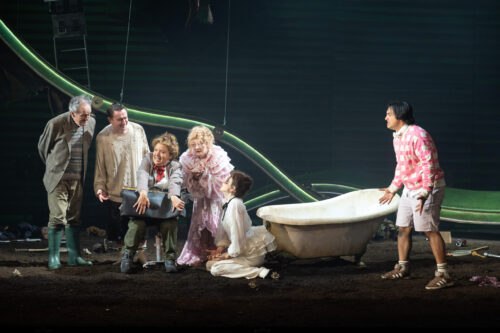
Furness’s vision of the work, with Francis O’Connor’s set design, pares back its surface respectability further and emphasises its absurdities with a sequence of surreal motifs and symbols on stage, laying bare the characters’ psycho-sexual anxieties in something like the manner that Ken Russell would have done had he turned it into a film. Some of those symbols arise suggestively and dynamically from the high social world of the original play’s milieu – for instance, the gigantically tall grand piano and stool at which Algernon plays as the piece opens, towering over the set as a symbol of the forbidding adult world which he and Jack must navigate; a ridiculously extended chaise longue snakes around the stage and down into the pit where the orchestra would be, except that the reduced instrumental ensemble sit up on the stage as, more or less, a part of the action. That connection is emphasised by having the circle in which the butler, Lane (diligently played by Peter Lidbetter) presides nearby abutting into their space. A seeming pun is made by conceiving of that area as a kitchen where Lane prepares the cucumber sandwiches and other comestibles, while conductor Douglas Boyd – the chef d’orchestre as the French would say – directs the Philharmonia Orchestra from its opposite side.
Such elements work well as an extension of the frenetic temper and mood which Barry casts upon Wilde’s play. But in other respects, the stagecraft and dramaturgy seem too knowing and revel too much in their jests to work as a fully successful expression of the absurd or surreal, since ideally these latter need to be delivered in a completely deadpan manner – i.e. the very opposite of camp, which is really how the performance feels instead. In this regard, it was a stroke of musical genius on Barry’s part in the first place to write the role of Lady Bracknell not for a male falsetto singer and overdo the character’s camp possibilities, but for bass and simply to let the absurdity arise from the visual impression of a man in drag. Henry Waddington’s solid, dry delivery achieves crisply, therefore, the comedy that comes from aligning the surreal with cool, detached execution.
The production descends into crude, futile caricature, however, by characterising her apparently tyrannical bearing as a fascist commandant in black gown, jackboots, and helmet for the third act. The reason why the Lady Bracknell character works so well as comedy is precisely because her pretensions and snobberies lie at a subtle level within the social and private domain of domestic life, rather than as a latent grab for overt power in the political realm. In a world of social or gender hierarchies which obtained until well into the 20th century, such female roles are comically successful – and actually enlist our sympathy and support – as they had been since at least the traditions of Baroque opera buffa because they use their wits in the small ways open to them to overcome their limitations, and usually also to make fun of the menfolk around them in the process. This interpretation of the role makes a simplistic political argument that isn’t in the text in the first place. And it highlights that wider problem of overblown actions on stage not quite aligning with how surrealism works at its more subtle best. The constant, enervating tension of what occurs on the stage rather destroys the impact of the denouement of Wilde’s play (which is about personal identity if it’s about anything), as well as the shock of its operatic adaptation in which the silent Lane shoots all the characters.
Despite that, the singers cope excellently in their parts which very often require them to shout or declaim, rather than sing in any lyrical sense – the near-quotations or riffs on Auld Lang Syne in several places are the obvious exception (the significance of which reference in this context I must admit escapes me). Zahid Siddiqui’s strenuous account of John Worthing comes closest to attaining some sort of comic lyricism and vocal flow which achieves something more musically satisfying, though Seán Boylan manages a more clipped, diffident manner as Algernon Moncrieff, which gets closer to the dry acidity at which this surreal reimagining of the play aims. Holly Brown skilfully navigates a split temperament in Gwendolen between geniality and a cutting, haughty impatience, while Jennifer France sustains Cecily’s soubrettish dignity with pure, silvery vocal lines that soar in a pithy sort of coloratura. Susan Bickley makes an oddly husky, vaguely sinister figure of Miss Prism, and too much of Dr Chasuble’s part is cut in the operatic adaptation to allow such a well-known actor as Kevin Whately to develop much presence in the role, though his discreet, silent appearances as a beekeeper on the side imply an apt sense of innocence and impotence.
Boyd and the Philharmonia maintain the score’s hectic, driven pace with lean and punchy efficiency. They make the maximum effect from almost a minimum of means, dovetailing with the voices in impressive, mechanical regularity. Their performance leaves the nerves frayed, as is evidently Barry’s intention with this adaptation.
Curtis Rogers
Featured Image: Garsington Opera’s The Importance of Being Earnest © Richard Hubert-Smith
Production:
Director – Jack Furness
Set designer – Francis O’Connor
Costume designer – Hannah Wolfe
Lighting designer – Paul Pyant
Movement director – Rebecca Meltzer
Intimacy director – Haruka Kuroda
Cast:
John (Jack) Worthing – Zahid Siddiqui
Algernon Moncrieff – Seán Boylan
Cecily Cardew – Jennifer France
Gwendolen Fairfax – Holly Brown
Miss Prism – Susan Bickley
Lady Bracknell – Henry Waddington
Dr Chasuble – Kevin Whately
Lane / Merriman – Peter Lidbetter
In the direction (rather than Wilde’s original) doesn’t Act 3 look forward to the First World War, when Edwardian complacency – cucumber sandwiches and all – gets blown away? Hence the relevance of Auld Lang Syne… an ending.