
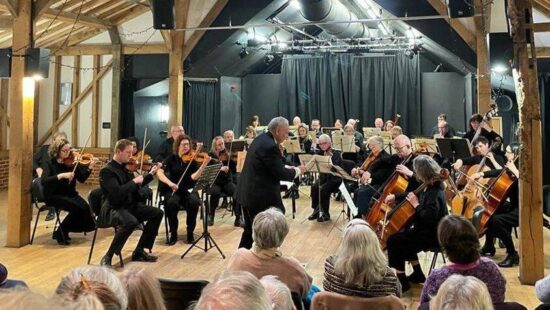
 United Kingdom Dvořák, Finzi, Beethoven: Per Piacere Chamber Orchestra / Martin Henderson (conductor). St Michael and All Angels’ Church, Lyndhurst, 18.7.2026. (CK)
Dvořák – Serenade for Wind Instruments
Finzi – Romance for Strings
Beethoven – Symphony No.3, Eroica
I first came across Per Piacere, an amateur chamber orchestra operating in and around Southampton, at a concert they gave last November; the highlights of an engaging programme were a sparkling performance of Cimarosa’s Concerto for 2 flutes in G major (featuring the orchestra’s flautists Sue Gibbons and Gina Briant) and a bracing account of Haydn’s last symphony, the London. I was sorry to miss their next concert, a mouth-watering programme which included Mozart’s Sinfonia Concertante for violin and viola and Dvořák’s delectable Fifth Symphony: so I was delighted to catch up with them at this concert in the heart of the New Forest.
The orchestra is presided over by Martin Henderson, a long-time double bass player with the Bournemouth Symphony Orchestra. His energy, geniality and love of music radiate from the podium to include the orchestra and the audience as well: his beat is clear and his rapport with his players almost tangible.
I have quoted George Hurst’s remark – ‘The world would be a better place if it heard more Dvořák’ – before: but it came irresistibly to mind in Per Piacere’s delicious account of his lesser-known Serenade for Wind Instruments. The instrumentation was in itself an unusual joy: no flutes, pairs of oboes, clarinets and bassoons, a trio of horns, a cello and a double bass …and an optional contrabassoon: a wonderful addition to the sonority of the outer movements, present here, played by Sandra Woolsey.
The sounds of this unusual band were marvellously rich, vibrant and tangy, with (as so often in Dvořák’s music) an unmistakably outdoor character. The opening movement had all the pungent gusto of a village band; in the second – with hints of the sousedzka, as in a couple of the first set of Slavonic Dances – the sounds were more graceful, without entirely losing their rustic bite. The atmospheric slow movement had a wonderfully Dvořákian freshness and warmth, with fine work from the first oboe (kudos to her – the busiest player, I think, in the whole work) and first clarinet. Towards the end of the movement the sound took on an almost Das Rheingold-like glow, with Rhine-like undulations on cello and double bass – reflecting, perhaps, the composer’s early love of Wagner. The finale built up a fine head of steam, with great work from the bassoons and a welcome return for the contrabassoon (and a lot more exercise for that hard-pressed oboe).
It was a good idea to follow such a splendid platform for the orchestra’s wind instruments with a piece for strings alone. Finzi’s Romance is an early work, and in scale a modest one: but it is beautiful, and it drew radiant playing from the Per Piacere strings, and in particular from their leader Sean Symon, taking to the air with a quietly ecstatic solo over a hymn-like accompaniment. For all the hints of English writing for strings – Elgar and Vaughan Williams in particular – the flow of melody is, characteristically and unmistakably, Finzi’s own.
The evening before this concert I was in the Royal Albert Hall for the First Night of the Proms: it ended with a performance of Finzi’s large-scale and rarely heard For Cecilia, for orchestra and chorus. Around 250 performers were involved. There were some lovely things in it, and I am grateful to the BBC for the opportunity to hear it in concert; but this performance of the Romance, in the ideal acoustic of a beautiful church, brought me closer to the composer’s essence: the Finzi of Dies Natalis, the Hardy song cycles, the Clarinet Concerto.
Finzi’s Romance was played in memory of the orchestra’s founder Jim Bailey, the music bought with funds he generously left to the orchestra. Perhaps fittingly – and with no disrespect to the powerful Eroica that formed the concert’s second half – this was, for me, the finest musical experience of the evening.
Beethoven’s Eroica Symphony is an inexhaustible masterpiece: it drew a vigorous and exciting performance from the Per Piacere players, assembled on stage complete for the first time. I remember Colin Davis saying that a sforzando – a strongly accented note – is, in Italian music, like the popping of a champagne cork; in German music, like pulling a plant out of the ground. So it was here: those two weighty, peremptory chords propelled us into one of the greatest journeys that music has to offer.
Henderson’s tempo was urgent, purposeful; the string playing was sharply accented when it needed to be, the violins superbly led by Sean Symon. The first tutti was a glorious noise, with bright trumpets and crisp timpani, the string body’s sound grounded in five cellos and two double basses. Henderson maintained his dramatic, dynamic approach to the score to the end of the movement, and the players were with him all the way. He ensured that tension was never lost in the unprecedentedly extended funeral march, attentive to rhythm and dynamics, his measured tempo bringing real grandeur to the great moments.
The Scherzo began with a keen sense of hushed anticipation; in the Trio, the horns (who had a mixed evening) were a little tentative at first, but became increasingly confident and secure. The Olympian revels of Beethoven’s finale put a smile on all our faces (musicians included), all the way to the symphony’s stirring and emphatic end.
The Per Piacere Chamber Orchestra are a force to be reckoned with, but their trump card is their infectious sense of enjoyment, from the podium to the back desks, in making music. I am looking forward to experiencing this again at their next concert in November.
Chris Kettle