
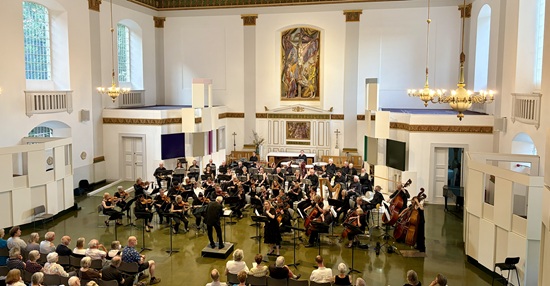
 United Kingdom Janáček, Katya Kabanova: Soloists, New Palace Opera Orchestra / Michael Thorne (conductor). St. John’s Waterloo, London, 19.7.2026. (JR)
Cast:
Vanya Kudryash – Robin Whitehouse
Glasha – Caroline Carragher
Dikoi – Ashley Mercer
Boris Grigoryevich – James Schouten
Marfa Kabanova – Lauren Easton
Tichon Kabanov – Jonathan Finney
Varvara – Joanna Harries
Katya Kabanova – Philippa Boyle
Thankfully, though regrettably, England were not playing in the World Cup Final on this very evening so that football fans with a penchant for opera did not have to make a sacrifice, even though – given an early start to the opera – the second half could still be savoured.
This was a concert performance of Katya (in Norman Tucker’s English translation). Fine singing was its strength. Whilst other smaller opera companies make do with reduced forces for their orchestras, or even go down to a five-piece chamber orchestra, Katya needs a strong accompaniment to bring out the force and colour of Janáček’s orchestration.
I had seen and been impressed by Philippa Boyle at the Lewisham Choral Society’s War Requiem; she is making waves at Opera North and has had her Royal Opera debut in Mark-Anthony Turnage’s Festen. Katya is an ideal role for her very strong, secure voice; and she acted the part well too. The other standout singer was Dutch-Canadian tenor James Schouten, who came to my attention as an exceptionally fine Narraboth (Salome) for Regents Opera and a splendid Froh (Das Rheingold) at Grange Park. He is rightly in demand; he sounds to my ears more like a baritone than a tenor, though he switched from baritone to tenor some years ago. He was most impressive as Boris, though not a role with high notes to test the very top register. It remains to be seen whether he can also manage the more arduous role of Parsifal in Regents Opera‘s upcoming production in 2027, though I have little doubt.
Australian/Mauritian mezzo-soprano Lauren Easton sang a strong and stern mother-in-law; Jonathan Finney a suitably wimpish son. The minor roles were all very well taken. I much admired Joanna Harries as Varvara, impish and frivolous, with a delightful voice, particularly in her folk song (‘Vanya strolls along the bank’). Robin Whitehouse as Vanya sang his Czech folk-style song to perfection Ashley Mercer made a properly ridiculous Dikoi, strongly voiced. Caroline Carragher completed the team of characters with distinction.
I must praise the English translation: Norman Tucker was the head of Sadler’s Wells Opera from 1948 to 1966 and this translation hails from 1951. It is lucid and sensitive and widely used. Janáček took great pains to match the words to the notes, and this translation did not fail in this regard. The opera may have lost an element of authenticity but gained greatly in comprehension.
Michael Thorne had good control of the orchestra and a clear knowledge of the score. Only once were the dynamics too loud and the soloists became momentarily inaudible. Sadly, too many of the 50-plus players of the orchestra were not entirely up to the task. The strings, in particular, often sounded rather tentative and scratchy. The timpanist forgot to tune one of his drums at the outset. The brass impressed initially until the principal horn fluffed his exposed solo. The orchestra is in need of, how can I put it politely, rejuvenation. Surely some competent music students could have been involved.
Katya is such a fine opera, and despite the shortcomings of the orchestra, I thoroughly enjoyed this performance.
John Rhodes