
 United Kingdom Three Choirs Festival [3] – Rachmaninov, Skidmore: Martha McLorinan (mezzo-soprano), James Robinson (tenor), Simone Rebello (bells), Ex Cathedra / Jeffrey Skidmore (conductor). Gloucester Cathedral, 26.7.2026. (JQ)
Rachmaninov – All-Night Vigil (Vespers), Op.37 interspersed with
Jeffrey Skidmore – Bell Preludes
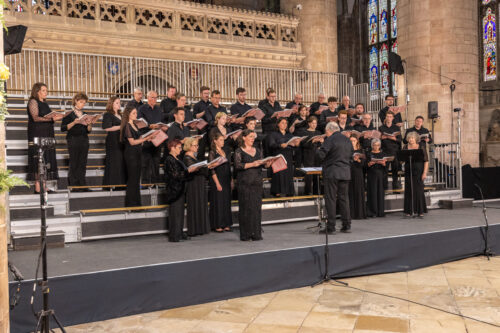
For the second evening concert in the cathedral, the Three Choirs Festival invited the Birmingham-based Ex Cathedra and their Artistic Director, Jeffrey Skidmore to make a guest appearance. They chose to perform a piece which has become something of a cornerstone of their repertoire over the years: Rachmaninov’s All-Night Vigil
I have heard Skidmore and Ex Cathedra perform Rachmaninov’s great choral masterpiece several times in the past. They performed it at the at the 2012 Cheltenham Festival and they also brought the work to the 2019 Three Choirs Festival (review here). Perhaps, though, it was the first performance which I experienced from them that was the most relevant to tonight’s concert. In 2011 they gave the work in Birmingham and on that occasion the music of the All-Night Vigil was interspersed with nine of Rachmaninov’s Preludes played by pianist Steven Osborne. I vividly recall that concert; I thought that innovative approach worked very well so it was with no little anticipation that I saw tonight’s performance would include music by Skidmore himself in the shape of his Bell Preludes. These short pieces were played at various junctures during the Rachmaninov performance.
Jeffrey Skidmore contributed an extensive and very interesting programme note in which he explained in some detail how he and his choir have evolved their performances of the All-Night Vigil since they first performed it in 1986, using an American edition of the work (in English) sanctioned by the composer. This performance history was highly relevant because it laid out for us how, thanks to scholarship, more authentic versions of Rachmaninov’s score have become available over the years. Skidmore is renowned for his inquisitive and scholarly approach to music – though in my experience the performances he directs are never merely scholarly – and it is evident that over the years he has refined his approach to the All-Night Vigil in order to make the performances he leads as authentic as possible. Ex Cathedra moved away from performances in English many years ago and tonight the work was sung, as it should be, in the original Church Slavonic.
Skidmore explained in his essay that ‘from his [Rachmaninov’s] childhood and throughout his life [bells] were an essential, ever-present part of his soundworld’. He also reminded us that the composer’s choral symphony, The Bells, Op.35 was written in 1913, just two years prior to the All-Night Vigil. So, there was a great deal of logic in the decision to interpolate bell sounds into the All-Night Vigil. I think it is worth adding that in a liturgical context the sung texts which Rachmaninov set would not all have been heard consecutively, as is the case in a straightforward concert performance. Skidmore made reference to Orthodox chants and to some of Rachmaninov’s own works in his Bell Preludes but these were fragmentary and I wouldn’t claim that I was able to pick up any of the references during the performances. What was much more significant was the effect that the Bell Preludes made. Skidmore devised them to be played (by one musician) in three elements: a set of chromatic tubular bells; an octave of chromatic crotales; and a tam-tam. The tubular bells contributed the principal melodic material; the crotales gave glistening treble decoration; the most inspired element was the tam-tam which gave a wonderfully deep and sonorous resonance to underpin Skidmore’s carillon, giving the illusion that a huge, very deep bell was tolling. In all, there were seven preludes which were interspersed between various movements – five of them in the first half. I thought the bell sounds acted as a superbly imaginative and richly atmospheric complement to Rachmaninov’s music. At times, with all three elements in the carillon audible at the same time, I wondered how one player could possibly control everything. Simone Rebello made a very significant contribution to the performance and it added to the sense of atmosphere that she played the instruments out of sight, to the left-hand side of the performance space.
For a long time, the All-Night Vigil was commonly known, at least in the West, as ‘Vespers’, though the correct title is now much more commonly used. Rachmaninov set the choral movements which are chanted in two Orthodox services: Vespers and Matins. There was an interval in this performance and very sensibly it was placed after the eight movements which make up the Vespers and before we heard the seven Matins movements. In the Matins section Skidmore departed from the familiar, published ordering of the movements – which is how the music is presented on all the recordings I have – and brought forward movements 13 and 14 (the two Troparions); these were sung right at the start of Matins and thereafter the other movements followed in their usual places. This arrangement replicated the first performance of the work in 1915.
The performance by Ex Cathedra was superb. I would estimate the size of the choir at around 50 singers. The sopranos produced a bright, clear sound while the basses, if perhaps not quite matching the sonority and depth of their peers in the very best East European choirs nonetheless provided a satisfyingly firm foundation to the sound; the descent to the famous bottom B-flat at the end of the fifth movement (‘Lord, now lettest thou thy servant’) was securely achieved. Throughout the performance I was greatly impressed by the discipline of the choir, not least in terms of dynamic contrasts. The soft singing was suitably hushed yet always tonally firm and when the singers delivered the open-throated climaxes these were thrillingly voiced, the sound of the choir flooding the nave. Rachmaninov uses two soloists. Martha McLorinan gave a highly expressive account of the solo in the second movement (‘Bless the Lord, O my soul’). Her tender singing was cushioned on a bed of hushed, sensitive singing by the rest of the choir. The tenor soloist, James Robinson was equally impressive. His sappy tenor voice sounded very idiomatic – no mean achievement for a non-Russian singer – in ‘Lord, now lettest thou thy servant’, and he was just as convincing in his shorter solos in two other movements. As I have noticed in the past, Skidmore’s conducting style is quite restrained but he certainly gets results. Clearly, the performance was the result of scrupulous preparation and Skidmore rightly trusted his singers to deliver – which, most assuredly, they did. Even for a choir of this level of accomplishment, the challenges posed by the requirement to sing complex and difficult unaccompanied music for more than an hour should not be underestimated. However, this group of singers were more than equal to the task. They gave us a technically assured, idiomatic and memorable performance of Rachmaninov’s masterpiece.
I hope Ex Cathedra will receive invitations to take part in future Three Choirs Festivals. However, this is likely to be the last time that they will appear at the Festival with Jeffrey Skidmore. The 2026/27 season will be his last as Artistic Director of Ex Cathedra. At the end of the season, after an astonishingly long tenure of 58 years, he will hand over to his successor, James Burton. I suspect that he will not be retiring completely, however; he will then become Artistic Director Emeritus. His achievement with Ex Cathedra has been immense. Not only has he developed a top-class choir but under his visionary leadership Ex Cathedra has grown from being ‘just’ a choir to its current position as a leading force for musical education and participation for people of all ages. His musical and educational legacy is truly unique.
John Quinn