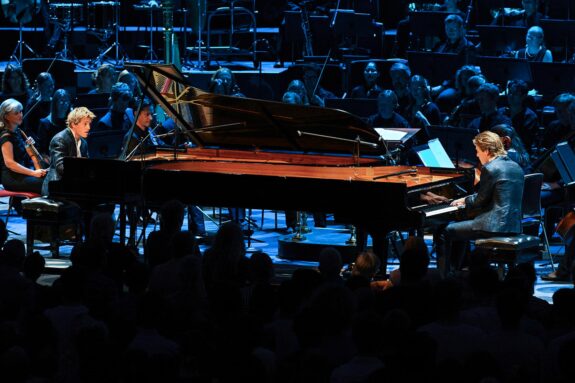
 United Kingdom BBC Prom 2026 [6] – Poulenc, Adams: Lucas and Arthur Jussen (pianos), CBSO Chorus, Sydney Philharmonia Choirs, City of Birmingham Symphony Orchestra / Kazuki Yamada (conductor). Royal Albert Hall, London, 26.7.2026. (AV-E)
Poulenc – Sinfonietta; Concerto for Two Pianos in D minor
John Adams – Harmonium (1980-1981)
This prodigious BBC Prom proved a perfectly balanced programme, with Poulenc and Adams complementing one another far more naturally than might initially have been expected. On the surface, the two composers appear to inhabit entirely different worlds: Poulenc’s refined wit, elegance and theatrical instinct seemingly standing apart from Adams’s vast harmonic landscapes, ritual intensity and choral transcendence. Yet together they revealed an unexpected continuity, each composer creating music of extraordinary colour, clarity and expressive directness, founded upon a remarkable economy of means where texture, sonority and the unfolding of sound itself became central to the experience.
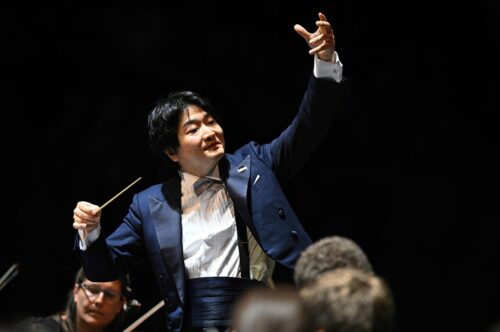
Francis Poulenc occupied the first half of the programme, revealing two contrasting facets of the composer’s personality: the urbane wit and crystalline elegance of the Sinfonietta followed by the dazzling brilliance of the Concerto for Two Pianos. Throughout, Kazuki Yamada proved an ideal Poulenc interpreter. His conducting possessed an unmistakable elegance and buoyancy, his balletic physicality mirroring the music’s supple rhythms with graceful, highly expressive gestures that were never merely theatrical. Every phrase seemed to breathe naturally, every transition carried with effortless poise, allowing Poulenc’s mercurial world of elegance, playful invention and lyric humour to emerge through a vivid and varied expressive palette.
Sinfonietta immediately established the orchestra’s superlative form. Yamada drew playing of striking character and dexterity. Rhythmic articulation remained crisp and buoyant, while the woodwind contributed characterful playing of great individuality. The strings combined remarkable unanimity with featherweight articulation, their transparency allowing Poulenc’s constantly shifting orchestral colours to register with crystalline clarity.
What distinguished Yamada’s reading was the way he allowed Poulenc’s elegance to coexist with a subtle undercurrent of irreverence. The music’s sudden changes of mood, unexpected turns of phrase and playful juxtapositions were never exaggerated for effect; instead, they appeared as natural extensions of Poulenc’s mercurial imagination. Beneath the surface sophistication there was always a sense of theatrical instinct and finely judged irony, qualities that Yamada revealed with exceptional instinct.
The arrival of Lucas and Arthur Jussen transformed the atmosphere entirely. Few piano duos today combine such effortless virtuosity with such infectious charisma. Their stage presence is naturally engaging rather than self-conscious, communicating an obvious delight in performing together that immediately draws the audience into the music. Technically, they remain astonishing: dazzling brilliance, immaculate ensemble and breathtaking precision delivered with complete ease, yet always placed entirely at the service of the music. The extrovert passages were dispatched with blazing intensity, panache and complete aplomb, while quieter moments revealed an altogether different side of their musicianship, one of exceptional subtlety, delicacy and finely judged nuance.
The Jussens possess an exceptionally wide-ranging tonal palette, capable of moving effortlessly from brilliant, full-bodied sonorities to passages of remarkable delicacy and introspection. Their playing was playful, exuberant and full of bravura and panache, yet never superficial; beneath the outward energy lies a finely developed sensitivity to colour, balance and phrasing. The brothers communicate with an almost instinctive musical understanding, their exchanges possessing the spontaneity of chamber music while retaining the precision required by the most formidable virtuoso writing.
Equally impressive was the partnership between the dynamic duo, City of Birmingham Symphony Orchestra and conductor, a collaboration in which every musical force seemed to spark from the other. Yamada ensured that Poulenc’s orchestral writing was never reduced to accompaniment, with the woodwind details and sharply placed percussion interjections woven seamlessly into the texture. The CBSO responded with remarkable alertness, creating a true dialogue with the pianos rather than merely surrounding them. The result was a performance in which every instrumental colour contributed to Poulenc’s constantly shifting world of elegance, brilliance and surprise.
The Allegro ma non troppo burst into life with irrepressible vitality. The Jussens attacked Poulenc’s glittering keyboard writing with fearless brilliance, their exchanges possessing astonishing unanimity while retaining a playful spontaneity that prevented the performance from becoming merely a display of virtuosity. Yamada matched them at every turn, keeping the orchestra rhythmically alert and transparent, allowing the pianos to sparkle without ever dominating the orchestral fabric.
The Larghetto provided the emotional heart of the concerto. Here the brothers displayed remarkable restraint, shaping Poulenc’s long Mozartian lines with unaffected simplicity and exquisite tonal control. Every phrase unfolded with complete naturalness, their beautifully matched sound allowing the music to sing with unaffected grace. The orchestral accompaniment was equally distinguished, Yamada maintaining an atmosphere of intimate chamber music while preserving the movement’s effortless forward motion.
The Finale: Allegro molto exploded with irrepressible brilliance. The Jussens revelled in Poulenc’s dazzling wit, dispatching the rapid-fire exchanges with breathtaking dexterity and infectious exuberance. Yet beneath the virtuoso display there remained complete precision of articulation and remarkable clarity of texture. Yamada propelled the movement with irresistible momentum, orchestra and the dashing duo responding to one another with exhilarating immediacy before bringing the concerto to a scintillating conclusion and rapturous applause.
For an encore, the jubilant Jussens performed Igor Roma’s Strausseinander for Two Pianos, a brilliantly conceived four-minute fantasy on Johann Strauss, combining breathtaking virtuosity, dazzling pianistic ingenuity, irresistible charm and infectious Viennese verve.
John Adams’s Harmonium (1980–1981) brought the evening to a close in a performance of overwhelming conviction and concentration. Despite being a landmark work of late 20th-century music, Harmonium does not announce itself as ‘contemporary music’ in the conventional, common-sense understanding of the term. There is something almost archaic about its subterranean soundworld: not postmodern in its references, but premodern in its sense of ritual, elemental harmony and timeless unfolding — a music that seems to emerge from a long-lost, forgotten past while somehow pointing towards an unfathomable future yet to come. Adams seems less interested in fragmentation or irony than in returning to the fundamental forces of sound — resonance, accumulation and transcendence.
Yet it has become a media-spun cliché that Adams is always about ‘minimalism’ and ‘repetition’. While Harmonium undoubtedly employs recurring gestures and processes of accumulation, the manner in which Adams shapes them completely transforms their effect. Repetition itself seems to dissolve into a constantly evolving continuum of resonance, colour and harmonic transformation. What emerges is not ‘minimalism’ but an almost classical economy of means: the Haydn-like ability to make limited material unfold into vast structures, combined with the crystalline concentration of Webern.
What became apparent was that Adams treats the human voice not primarily as a vehicle for poetic language but as an orchestral resource in its own right. The words themselves were incidental, absorbed into a far greater sonic continuum where poetic meaning surrendered to pure sound. I found myself listening not to what the choruses were saying but to what they were sounding. Here, the ‘sound texture’ became immeasurably more important than the ‘textual texture’, the voices functioning less as conveyors of poetry than as living orchestral sonorities within Adams’s immense harmonic landscape.
The opening movement revealed this principle immediately. Its almost plainsong-like simplicity gradually expanded into a more traditional choral lyricism, the voices unfolding above an orchestra whose recurring rhythmic patterns never settled into mechanical repetition. Instead, Adams creates a constantly evolving web of resonance and colour, where repeated gestures become part of a larger harmonic continuum. The two orchestral interludes were beautifully balanced, Yamada highlighting subtle shifts of rhythm, articulation and attack as the music moved towards its final accumulation. The chorus negotiated Adams’s repeated syllables with remarkable precision, their voices integrated into the orchestral fabric rather than functioning merely as carriers of text.
‘Because I could not stop for Death’ deepened this sense of transformation. Here Adams’s setting of Emily Dickinson moved beyond any simplistic association with minimalism, drawing instead on a broader post-Romantic expressive world. The poetry itself gradually moved away from conventional ‘meaning’ towards pure ‘sensation’, the individual words dissolving into an abstract sonic continuum.
Language became less a vehicle for verbal expression than a source of colour, rhythm and resonance, with the chorus functioning as an orchestral presence in its own right. Yamada shaped the movement with flowing inevitability, preserving its underlying melancholy while maintaining a mesmerising sense of suspended time and motion.
The vast orchestral eruption that followed possessed an almost cinematic grandeur, yet its impact came not from sheer volume but from exceptional clarity of structure and colour. The chorus responded to the ferocious, high-lying declamations with remarkable assurance, while Yamada allowed the returning rhythmic impulses to recede into the background, no longer as dominant processes but as a distant pulse within the music’s gradual dissolution.
From beginning to end, the audience was transfixed and mesmerised by the sheer intensity of orchestra and choirs, held in unbroken attention as Adams’s vast soundworld unfolded with extraordinary inevitability. The Royal Albert Hall itself seemed transformed into an atmospherium of sound, its vast circular acoustic embracing Adams’s immense waves of choral and orchestral sonority and allowing the work’s sense of suspended time and transcendence to become almost tangible. A masterpiece not of ‘contemporary music’ in the conventional sense, but of music itself, Harmonium revealed a rare fusion of ritual, resonance and transcendence — a wondrous work that feels anciently archaic and monolithically modern, and one whose solemn sonic beauty and pulsating power will remain unforgettable.
The monumental choral achievement culminated in a passionate standing ovation for Julian Wilkins, CBSO Chorus conductor, and Brett Weymark, Artistic and Music Director of the Sydney Philharmonia Choirs. The appreciative acclaim was a deeply deserved tribute to their meticulous stewardship, completing a night in which choral and orchestral forces combined to reveal a rare musical multivalence.
Alexander Verney-Elliott
Featured Image: Jussen brothers at the BBC Proms © BBC/Chris Christodoulou