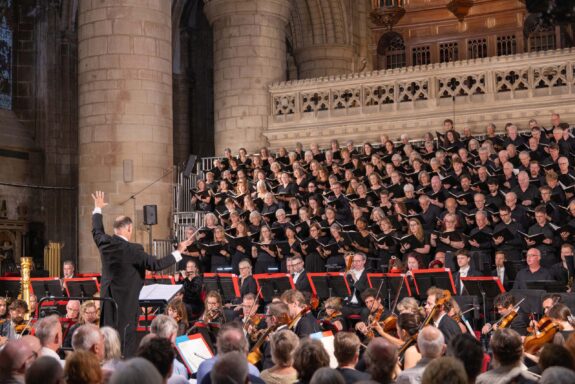
 United Kingdom Three Choirs Festival [4] – Elgar, Poulenc, Janáček: Katelyn Emerson (organ), Rachel Nicholls (soprano), Hilary Summers (contralto). Gwyn Hughes Jones (tenor), Ashley Riches (bass), Three Choirs Festival Chorus, Philharmonia Orchestra / Adrian Partington (conductor). Gloucester Cathedral, 27.7.2026. (JQ)
Elgar – Cockaigne Overture, Op.40
Poulenc – Concerto in G minor for organ, strings and timpani, FP93
Janáček - Mša glagolskaja (Glagolitic Mass)
This eagerly-awaited programme was surely designed to showcase the new Nicholson organ in Gloucester Cathedral. However, we had to wait a little while for the instrument to be fully revealed because the evening began with a warm and gracious tribute by David Francis, CEO of Three Choirs Festival, to Geraint Bowen, who retired as Director of Music at Hereford Cathedral earlier this year. Bowen only announced his retirement some weeks after the 2025 Hereford Festival so this was the first opportunity there had been to thank him publicly. Bowen was in post at Hereford Cathedral between 2001 and 2025 and in that time he was Artistic Director of eight Three Choirs Festivals. In his very nice speech, Francis referenced in particular Bowen’s appetite for programming new music and reviving neglected scores. The warmth of the applause after Francis’s tribute told its own story.
The concert began with Elgar’s Cockaigne Overture. On the opening evening of the festival, we had heard an excellent Elgar performance when Adrian Partington and the Philharmonia played the First Symphony (review here). Tonight, working on a slightly smaller canvass, they were no less successful. Elgar’s affectionate tribute to the city of London teems with colour and incident. I thought all this came out well in a very lively reading. Partington gave clear, energetic direction and I admired the ease with which, as he had done in the symphony, he navigated the transitions between all the different episodes in the work. Furthermore, though the performance was full of vitality, the several lyrical passages were delivered with warmth and affection. The Philharmonia played with freshness and brio. This was an excellent opening to the concert.
The composition of his Organ Concerto occupied Poulenc for quite some time: he worked on it between 1934 and 1938. He was asked to write it by Princess Edmond de Polignac, an American heiress who had made her home in France and who commissioned a wide range of composers to write works for performance at the concerts which she promoted in the (substantial) studio adjacent to her Paris home. She was an amateur pianist and organist and had had a relatively modest organ installed in the studio. She may have hoped for a concerto that she herself could play but in fact the premiere was given in December 1938, in her salon, by the composer/organist Maurice Duruflé with Nadia Boulanger conducting. I suspect that the work which Poulenc produced was not what the princess had been expecting: it is an unusual concerto in that although the soloist has some opportunities for virtuosity, the overall tone is restrained, even austere. There is, I think, a reason for that. As Richard Bratby pointed out in his programme note, during the period of composition Poulenc paid a visit to the famous shrine of the Black Virgin of Rocamadour, an experience which was life-changing in that it restored his childhood religious faith. What Bratby dd not say was that Poulenc was prompted to visit Rocamadour by a most distressing event: the sudden death of a close friend, Pierre-Octave Ferroud in 1936. This event directly sparked the creation of his only other published work involving the organ, the Litanies à la Vierge noire (1936) for female choir, and also his profound Mass in G major (1937). Ferroud’s death must surely have influenced the concerto as well
To play the concerto the Festival welcomed the exciting American virtuoso, Katelyn Emerson. Of course, for this performance she was seated up in the organ loft at the instrument’s impressive console, However, she was not out of our sight; excellent CCTV pictures relayed into the nave enabled us to see her in action.
Poulenc’s concerto plays continuously but falls into several defined sections. The work opens with a Bach-inspired flourish on the organ. Emerson’s commanding delivery of this flourish heralded a most impressive performance. I am sure it helped greatly that the concerto was conducted by Adrian Partington who is, of course, an organist himself and, moreover, someone with an intimate knowledge of the Gloucester Cathedral acoustic. The communication between rostrum and organ loft seemed to be excellent and I noticed many instances where the conductor brought out telling points of detail in the orchestral accompaniment. I was impressed with every aspect of Emerson’s playing. Though she would have had fairly limited time to familiarise herself with the organ, it seemed to me that her registrations were apt and interesting. Examples of particularly felicitous registration caught my ear in the Andante moderato section early on in the work and, later, in the Très calme. Lent episode. I also loved the reedy sounds she conjured from the organ in the loud passages. Poulenc gives his soloist plenty of chances to show sensitivity – all of which were grasped in this performance – but relatively few opportunities for virtuosic display. However, the naughty side of Poulenc’s nature finally comes out in the Allegro section near the end, where the organ part sounds a bit like something one might hear in a fairground; in this episode, Emerson played with wit and vitality. As I listened to this sophisticated and eloquent account of the Poulenc concerto, I couldn’t help but reflect that a performance of such quality simply would not have been possible on the cathedral’s old organ. As Katelyn Emerson demonstrated tonight, with the installation of the new Nicholson organ, Gloucester Cathedral has truly got its voice back. The audience gave her – and, I suspect, the organ – a prolonged, enthusiastic ovation.
I had been looking forward with the keenest anticipation to hearing Janáček’s Mša glagolskaja; all the more so since the performance would both involve the new cathedral organ and celebrate the centenary of the work itself. Though I have never had the chance to sing in it – and I might well think twice if an opportunity came my way – Janáček’s late masterpiece is perhaps the most thrilling choral work I know. For me, it is to choral/orchestral music what Le Sacre du Printemps is to ballet. Even when you’re ‘just’ listening to it the music is physically exciting. I think Gwilym Bowen nailed it in his programme note when he declared the work to be ‘a glorious explosion of life’. Yet this explosion took a long time to happen. The origins of the work lie in a setting of the Latin Mass which Janáček composed – but never finished – in 1907-08. In the early 1920s, he felt an urge to compose a liturgical work which was specifically Czech and he dug out his old incomplete Mass. Quite how much of the music from that aborted setting found its way into the Mša glagolskaja I am unsure – quite a lot, I believe – but I learned with great interest from Bowen’s note that the text which Janáček finally set could fairly be described as corrupt – my choice of word – not least because when he was making various revisions the composer relied on (faulty) memory in transcribing the words and made a number of mistakes. Mša glagolskaja was finished by the end of 1926 but even that is not the end of the story. The composer made a number of significant, enforced alterations when the work was in rehearsal for its first performance; then further editorial changes were made after the composer’s death when the score was being prepared for publication. As a result, the version which has been in common usage for the first 100 years of the work’s existence is not exactly how Janáček intended it. However, the British scholar Paul Wingfield produced a definitive reconstruction of the original score in the early 1990s and in 1994 Sir Charles Mackerras made a fascinating recording of the Wingfield edition (Chandos CHAN 9310). Tonight’s performance incorporated one very important feature of the Wingfield edition: Adrian Partington opted to play the orchestral ‘Intrada’ at the beginning as well as at the conclusion of the piece, something I have never previously experienced in live performance.
The ‘Intrada’ got things off to a bright and breezy start, after which the orchestral ‘Úvod’ (Introduction), the normal starting point, continued to demonstrate Janáček’s highly individual and imaginative instrumental colourings. The Philharmonia was on excellent collective form here and throughout the work. Rhythms were taut and incisive – the brass were consistently superb – and all the players, not least the woodwind, audibly relished the composer’s sharply pointed and colourful writing. That said, it was noticeable, both in ‘Úvod’ and elsewhere in the score, how characterfully the more restrained, pastoral elements were played. The Festival Chorus was marvellous in such difficult music. Let it not be forgotten that these are amateur singers, to most of whom the style and nature of this music will have been very unfamiliar. They have only had about three months to prepare this score – and a great deal of other demanding music as well. Not the least of the challenges is the old Church Slavonic text, which must have taken a lot of time and effort to master. I am not qualified to judge whether the choir’s pronunciation was 100% accurate; all I can say is that they sounded both confident and convincing throughout the performance. The same description applied to their command of the rhythms. Janáček’s writing bristles with irregular rhythms and changing time signatures, often at pace; the choir was highly disciplined. Furthermore, their contributions always came through clearly. Overall, both the Festival Chorus and the Philharmonia did full justice to this wild, unpredictable and demanding piece.
I am afraid I had reservations about the two principal soloists. On paper, Rachel Nicholls was eminently qualified to meet the demands of the soprano role – for example, she has a number of important Wagner and Richard Strauss roles in her operatic repertoire. On this occasion, though, her singing seemed to be effortful; perhaps she was working too hard to project Janáček’s often-punishing tessitura into the cathedral’s big space; nonetheless, I struggled to hear her at times. As the sound of her voice reached me in my seat about halfway down the nave the notes seemed to be almost invariably spread and, in addition, as I heard it, she sometimes appeared to attack notes from below. Her performance was deeply disappointing. Tenor Gwyn Hughes Jones similarly has the pedigree for this work; in recent years, for instance, he has sung the title roles in Tristan und Isolde and Peter Grimes. However, I often found it hard to hear him – his crucial contributions in the Credo did not cut through as tellingly as they should have done. I ought to record, though, that although I had an incomplete aural picture of his singing what I could hear demonstrated a fine, virile ring to his voice and full engagement with the music. In fairness to both these singers, I don’t think they were helped by their positioning in the performance space. Both of them sang from the extreme left-hand side of the platform and it must have been a significant challenge to sing from there over Janáček’s often-full scoring. Perhaps there were practical reasons for this but the balance suffered. Questions of audibility also arose in the Sanctus and Agnus Dei, where the scoring is somewhat lighter. The other two soloists have much less to do. Hilary Summers and Ashley Riches, who were placed at the far right-hand side of the platform, gave completely dependable performances. Incidentally, I don’t blame the Philharmonia for the issues I had concerning the balancing of the soloists; you can’t play a work like this in a restrained fashion without the music sounding mealy-mouthed and it was noticeable that the orchestra did not swamp the chorus. There is a fifth soloist in Mša glagolskaja. Katelyn Emerson had two important contributions to make. Her short solo midway through the Credo erupted excitingly; I loved the reedy sound she obtained from the organ. The penultimate movement in the work is a wild organ solo. Emerson treated us to a storming performance, showing enviable virtuosity.
Adrian Partington conducted with complete conviction. Clearly, he had the score at his fingertips; I gather he has known it since singing it as a boy chorister during the 1969 Three Choirs Festival at Worcester. I had an aisle seat so I could see that throughout he was galvanising his musicians. He succeeded in bringing out all the lyrical aspects of this score – of which there are many more than you might think – but under his direction the elemental, seismic nature of Janáček’s music really registered.
Despite my reservations concerning the two principal soloists in the Janáček, this was an evening which lived up to my expectations.
John Quinn
Featured Image: Adrian Partington conducts the Glagolitic Mass at the Three Choirs Festival © TCF/James O’Driscoll