
 United Kingdom ‘Invisible Threads’ – Various: La Locura: Ana Beard Fernández (soprano), Iain Hall (cello and recorders), Louise Anna Duggan (percussion), Oliver Wass (triple harp). St Clement Danes Church, London 26.7.2026. (PC)
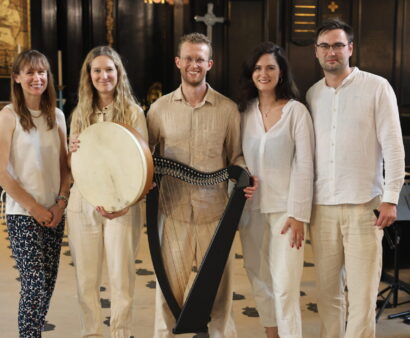
Founded by soprano Ana Beard Fernández in 2024, La Locura is an early music ensemble noted for pairing ancient and baroque music with contemporary song and presenting their programmes in an informal way. Entitled ‘Invisible Threads’, their early afternoon recital at St Clement Danes Church in London’s The Strand on 26 July wove together songs drawn from a broad range of eras and traditions with the first performance of Three Rilke Songs, commissioned by the ensemble from composer Emma-Ruth Richards. This contemporary work excepted, the pieces were all arranged by Fernández, with input from each player and honed in rehearsal. The programme was given as a single, unbroken sequence with applause invited only at the end to avoid breaking the mood.
The sequence began with Hildegard von Bingen’s antiphon O virtus sapientiae, which addresses Sapientia (Divine Wisdom), a feminine figure drawn from Proverbs, Sirach and the Wisdom of Solomon. The audience was invited to join the cello in holding an E note throughout, reinforcing a pedal point underlying the soprano’s rapt, melismatic vocal lines. This atmospheric, hymnic concert opener established the programme’s predominantly reflective character.
From here we moved seamlessly to the first of the Three Rilke Songs, for soprano and recorders by Emma-Ruth Richards. This piece sets texts from Sonnets to Orpheus by Rainer Maria Rilke presented in English translations, including some by the composer. As the programme notes stated, Rilke’s sonnets focus on ‘the elemental act of breathing – inhaling, holding, and exhaling – as a metaphor for being, becoming, and release’. An affirmation of life, they use sensuous imagery, mirrored by the composer’s freely expressive, often spontaneous-sounding musical treatment.
The first song related to the inhale, with constantly ascending phrases for both musicians. The music’s light, breezy and ethereal quality was assisted by breathy vocal tones and white noise effects on the recorder. Of especial note was the subtle way the instrumental line transferred from bass recorder to tenor recorder and finally descant recorder, matching a gradually rising vocal line that evolved from initially high, thin, airy phrases to the fluently lyrical setting of the final bars.
Manuel de Falla’s Nana, the fifth song of his Siete conciones populares españolas was a gentle miniature with the lilting wistfulness of a lullaby. This mood was adroitly maintained by the ensuing melancholic lyricism and jauntily swaying rhythm of Françoise Hardy’s La maison où j’ai grandi from her 1966 studio album, which considers how places stay the same while those who return to them have changed.
The second of Richards’s Three Rilke Songs evoked the stillness of held breath. A freely expressive sopranino recorder solo established a contemplative, illusory mood, paving the way for a relaxed and spacious treatment. According to the composer, this is ‘a space of waiting, of inner presence’ and the warm interplay between the musicians was both poised and tender.
That Yongë Child, from Britten’s A Ceremony of Carols sets a fourteenth-century text in a soft, recitative-like song praising the Virgin Mary’s lullaby to the infant Christ. There followed a contrasting Marian setting, Or ch’è tempo di dormire by Tarquinio Merula (1595-1665), in which the Virgin Mary foresees the terrible Passion that awaits the Christ Child as she rocks him to sleep. This hypnotic lullaby, with its plaintively eloquent vocal line and obsessively repeated, rocking, two-note accompanying motif, cast a long and lingering shadow. An aria-like conclusion brought relief from the mesmeric main section without dispelling its potent incantation.
The last of Richards’s Three Rilke Songs was the exhale. In this affectionate setting, the material descended in falling, melancholic phrases. A use of vocal slides added to a sense of release as the music moved downward, ‘weighted yet unburdened, completing the breath cycle in a gesture of surrender and release’, in the composer’s words. Here the succession of treble recorder to tenor recorder to bass recorder allowed the accompaniment to maintain richness, supporting effectively the freely wide-ranging, improvisatory-seeming vocal line. Among the music’s expressive effects, the composer’s use of ascending vocal leaps at the words ‘deep’ and ‘heavy’ caught the ear, typically fresh and unexpected gestures in a score that elicited and captured the life-affirming essence of Rilke’s words.
The concert ended with The Parting Glass, a traditional Celtic tune that bids farewell with thanksgiving for friendship, hospitality and love. With harp and frame drum nimbly simulating clarsach and bodhran, this gently upbeat leave-taking was a perfect way to round off a carefully curated collection of eclectic but thematically interrelated songs.
It was a particular pleasure in this hugely enjoyable recital to hear the first performance of Emma-Ruth Richards’s Three Rilke Songs. Her valuable and distinctive addition to the repertoire was graced with a detailed and imaginative interpretation by Ana Beard Fernández and Iain Hall and was well received by an appreciative audience.
Paul Conway
Hildegard von Bingen – O virtus sapientiae
Emma-Ruth Richards – Song I – Sonnet II.1, Song 2 – Sonnet II, Song 3 – Sonnet I.4, from Three Rilke Songs (world premieres)
de Falla – Nana
Françoise Hardy – La maison où j’ai grandi
Britten – That Yongë Child, from A Ceremony of Carols
Tarquinio Merula – Or ch’è tempo di dormire
Trad. Irish – The Parting Glass