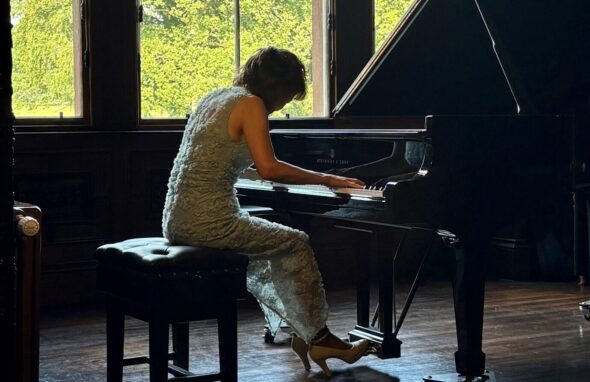
 United Kingdom R. Schumann, Mussorgsky, Brahms, Bartok, Chopin: Martin Roscoe (piano), Noriko Ogawa (piano). Netherby Hall, Carlisle, 20.7.2026. (RB)
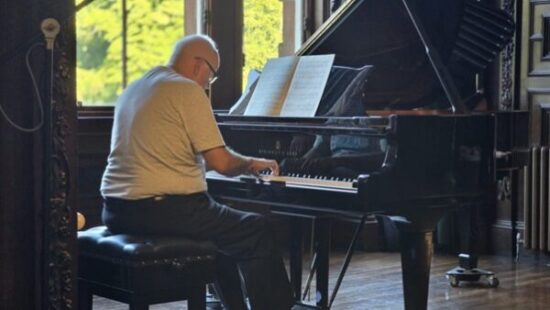
Martin Roscoe
Robert Schumann – Kinderszenen, Op.15
Mussorgsky – Pictures at an Exhibition
Noriko Ogawa
Brahms – Four Pieces for Piano, Op.119
Bartók – Piano Sonata, BB 88, Sz.80
Chopin – Ballade No.3 in A-flat, Op.47; Scherzo No.2 in B-flat minor, Op.31
I was delighted to take part in the inaugural year of the Netherby Piano Course in late July. The course was set up as a successor to the hugely successful Lot Music. It took place in the beautiful grounds of Netherby Hall in Carlisle just north of the Lake District and close to Hadrian’s Wall. The course tutors, Martin Roscoe and Noriko Ogawa, both gave recitals.
Roscoe opened his recital with Robert Schumann’s Kinderszenen which the composer described as ‘an adult’s recollection for adults’ of childhood experiences. Schumann originally wrote 30 short pieces and selected 13 of these for the set. The remaining pieces were later published in Bunte Blätter and Albumblätter.
Roscoe’s performance of these miniatures was masterful. He captured just the right balance between childhood innocence and adult nostalgia in the opening Von fremden Ländern und Menschen. He brought an infectious childlike exuberance and carefree quality to Hasche-Mann and Ritter vom Steckenpferd. Träumerie was a model of poetic refinement: Roscoe conjured a gorgeous luminous tone from his Steinway. The soprano line floated above the rich harmonies while the inner voices were controlled in a nuanced and poetic way. The tempo for Glückes genug was a little slow for my taste but Roscoe’s performance was enchanting nonetheless. He moved seamlessly into the darker, more emotionally complex later pieces in the set before ending on a note of poetic reflection.
Mussorgsky wrote Pictures at an Exhibition in a white-hot 20-day burst of inspiration in June 1874 after visiting a memorial exhibition featuring Viktor Hartmann’s watercolours and drawings. It remains one of the most highly original piano works to emerge from the second half of the 19th-century.
I had not heard Roscoe play Russian repertoire before this concert, but his performance of this masterpiece was captivating. He imbued the various transformations of the famous Promenade theme with extraordinary colours, moving from the energetic opening to feelings of unease after Gnomus and on to the eerie ghostly atmosphere in the catacombs. He captured the jagged unpredictability of Gnomus to perfection and brought a silky legato touch to the haunting melody in Il Vecchio Castello. The Ballet of the Unhatched Chicks was dispatched with a feathery lightness of touch while the heaviness of the lumbering ox cart was conveyed brilliantly in Bydlo. The contrasting portraits of Samuel Goldenberg and Schmuyle were artfully drawn. I wondered if Roscoe could have done even more to evoke the feelings of pity on viewing the impoverished and shivering Schmuyle. The rapid-fire octave jumps in Baba Yaga were fierce and muscular as the wildness of Mussorgsky’s witch came into view. The pealing of bells resounded through the concert hall in the Great Gate of Kiev (unlike the current Russian administration, Mussorgsky had enormous respect for this great city!). Some minor details were lost in the engulfing sonorities although it did not really matter. Roscoe delivered Mussorgsky’s final chords with a robust energy capturing the monumental character of the scene and bringing the set to a triumphant conclusion.
Noriko Ogawa opened her recital with Brahms’s Piano Pieces Op.119. Brahms wrote the set in 1893, and they stand as his final contribution to the solo piano repertoire. Many of his late piano compositions are marked by rich harmonies, an Autumnal warmth and an introspective melancholic quality. This final set is more of a mixed bag as the third intermezzo is sunny and playful while the final Rhapsodie is symphonic and heroic in nature.
Ogawa has not previously performed Brahms very much in concert. With this performance, she showed herself to be a consummate Brahmsian. She created rich opulent textures in the opening intermezzo while at the same time bringing a pristine clarity to the harmonies. She captured the feelings of unease in the opening of the E minor intermezzo to perfection while the E major melody in the central section was absolutely gorgeous – this was superlative Brahms playing. The voicing of the C major intermezzo was handled with great skill, and the piece had a wonderful buoyancy. I wondered if there was scope to bring out the lighter, more playful qualities of this piece that one hears, for example, in Clifford Curzon’s performance. Ogawa unleashed the full range of orchestral sonorities in the final Rhapsodie and played with a robust energy.
Bartók’s Piano Sonata was composed 100 years ago in his so called ‘piano year’ of 1926. The work synthesizes Baroque contrapuntal rigour with the raw percussive energy of Eastern European folk music. It is one of the most technically demanding piano works of the 20th-entury. Ogawa was fully on top of the technical demands and delivered one of the most explosive exciting performances I have heard in a live concert. The opening movement had rhythmic bite and an unstoppable driving energy and Ogawa seemed to relish the percussive qualities of the music. She did an excellent job maintaining the slow pulse of the austere second movement and elicited dark colours from Bartók’s uncompromising tone clusters. In the finale she infused the traditional folk dances with a raw kinetic energy. The coda was a barnstorming virtuoso tour de force.
Ogawa concluded her recital with two of Chopin’s most popular large-scale works. In the third Ballade she struck a nice balance between aristocratic refinement and leggiero brilliance. The work built inexorably to a wonderful celebratory apotheosis. In the second Scherzo, I was struck by her impeccable articulation and handling of Chopin’s shifting mercurial contrasts. The coda with its sweeping arpeggios brought the recital to a triumphant conclusion.
Marvellous playing by both pianists and a great way to launch the Netherby Piano Course.
Robert Beattie
Featured Image: Martin Roscoe © Netherby Piano Course