
 United States Colorado Music Festival [2] – Bach: Colorado Music Festival Orchestra / Jeffrey Kahane (conductor, pianoforte). Chautauqua Auditorium, Boulder, 19.7.2026. (DS)
J. S. Bach – Brandenburg Concertos Nos.1, 3,.5, 4, 6 and 2
To most, the Brandenburg Concertos are very much about the harpsichord: twinkling with its signature tinny sound, transporting the listener to another time. But hear pianist and conductor Jeffrey Kahane out: there is value to using the pianoforte instead.
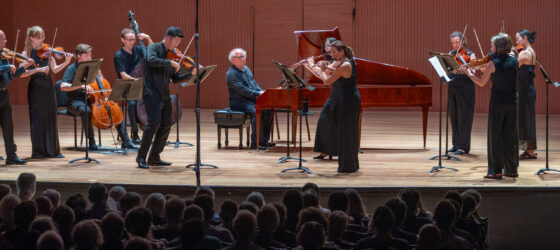
‘It’s the piano that Beethoven and Mozart played Bach on’, Kahane explained to the audience at Colorado Music Festival’s performance of the complete Brandenburg Concertos which he joined the Festival to lead. What he didn’t mention was the versatility of this early-19th-century transition instrument: gradual dynamic changes (a harpsichord can’t vary dynamics just from touch) allow for a more sensitive approach to interpretation while still holding on to some of that metallic sound that would disappear with the invention of the modern piano.
The performance began with Concerto No.1, and the difference made by the keyboard was instantly audible. Or rather, not so audible: the fortepiano blended more with lower register strings, drowned out by the bass and not easily heard beside the mellifluous and declamatory first oboe part spun so clearly by Olav van Hezewijk. And it had virtually little chance against the gleefully played Trio with horn calls in the fourth movement. However, this sparked my curiosity. It forced me to listen more carefully to the nuance presented by the instrument which had been amplified for this performance.
In Concerto No.3 which followed, there are no woodwinds, making for more space to hear lower, quieter timbres. For his solo, Kahane’s purpose was revealed with the great depth of subtlety and character he could add to this iconic, highly virtuosic harpsichord solo (the first of its kind in musical history) by way of the pianoforte. It transformed a period piece into a more modern, adaptable work, without losing that Brandenburg brand of timelessness, by adding possibilities of depth which were refreshing to hear.
Aside from offering a singular approach to instrumentation, this concert was a marvelous showcase for the musicians who come annually to play on the Chautauqua Auditorium stage. In Concerto No.5, Viviana Cumplido Wilson on flute and Kate Arndt on violin played the duo solo with a clear pulse on each other’s dynamics and articulation, creating an exciting dialogue that added a deeply appealing understated grandeur to the work.
After the intermission, the marathon continued (with admirable endurance from the players who never slipped in prowess or enthusiasm). No.6 is for violas, cellos and keyboard and is one of the lesser mentioned or sometimes ignored pieces, like a stepsister pushed to the background. This evening, it was the hidden gem. With all lower string registers, a heavenly balance blended with the pianoforte whose higher pitch tones ring more softly than a harpsichord or modern piano. Violists DJ Cheek and Darren Carter played duets with distinct voices that were dazzling to follow. They matched each other in energy and intention, creating a contrapuntal verve in this more mellow piece.
Concerto No.4 is well known for its nearly insurmountable violin part in the Presto. Kevin Lin, who serves as concertmaster of Indianapolis Symphony Orchestra, played with a stunning technicality that did not detract at all from his ability to infuse even the fastest passage with brilliant expression. Lin plays on the 1683 Ex-Gingold Stradivarius which made No.4 doubly special to hear – it has a piercing sheen to its tone that nature cannot rival.
Finally, the superlative No.2 was met with murmurs of excitement from the audience. It holds one of the most soaring (and challenging) trumpet parts one can find, which Maximilian Morel played with musculature and ever-increasing color and flow. The Andante in particular reached the zenith of musicality. And even after two-and-a-half hours, the expressive flow of the final Allegro assai movement proved downright groovy – a testament to the well-matched players of this ensemble and Kahane’s dynamic leadership.
The role of the forte piano (crafted by Paul McNulty based on the 1805 Walter & Sohn model) became easier to perceive as the music progressed. Perhaps Kahane was right. What at first would seem amiss eventually was traded for a different, yet balanced, malleable sound. It held the concertos together with a new touch of character, one more mellow and somewhat wiser sounding than the harpsichord but equally powerful in its ability to evoke the hidden contrapuntal connections in one of Bach’s greatest, most memorable creations.
Daniele Sahr