 United Kingdom Three Choirs Festival [6] – McDowall, Rubbra, Beethoven: Charlotte Bowden (soprano), Olivia Ray (mezzo-soprano), Mark Padmore (tenor), John Savournin (bass). Three Choirs Festival Chorus, Philharmonia Orchestra / Samuel Hudson (conductor). Gloucester Cathedral, 29.7.2026. (JQ)
Cecilia McDowall – A Song for St Cecilia (orchestral version premiere); Rain, Steam and Speed
Edmund Rubbra – Sinfonia da camera (Symphony No 10), Op 145
Beethoven – Mass in C, Op 86
This nicely varied programme had been constructed to mark two anniversaries: it’s 40 years since Edmund Rubbra died; happily, Cecilia McDowall is still very much with us and is celebrating her 75th birthday
Samuel Hudson opened proceedings with McDowall’s A Song for St Cecilia. This was commissioned by The Bar Choral Society to celebrate its tenth anniversary in 2024. It was originally conceived for soprano solo, SSATB choir. two trumpets and organ; for this performance the composer had reworked the organ part for a string orchestra. I have not heard the original piece but I thought the string writing was most effective. In this piece McDowall sets a poem by the contemporary poet, Kate Wakeling. To quote from the composer’s programme note, the words are ‘based on ‘The Life of Saint Cecilia’ in Jacobus de Voragine’s 1275 The Golden Legend or Lives Of The Saints, translated by William Caxton in 1483’. The piece, which here played for about 12 minutes, is continuous but divides into three sections: cheerful, extrovert music frames a central, more reflective episode.
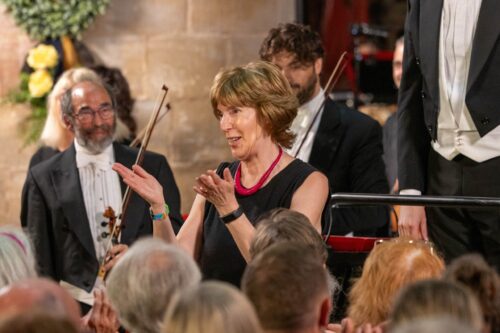
The opening section was joyful in this performance. The choral writing, which is mainly homophonic, was sung with no little enthusiasm while the two trumpets – who are kept very busy – added a festive touch. In the central section we heard soprano soloist Charlotte Bowden. She sang from a place behind the strings and in front of the choir on the right-hand side of the performance space. Despite the distance, her voice carried clearly to where I was seated midway down the nave. The sound of her voice was clear and warmed by a well-judged amount of vibrato. The reflective section, which is dominated by the soloist, is concerned with the decision which Cecilia made on her wedding day to set music as the priority in her life, and the consequences of her determination to remain a virgin. (Incidentally, it was helpful that in the programme the divisions between the three sections of the text were discreetly marked.) I liked this central episode very much but, equally, I was pleased when the lively, celebratory music returned to bring the piece to an end. This work made a most attractive start to the evening; the audience clearly liked it and gave both the performance and the composer a warm reception.
You could say that the music of Edmund Rubbra is the polar opposite of Cecilia McDowall’s. Both composers explore serious issues in their music but Rubbra’s output is, in general, much more austere. Performances of his orchestral music are, in my experience, rare and I owe my knowledge of the music primarily to CDs, most notably the set of all eleven of his symphonies which Richard Hickox recorded with the BBC National Orchestra of Wales in the 1990s. These recordings are one of Hickox’s finest achievements and are well worth exploring. (The disc which includes the Tenth Symphony also contains the Fourth Symphony, which is a masterpiece.) Rubbra composed the piece for the Northern Sinfonia, which, as Richard Bratby reminded us in his programme note, was then a chamber orchestra. This meant that the symphony was modestly scored for pairs of woodwind, two horns and strings. The work which lasts about 15 minutes, has three movements, which play without a break: Lento e liberamente – Scherzando ma grazioso – Lento; there is also a short Molto adagio coda. Rubbra dedicated the symphony to his longtime friend, Sir Arthur Bliss, who died just weeks after the symphony’s premiere in January 1975; did Bliss get to hear the score, I wonder?
I thought Hudson did the symphony very well and he was supported by really excellent playing by the Philharmonia. Rubbra has a reputation in certain quarters for music that is somewhat grey but playing such as that offered by the Philharmonia gives the lie to that opinion. In the Lento e liberamente, Hudson gave the music the necessary space but, very rightly, did not allow it to drag. I was put somewhat in mind of the music of Sibelius, though this came about from a sense of organic growth in the music; the two composers have very different styles and soundworlds. Introduced by the oboe, followed by other woodwinds, the move into the Scherzando ma grazioso is almost imperceptible. This is no witty scherzo but the music is lighter than what has gone before and it also has grace – Hudson’s beat had a good lilt to it. As is almost always the case in Rubbra’s orchestral music, there is a lot going on in this section but Hudson and the Philharmonia achieved clarity. Quite suddenly, Rubbra returns to slower-paced music in the Lento. Here, a haunting cor anglais sets the tone, followed by the oboe. Though this is essentially a slow section, the pulse changes quite frequently; the music is densely argued and Rubbra makes the orchestra sound bigger than is actually the case – as, on this occasion, did the very fine playing of the Philharmonia. Eventually, flutes and oboes lead the way into the short Molto adagio coda. I thought Hudson and the Philharmonia made a very good job of this symphony. I must admit that my experience is that Rubbra’s music does not give up its secrets easily; probably that explains why I sensed that the audience response was respectful rather than enthusiastic. However, the Three Choirs Festival paid Rubbra a good anniversary tribute; I suspect few other performances of his music will be programmed this year.
We returned to the music of Cecilia McDowall to conclude the first half. This time we heard a purely orchestral work, which was new to me, in the shape of Rain, Steam and Speed. I was interested to read that this fairly short piece was commissioned by the Portsmouth Grammar School; it was they who had previously commissioned Ave Maris Stella which we heard the previous evening (review here). The present work was premiered by the London Mozart Players in 2006. I can do no better than quote from the composer’s programme note. She says that the work was inspired by the 1844 painting Rain, Steam and Speed, The Great Western Railway by J. M. W. Turner. This, McDowall explains ‘depicts a broad-gauge engine steaming across Maidenhead Viaduct, one of Brunel’s greatest achievements. The painting offers several perspectives to the viewer: a dark diagonal of bridge and train, crossing the Thames, intersects visions of tranquillity. To the left, far below, a fisherman sits in his skiff and to the right of the picture a ploughman turns his furrow. Ahead of the train a startled hare, the swiftest of creatures, leaps across the track’. It’s important to note, though, that McDowall hasn’t tried to depict Turner’s picture in sound: it is a most enjoyable and imaginatively written piece which creates a series of impressions. The music was incisively played by the Philharmonia. I was glad to hear it for the first time and should welcome further opportunities to experience it. The audience evidently enjoyed what they heard and gave the composer a second warm reception.
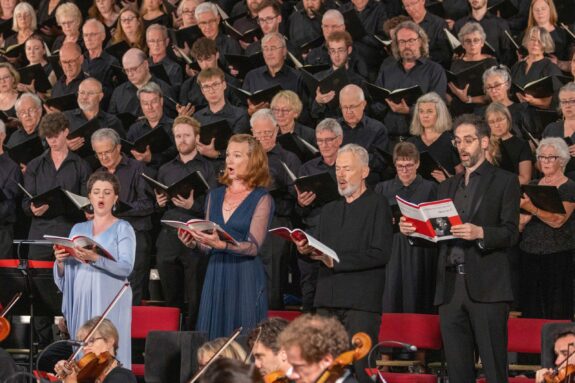
After the interval, we heard Beethoven’s Mass in C. The Mass, which was written in 1807, is a fine piece. I have taken part in a few performances over the years and have always enjoyed it. It is not on the physical or emotional scale of Missa Solemnis – which is to be heard at the 2027 festival in Worcester – but it is still notable in its own right, not least in the Credo, the movement which, in places, most closely anticipates the drama of Missa Solemnis. I liked this performance very much. The soloists, who were positioned to the conductor’s right between the orchestra and the choir did well. They were all good in their respective solo passages and, just as importantly, sang as a team in the episodes involving the quartet. I found that their voices carried well – Mark Padmore achieved particularly good cut-through – though bass John Savournin didn’t make as strong an impact as his colleagues; perhaps that was a question of the way the bass part is written. The Festival Chorus impressed on many occasions though I should get my one quibble out of the way first: often, I didn’t feel that there was sufficient attention paid to the quieter dynamics; I think Hudson could and should have insisted on greater contrast. That said, when the Chorus was required to sing out they did a fine job. The fugues in the Gloris and Credo were crisply and clearly articulated; all four voice parts registered well. In the Credo the passage from ‘Et resurrexit’ was suitably jubilant. I also admired the way the chorus projected strongly the start of the Agnus Dei. During the last portion of that movement, the performance put across the optimism of ‘Dona nobis pacem’ very successfully. The Philharmonia were not required to be to the fore in the way that had been the case in the first half. However, they played stylishly under Hudson’s direction.
This concert offered a nicely varied programme, which I enjoyed very much.
John Quinn
Featured Image: Soloists and Three Choirs Festival Chorus singing Beethoven’s Mass in C © TCF/James O’Driscoll