
 United Kingdom Three Choirs Festival [5] – Mendelssohn, Wood, Elgar, Sumsion, McDowall, Stanford: Roderick Williams (baritone), Hannah Etherington (soprano), Three Choirs Festival Youth Choir, Philharmonia Orchestra / Martyn Brabbins (conductor). Gloucester Cathedral, 28.7.2026. (JQ)
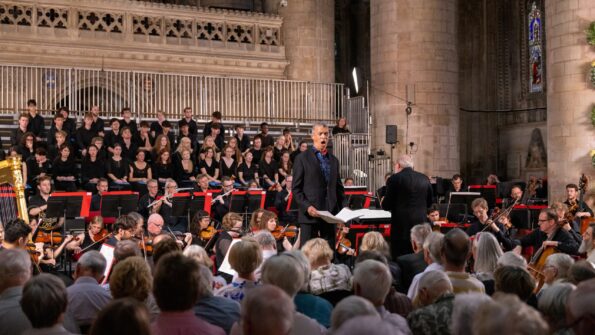
Songs of the Sea
Mendelssohn – ‘The Hebrides’ Overture
Charles Wood – Never weather-beaten sail
Elgar – Sea Pictures
Herbert Sumsion – They that go down to the sea in ships
Cecilia McDowall – Ave Maris Stella
Stanford – Songs of the Fleet, Op.117
The Three Choirs Festival Youth Choir (TCFYC) is an excellent venture, founded in 2010, I believe, on the initiative of Adrian Partington. Each year the choir is formed specifically for the purpose of giving a concert at the festival. The members of the choir are thereby given the opportunity to have the experience of singing in a main evening concert, usually accompanied by the Philharmonia. I have attended several of these concerts over the years and I have never been disappointed. Tonight, I counted 47 singers on the stage.
The concert programme had a decidedly nautical theme and this anticipated the 200th anniversary in 2027 of Gloucester Docks. For those who may not know, Gloucester, though situated many miles from the sea, was a major inland port for several hundred years. The opening of the Sharpness Canal in 1827 greatly enhanced its trading importance and led to the construction of a large number of very substantial warehouses at Gloucester Docks. These have been repurposed in recent years so that the docks area is thriving again. So imposing are the warehouses that they were used as the filming location for the popular TV series, The Onedin Line
Martyn Brabbins was at the helm of the Phlharmonia Orchestra for this concert and he began with Mendelssohn’s ‘The Hebrides’ Overture. This is a much-loved piece but that status, though justified, brings dangers; the work can become hackneyed. There was no danger of that tonight. Brabbins and the orchestra gave a fresh, vital performance. For me, the highlight was the wonderfully poetic playing of the clarinets just before the final turbulent section; it was right that Brabbins singled out the two players for their own bow at the end.
The first offering from the TCFYC was the short anthem Never weather-beaten sail by Charles Wood. The Festival is marking the centenary of Wood’s death by including a number of his pieces in programmes throughout the week. This anthem, which dates from 1910, sets words by Thomas Campion (1567-1620), which Parry also set in his Songs of Farewell. In his programme note, Andrew Burn rightly described Wood’s piece as ‘an intimate two-verse setting of a gentle melody’. I would go further and describe it as a little gem. We heard it in a new arrangement by Iain Farrington with string orchestra accompaniment. I thought this worked extremely well, Farrington’s arrangement sensitively complemented Wood’s composition. The TCFYC sang the music quite beautifully. Their collective sound was fresh and very pleasing and while the sopranos made a bright, attractive sound, they did not dominate the ensemble; the blend was very good.
If Martyn Brabbins was the captain of the ship for this nautical programme, then his first mate was the baritone Roderick Williams, who sang a song cycle in each half of the concert. His first choice might have raised eyebrows in some quarters because Elgar’s Sea Pictures was conceived for female lower voice. However, the songs are in no way gender-specific; so, in principle there is no reason why a male singer should not present them. In fact, Williams recorded the cycle back in 2009 (Dutton CDLX 7243). I bought the disc when it came out and I remember being thoughtful about what I heard, admiring the singing per se but unsure whether the songs and, in particular, the lie of some parts of the vocal line in relation to Elgar’s orchestration was ideally suited to the baritone voice. That said, I recognise that I may not have been able to dislodge from my mind the sound of the songs as sung by such luminaries as Sarah Connolly, Alice Coote and, above all, Janet Baker. So, I made a conscious decision not to re-listen to Williams’s recording prior to this concert so that I could approach his rendition of the songs with open ears. One detail that I spotted was that although Williams carried a copy of the music he barely glanced at it; nothing was allowed to get in the way of eye contact and communication with the audience.
There was much to admire in Williams’s performance. I had a seat not too far from the front and I could hear him very well, though I understand from comments I heard afterwards that in some other parts of the cathedral he was less clearly heard. Williams and Brabbins put across ‘Sea Slumber-Song’ with great calm. During ‘In Haven (Capri)’ I very much appreciated Williams’s effortlessly spun vocal line and I also liked the way that Brabbins and the Philharmonia placed the accompaniment with delicacy. ‘Sabbath morning at Sea’ is the first of the big songs. Williams did it well; the passage beginning ‘The new sight, the new wondrous sight’ was delivered with determination and fine feeling and that was even more the case at ‘He shall assist me to look higher’. Having said that, I couldn’t help but wonder if a well-focussed mezzo-soprano voice might have achieved greater cut-through in these fully-scored passages. Williams put across the words of ‘Where Corals Lie’ really well; I liked the little upsurge of intensity at ‘Yes, press my eyelids close’. Finally, Williams brought ardour to ‘The Swimmer’. He and Brabbins produced an exciting performance of the song and there was genuine exaltation in Williams’s delivery of the passage beginning at ‘I would ride as never man has ridden’, though once again I wondered if the baritone voice can achieve ideal cut-through in this music. I am still not entirely convinced by a male voice in these songs, but I was a lot more convinced by seeing them sung live by Williams.
After the interval we heard again from the Youth Choir. First, they sang Herbert Sumsion’s anthem They that go down to the sea in ships (1979). Sumsion’s name is renowned in Three Choirs history; he served as Organist of Gloucester Cathedral from 1928 until 1967. This fine anthem sets verses from Psalm 107. The original organ accompaniment has been arranged for string orchestra by Iain Farrington, and I thought his arrangement was just as successful as was the case with the Charles Wood piece. The members of TCFYC sang the piece very well indeed and with evident confidence. They then moved on to a more recent composition. Cecilia McDowall is celebrating her 75th birthday this year and the Three Choirs Festival is marking that with performances of several of her pieces. I have experienced quite a lot of her music over the years, principally on CD, and have enjoyed and admired what I’ve heard. I know Ave Maris Stella (2001) from CD and I was delighted to have my first opportunity to hear it live. It was appropriate for TCFYC to sing it since McDowall wrote it for a school choir; it was commissioned by Portsmouth Grammar School. I should make it clear, though, that this piece is very much an adult work; there is not the slightest trace of ‘dumbing down’. I don’t think I have previously been quite as struck as I was by the echoes of the music of Morten Lauridsen in the opening and closing sections of the work; I am sure that’s pure coincidence. The young singers of TCFYC gave an assured account of this attractive and effective piece and they benefitted from expert accompaniment by the Philharmonia strings. The work contains some important and exposed soprano solos. Stepping in at short notice for an indisposed colleague, Hannah Etherington, a member of the choir, delivered these solos very confidently and with lovely, pure tone. The performance was very warmly applauded, and rightly so; these excellent young singers deserved nothing less. The composer was present and clearly appreciated what she heard.
Roderick Williams returned to join the Youth Choir in Stanford’s Songs of the Fleet, Op.117. These five songs date from 1909-10 and all of them set words by Sir Henry Newbolt (1862-1938). Stanford had already composed one set of Newbolt songs, Songs of the Sea Op.91 (1904); these met with great success but, generally, I think the Op.117 set is superior. Newbolt’s patriotic poems are definitely of their time but Stanford set them very well indeed. Hitherto, we had heard the Youth Choir lightly accompanied by strings only. I wondered if a choir of fewer than fifty young voices might be swamped by Stanford’s quite full orchestral scoring. However, it became clear in the first song, ‘Sailing at Dawn’, that these singers could more than hold their own. In truth they were a bit swamped at times in ‘The Song of the Sou’Wester’ but Stanford’s scoring colourfully illustrates a gale-force wind at sea and even a large adult choir might struggle in these turbulent conditions. In this song, Williams delivered the solo part with relish, as he did in the other ‘patter song’, ‘The Little Admiral’, which he sang with a sizeable twinkle in his eye. Martyn Brabbins visibly enjoyed navigating his way through these two songs. By contrast, ‘The Middle Watch’ is a very still setting; the fleet is at anchor in calm seas at night. Williams was at his most poetic here; the choir supported hm admirably and the Philharmonia’s playing was refined. The final song, ‘Fare Well’ is by some distance the best of the set. The performance of this noble elegy was very moving. Williams sang with great eloquence – such music is ideally suited to his voice – while the choir and orchestra gave him splendid support. This affecting song brought the cycle and the concert as a whole to an impressive conclusion.
Roderick Wiliams was a fine soloist, Martyn Brabbins directed all the performances expertly, and the contributions of the Philharmonia were excellent in every way. I hope, though, that these seasoned professionals will not object if I single out for special praise the Three Choirs Festival Youth Choir. It was great to see and hear these young singers deliver such assured, well-disciplined and thoroughly musical performances. Though, disappointingly, she was not credited in the programme, I later established that they had been prepared for this concert by the rising British conductor, Charlotte Corderoy. I well remember her very impressive conducting of Vaughan Williams’s The Pilgrim’s Progress at the 2023 Three Choirs Festival (review here). From interviewing her for Seen and Heard prior to that concert, I recall that she is a past member of both the Gloucester Cathedral Youth Choir and of the Festival Youth Choir; with such a talented musician to prepare them I am not surprised that the Youth Choir delivered the goods in some style this evening. I wish there had been such an opportunity when I was the same age; I hope that at least some of these young singers will take part in future festivals as members of the Festival Chorus.
John Quinn