 Germany Bayreuth Festival 2026 [3] – Wagner, Rienzi: Soloists, Chorus and Orchestra od the Bayreuth Festival / Nathalie Stutzmann (conductor). Livestreamed on STAGE+ (directed by Michael Beyer) from the Bayreuth Fespielehaus, 26.7.2026. (JPr)
Adolf Hitler apparently first saw Rienzi in Linz with his friend August Kubizek in 1905. Without much money in their pockets, they both would go to the opera house early to find the best places in the standing-room-only section and they saw all of Wagner’s works while leaning against the columns of the old Linz Opera House. Kubizek wrote that of all they saw there, Rienzi took an almost mystical hold on the young Adolf. After seeing the performance, and seemingly to be transfixed by it, for the first time in his life Hitler talked at length about politics. It is because of this account – and the indiscretions of some of Wagner’s writings when he was at a low ebb – that Wagner has become so associated with the undoubted horrors of World War II.
Prior to 2026 the Bayreuth Festival has declined to perform Rienzi, Wagner’s third opera, with the composer distancing himself from it later in life, even though it had more performances during his lifetime than all of his other works. This is a fairly common occurrence among composers: Puccini and Verdi rejected many of their early operas, such as Le Villi, Edgar, and Il corsaro. The Bayreuth Festival website suggests that ‘the ten works of the so-called “Bayreuth canon” [Der fliegende Holländer onwards] are not based on a will or authoritative formulations in the foundation deed of the Richard Wagner Foundation Bayreuth, but exclusively on passages from Wagner’s letters to King Ludwig II of Bavaria from 1882’ and reveals how the version we were seeing and hearing has considered ‘layers of tradition as carefully as the history of reception. Likewise, the Rienzi philology of recent decades has been meticulously taken into account. Furthermore, the team has attempted to uncover new sources and reconstruct parts of the score believed to be lost.’ The 2026 running time suggests that while keeping the five-act structure basically intact, as always, some scenes have been shortened, yet even with an extended account of the ballet music the performance (minus intervals) was minutes short of four hours.
The Wagner of Holländer and Tannhäuser has undoubted roots in Rienzi and this is blatantly detectable also in musical ideas recycled in his later works. However, differences in Rienzi from those include the use of a non-mythical historical topic for the opera. And instead of providing his own libretto, Wagner adapted the plot from Edward Bulwer-Lytton’s 19th-century novel of the same name. In the story (proper!), Rienzi, proclaims himself tribune of Rome, faces assassination plots from noblemen led by Orsini and Colonna, whose son Adriano loves Rienzi’s sister Irene. After his opponents are killed, Rienzi is excommunicated by papal allies of Colonna and is abandoned by everyone except Irene, who remains loyal to the end. As Rienzi and his sister are stoned by the people, Adriano tries to rescue Irene but all three are killed when the burning Capitol building collapses. Afterwards the nobles attack the people. Co-directors Alexandra Szemerédy and Magdolna Parditka have their own ‘take’ on this original story of course.
At this time Wagner was trying – for an anticipated Parisian audience – to ‘out-Meyerbeer’ Meyerbeer and was not being true to his musical instincts. He also voluntarily included a ballet in the score without being compelled to do so by the Paris Opéra as he was with Tannhäuser. In the original the pantomime/ballet tells the story of the rape of Lucretia, as well as allegorising the union of classical and modern Rome. In 2026 overseen by a cartwheeling mini-Wagner in gold (looking similar to his statues proliferating in Bayreuth) we get fleeting pastiches – with cartoonish costumes and one-dimensional scenery – of several operas from Das Rheingold to Parsifal.
So at nearly four hours Rienzi still has occasional longueurs (the ballet notwithstanding) especially when the brass section is required to blow too long and loud, where choruses repeat themselves or we hear Rienzi’s battle-cry ‘Santo spirito cavaliere!’ possibly more times than necessary. The melodic inspiration in the accompaniment also sags a little from time to time with far too much Verdian ‘rum-ti-tum’; though on the plus side there is also more inspired music than Wagner himself seems to have acknowledged. Examples are the fine duet ‘Mein Bruder/Irene, meine Heldenschwester!’ between Rienzi and his sister in the final act and his sublime prayer ‘Allmächt’ger Vater’.
So to sum up, Rienzi is a very large scale work requiring several great voices (which is almost achieved in 2026) and several scenes for an outstanding chorus (definitely achieved in 2026). It has a long, convoluted plot including standardised dramatic operatic devices like power struggles, divided family loyalties and star-crossed lovers. There is even an excommunication, and it all ends with the obligatory operatic tragic ending. In 2026 all of this is open to interpretation and for Szemerédy, Parditka and their colleagues, ‘Not only a comprehensible sequence of the plot lines was important to the team, but also the internal structure of the individual musical numbers. Here, too, the “unhealthy” relationship between Rienzi and his sister Irene plays an essential role.’ The suggestion of incest foreshadowed Die Walküre and is deemed ‘fundamental to the emotional – and thus musically formed – triangle story Rienzi-Irene-Adriano’. Their Konzept also investigates ‘what politics does to people and not the other way around, and where the music-dramatic treatment of these questions can be found in the score’. The former is hugely significant in the UK, as well as the US, in 2026.
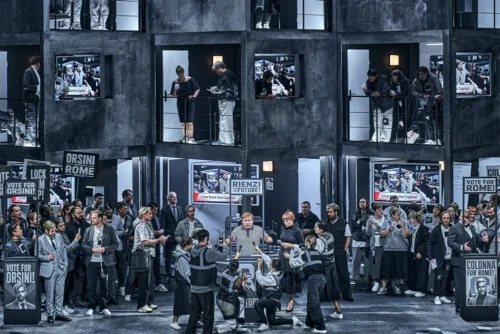
So the Hungarian co-directors have created a dystopian near-future, which is not so much an Orwellian ‘Big Brother is watching you’ with a constant mass surveillance of citizens, more so that the citizens have 24/7 access to rolling news (‘Live from the Capitol’) of current events; though how much this can be trusted is a moot point. Also, everyone seems to have a mobile phone and can respond by putting their comments in the continuous live chat (which appears to have superseded newspaper headlines).
So, the charismatic Rienzi takes power on a wave of popularism offering grand promises through simple slogans – possibly offering ‘change’ or hope’? – in an aggressive social media frenzy. Our ‘man of the people’ soon is holding black-tie, prosecco(?)-fuelled gala events and actually the interludes where guests rush to queue for the toilet or beer and pretzels is actually quite funny. However, we see how Rienzi’s attempt to reform society ends in a fascist dictatorship and isolation as he loses touch with reality (shown against a passage from Matthew 24) that results in those that brought him to power turning against him and bringing him down. Rienzi first appears as a candidate for office addressing his – placard holding (one says ‘Our saviour is coming’) – factional supporters informally dressed in a polo shirt (ok so it is not a Burnham dark navy T-shirt). Rienzi’s speechifying will be seen to involve cue cards rather than the new British PM’s probable AI glasses. When taking office (having defeated his revivals, Colonna and Orsini) Rienzi increasingly becomes megalomaniacal, responding with violence when his authority is threatened and there is even an attack, of sorts, on the Capitol in the final act. Does that remind you of anyone?
The sets and costumes are fairly monochrome: there is a grey tenement-like building where every unit has a screen, either showing the news or often a pigeon! Scenes were either set between this version of a Roman ‘forum’ or the one of the ‘senate’ as a modern parliament with a semi-circular debating chamber with seats allocated (and displayed on a large rear LED screen) as 41% for Rienzi’s party, 33% for Colonna’s and 26% Orsini’s. Towards the end Rienzi’s downfall is backstage at a theatre (‘All the World’s a Stage’, perhaps?)
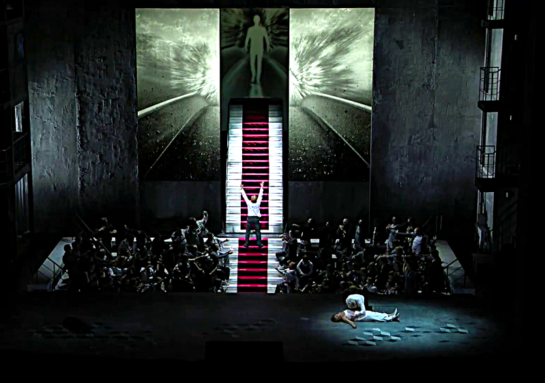
Crucial is the Rienzi, Irene and Adriano love triumvirate (rather than triangle). It is clear from the start that the young boy first shown – during the long Overture – ailing and then quickly dying is not Rienzi’s little brother of the original story but his son from an incestuous relationship with his sister. Irene attempts to resist Rienzi, but they will be shown hugging and kissing. Guilt makes Rienzi increasingly reliant on alcohol and Wagner’s ‘Messenger of Peace’ – who proclaims how Rienzi has restored law and order to the Roman lands – ‘appears’ as the vision of Rienzi’s teddy-holding dead son (descending and ascending a huge staircase) and Rienzi is distraught as a result. Adriano is rather an androgynous figure in an oversized suit who passionately pursues Irene (with some success) until ‘he’ turns against Rienzi when he executes his father, Steffano Colonna. At the end of the opera there is no stoning though we see a cityscape disintegrating (in a way recognisable from several Marvel films) after Rienzi is stabbed by Irene, who then opens her veins, before appearing to be saved by Adriano while a still-gesticulating Rienzi ascends a stairway towards a shadowy figure (in heaven?). A slightly inconclusive ending to an interesting one-off (apparently?) Rienzi for the 21st-century. The stagecraft is mightily impressive but perhaps Alexandra Szemerédy and Magdolna Parditka under the pressure of once-and-for-all performances had too many ideas they felt unable to jettison and that Werkstatt Bayreuth might have clarified in coming years had there been the opportunity. Nevertheless, the applause the production team had at the end showed they had achieved something.
The cast was very strong with the ubiquitous Andreas Schager – is there no one new we could hear? – as Rienzi. He always has a dull rather than stylish voice, which is now showing some wear and tear but with effort it can easily ride the orchestral climaxes. His singing was exposed during the Act V prayer which at one point was as painful to listen to as his character’s pain he was portraying at the time! Of course, Rienzis are a rare breed and Schager is cast because he still has the stamina to get through the role which itself is much of the battle won. Gabriela Scherer’s Irene – despite attempting to further her brother’s political future – was in mourning for most of the opera or fending off or submiting to Adriano’s entreaties. Scherer sang and acted impressively and contributed affectingly to that last act duet with Rienzi. Possibly the best singer was Jennifer Holloway in the difficult trouser role as Adriano, conceived originally for Wilhelmine Schröder-Devrient, Wagner’s favourite soprano. Holloway brought passion and a fine legato to everything she sang but her highlight was her Act III ‘Gerechter Gott!’ when swearing vengeance for her father’s death. Wagner gave the other characters less opportunity to make a notable contribution: Andreas Bauer Kanabas and Michael Nagy sang well and were suitably contemptuous of Rienzi and conspiratorial as Colonna and Orsini; Vitalij Kowaljow was a stentorian voiced Raimondo, more a figure of supreme authority – rather than a Cardinal – who is initially pro-Rienzi but will later excommunicate (banish?) him; Victoria Randem was the offstage sweet-toned Messenger.
Nathalie Stutzmann clearly knew how to shape the music and began with an unhurried Overture to underscore the action on the stage, as well as anticipate better music to come than we would actually hear. Because of her likely close involvement in preparing the score Stutzmann was completely at ease with it, well aware of the points at which dangerous tedious moments could occur and more often than not she overcame these well. As heard through loudspeakers there were possibly some ensemble issues at the start but otherwise – offstage music included – everything sounded nicely balanced between the principal singers, the outstanding chorus and the superb musicians of the Bayreuth Festival Orchestra. Stutzmann appeared to revel in Wagner’s overly used choruses and marches that occasionally sounded relentless and loud. I suspect at this stage in his career the composer probably believed that the more brass and wind instrumentation he could put in, the better his score would get judged.
Jim Pritchard
Featured Image: Rienzi final scene © BF/Enrico Nawrath
Creatives:
Directors, Stage design and Costumes – Alexandra Szemerédy, Magdolna Parditka
Lighting – Bernd Gallasch
Video – Leonard Koch
Dramaturgy: Markus Kiesel
Chorus conductor – Thomas Eitler-de Lint
Cast:
Cola Rienzi – Andreas Schager
Irene – Gabriela Scherer
Steffano Colonna – Andreas Bauer Kanabas
Adriano – Jennifer Holloway
Paolo Orsini – Michael Nagy
Cardinal Raimondo – Vitalij Kowaljow
Baroncelli – Matthias Stier
Cecco del Vecchio – Michael Kupfer-Radecky
A Messenger of Peace – Victoria Randem
Generally your review succeeds in demonstrating how really, really, silly the production was, how far from Wagner it was, and how it utterly failed to establish a firm basis for interpreting the work in future performances – as well as how desperate the directors were to assuage a 21st-century audience’s rather vapid dependency on believing its own self-image is historically so, so (I’m weeping here) wonderful.