 United Kingdom BBC Proms 2026 [8] – Turnage, Britten, Sibelius: Guy Johnston (cello), BBC Symphony Orchestra / Sakari Oramo (conductor). Royal Albert Hall, London, 28.7.2026. (AV-E)
Mark-Anthony Turnage – Festen Suite (2024-2025)
Britten – Cello Symphony, Op.68 (1963)
Sibelius – Symphony No. 2 in D major (1901-1902)
Mark-Anthony Turnage’s Festen Suite proved the real revelation of the evening. I had come specifically to hear this UK premiere, having long admired Thomas Vinterberg’s unsettling 1998 Danish film The Celebration (Festen), and was eager to discover how Turnage’s own operatic response to the same material had been transformed into a purely orchestral work. His opera Festen captures the psychological violence, grotesque humour and emotional fractures beneath the surface of the film’s family drama, while the suite distils that dramatic universe into a concentrated orchestral portrait of extraordinary character and invention.
The Prelude immediately established Turnage’s turbulent orchestral characterisation, its nervous rhythmic energy, sharply etched gestures and sudden flashes of colour capturing the suppressed anxieties simmering beneath the drama’s outward civility. The percussion writing was especially striking, acting as a dramatic force in its own right, injecting violence, irony and dark humour into the musical fabric; yet the music occasionally required a more biting edge and greater rhythmic aggression to fully release its volatile charge.
In Blue or Green, Turnage revealed a more introspective side, its muted lyricism and quietly unsettled harmonic language suggesting moments of vulnerability beneath the psychological strain of the drama. Here too, however, the emotional tension might have benefited from a little less restraint and a more unsettled expressive freedom.
Grandma’s Song offered a fleeting moment of tenderness and fragile humanity, its simplicity providing a poignant contrast to the emotional brutality surrounding it. The affection and nostalgia were beautifully drawn, though Turnage’s darker irony remained somewhat softened rather than fully exposed.
The grotesque energy of Conga transformed celebration into something increasingly unsettling, Turnage twisting familiar dance rhythms into a brilliant mixture of humour, menace and social unease. The movement cried out for greater attack, sharper rhythmic bite and more dangerous theatrical swagger than it ultimately received.
In Interlude I, the composer’s theatrical instincts were again evident, the orchestra suspended between reflection and tension, as though emerging emotions remained unresolved beneath the subdued surface.
The Fight brought the psychological conflicts of Festen into open confrontation, with jagged instrumental attacks, sharply drawn brass and woodwind writing, and percussion deployed with explosive dramatic purpose. Yet even here the performance remained curiously civilised where Turnage demands something far more feral.
The BBC Symphony Orchestra responded with polish and precision, every instrumental detail contributing to Turnage’s vividly realised soundworld. Yet the percussion, so central to the suite’s theatrical fervour, lacked visceral impact; the missing edge, bite and volatility were entirely due to the conductor’s lacklustre and timorous restraint.
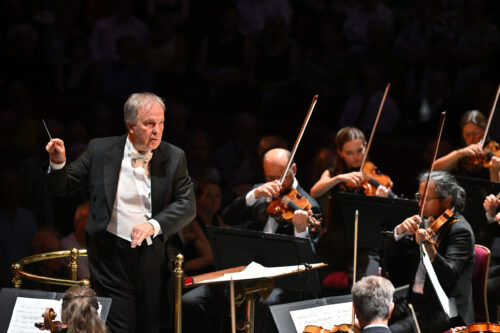
As the audience responded with rapturous applause, Oramo turned towards Turnage, seated nearby, in a clear gesture of praise and acknowledgement. The celebrated composer rose to receive the ovation, wearing his customary trilby hat — an instantly recognisable part of his public image.
It was in Britten’s sombre and enigmatic Cello Symphony that the BBC SO truly came into its own, producing some of the finest playing of the evening. Here the musicians responded with heightened involvement, attentiveness and incisive precision, fully engaging with Britten’s elusive shifts of mood, chamber-like textures and constantly evolving instrumental dialogues. Every section seemed alert to the music’s psychological undercurrents, the orchestral detail emerging with clarity, intensity and remarkable responsiveness.
The consummate cellist Guy Johnston proved an ideal advocate for Britten’s extraordinary work. His playing possessed an almost spectral transparency, the cello line often seeming to emerge from silence itself rather than merely from the orchestral texture. His eloquence was never overstated; every phrase was shaped with extraordinary subtlety, sensitivity and restraint. There was something uncanny about the purity of his sound, an almost weightless quality that made the cello appear detached from ordinary instrumental expression. His hyper-sensitive response to Britten’s shifting emotional currents revealed a performer completely attuned to the composer’s ambiguous and elusive world. At times the soloist’s playing was deliberately reduced to the threshold of audibility, yet this very fragility created an extraordinary intensity — a rare example of playing silence itself, as a sensation of silence.
I found Britten’s Cello Symphony incomprehensible in the most positive sense: a worrisome work of such diverse complexity and dense abstraction that I felt unqualified to write about it. I am not a musicologist by profession, and its mysteries seemed to exist beyond conventional explanation, revealing themselves through an ever-unfolding network of textures, colours and elusive musical relationships where words fail — and should.
For an encore, Guy Johnston played the closing coda of Britten’s Third Cello Suite, including the Kantakion, a Russian Orthodox Byzantine chant for the dead. It was an unusually moving choice for an encore with Johnston’s soulful playing capturing the sombre melancholy and serene reserve of the Kantakion. Before performing, Johnston recalled appearing at the Proms on 8 August 1998, aged 16, in Britten’s The Young Person’s Guide to the Orchestra, conducted by Mstislav Rostropovich with the National Youth Orchestra of Great Britain. That memorable concert included the world premiere of Michael Berkeley’s The Garden of Earthly Delights and Shostakovich’s Symphony No.10.
Sibelius’s Symphony No.2 brought the evening to a depressingly disappointing conclusion. Rather than allowing the symphony’s vast architecture to unfold with organic inevitability, Oramo imposed mannered stop-and-start interventions that fractured the work’s natural momentum, transforming moments of repose into stagnant pauses rather than expressive spaces within the architecture of the symphony.
The Allegretto lacked the sense of accumulation and organic growth that lies at the heart of Sibelius’s writing. His seemingly simple motifs require patience, tension and an instinctive understanding of how fragments gradually coalesce into something monumental, yet the performance too often felt earthbound and cautious, the music failing to generate the underlying currents of mystery and inevitability.
The Andante, ma rubato revealed the same fundamental limitation. What should emerge as a profound meditation of darkness, longing and spiritual struggle remained curiously restrained, the emotional temperature rarely reaching the necessary intensity. The strings lacked the depth, warmth and burnished sonority required, while the brass lacked the gravitas and nobility that give Sibelius’s writing its monumental force.
The Vivacissimo never generated the nervous propulsion or rhythmic bite that should drive the symphony towards its culmination. Instead of gathering irresistible momentum, the music felt earthbound and episodic, its restless energy dissipating before the great transition into the finale. One longed for that overwhelming sense of inevitability with which Sibelius fuses the two movements into a single, unstoppable arc.
The Finale: Allegro moderato exposed the shortcomings most painfully. Sibelius’s great peroration demands a sense of arrival — a release of accumulated tension into overwhelming affirmation — yet the performance remained effete and devoid of grandeur. What was missing was the force and conviction behind it: the brass lacked bite, the strings lacked attack, and the players never approached the elemental force of Sibelius’s scorching ice-cold score.
This laboured and mannered performance demonstrated a fundamental lack of rapport between Oramo and Sibelius. The broad spaciousness of Sir John Barbirolli’s 1964 Boston performance of Sibelius’s Second Symphony maintained a brooding and buoyant breadth without ever becoming slack and sluggish. The stark contrast makes painfully clear what was missing tonight.
Seemingly having absolutely no rapport with the composer, Oramo would be well advised to leave Sibelius alone.
Alexander Verney-Elliott
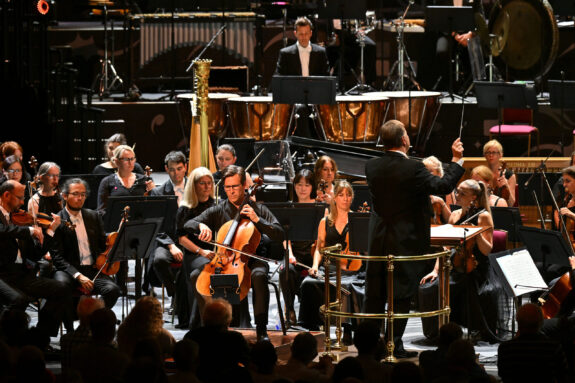
Featured Image: Cellist Guy Johnston with Sakari Oramo conducting the BBC SO © BBC/Mark Allan
The review of the Britten Cello Symphony is excellent. The review is a bit overgenerous to the Turnage and inexplicable about the Sibelius. Okay not the ever-flowing version, but I thought the shifts, and pauses, and restarts by Oramo within the inexorable dynamic really impressive, and told us things that the ever-flowing onwards versions don’t quite reach, about fragility and isolation and fierce determination.