 United Kingdom Three Choirs Festival 2026 [12] – Faire is the Heaven: Sydney Philharmonia Choirs, Luke Mitchell (organ) / Brett Weymark (conductor). Gloucester Cathedral, 1.8.2026. (JQ)
The Sydney Philharmonia Choirs (SPC) made a welcome visit to the Three Choirs Festival. This was the last stop on their short UK tour, during which they have sung in some cathedrals and also at the BBC Proms; there they took part in John Adams’s Harmonium with the City of Birmingham Symphony Orchestra and the CBSO Chorus (review here). When I met recently with the Three Choirs CEO, David Francis I discovered that the invitation to the festival came about on account of his association with the SPC, of which he was CEO for some years (interview here). The SPC is a remarkable institution, founded in 1920. Nowadays it involves some 2000 singers, of all ages, in a number of different choral ensembles. Today’s choir was drawn, I think, from the three auditioned choirs, the Symphony Chorus, the Chamber Choir and Vox, a choir for singers between 18 and 30. The SPC is not unaccustomed to singing in substantial acoustics such as the one at Gloucester Cathedral; after all, they are a Resident Company at the Sydney Opera House.
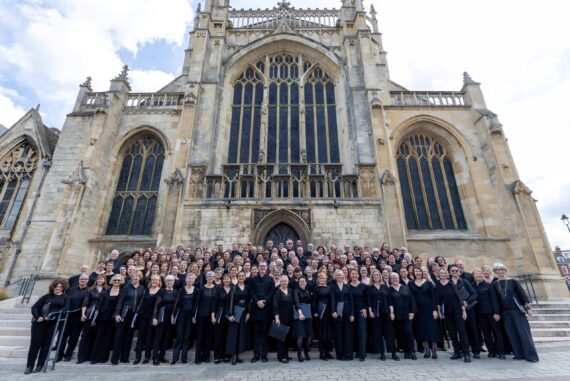
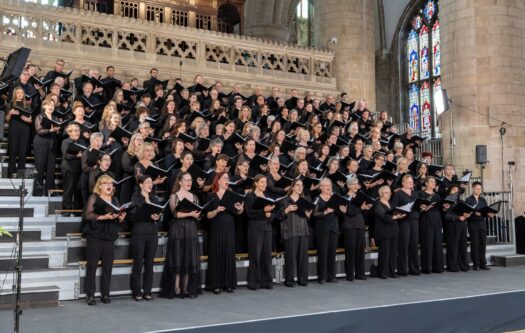
The choir which we heard this morning was comparable in size to the Festival Chorus; I would estimate that 140/150 singers were on duty. It was noticeable that, as is the case in most choirs today, the sopranos and altos significantly outnumbered the tenors and basses; why is it that even the best choirs seem to find it hard to attract tenors and basses these days? That said, the tenors and basses punched above their (numerical) weight and, as a paid-up member of the tenors’ union, I was particularly delighted at the cut-through achieved by the tenors in a couple of important places in the Parry and Balfour Gardiner items. All four sections of the choir made a fine contribution to the overall sound. Before discussing the singing, I should record that the appearance of the choir made a very favourable impression before they even opened their mouths; they were immaculately turned out; their platform discipline was excellent; and throughout the performance they showed their enjoyment by smiling. I wasn’t the only member of the audience to notice this.
Today, they brought a programme which mainly featured famous choral pieces by British composers, but I was glad that they had seasoned the mix by including some pieces by contemporary Australian composers.
Their organist, Luke Mitchell had clearly enjoyed familiarising himself with the magnificent new Nicholson organ of Gloucester Cathedral. His imposing and thrilling introduction to Parry’s I Was Glad surely enthused the choir; the way they delivered the opening to the anthem was thrilling. They made a splendid sound, but I admired just as much the contrast which they brought to the quieter music (‘O pray for the peace of Jerusalem’). The concert was off to the best possible start. I was pleased that Brett Weymark found room for a piece by Bliss. His Sing, mortals! (1974) is not often heard; I have only encountered it on CD. It is a strong piece, which the SPC did very well; as in the Parry, they made the most of the dynamic contrasts.
The published programme order was slightly changed; we heard Ireland’s Greater love hath no man and then Harris’s Faire is the Heaven. The former was well sung, but I was rather discomfited by Weymark’s pacing; I felt he took the piece too swiftly. Not only did this mean that the music sounded hasty but also there was insufficient contrast between the various sections of the anthem. Luke Mitchell then played a short organ interlude which segued seamlessly into the Harris anthem. I suspect there was a pragmatic reason for this, namely to get from the key in which Ireland finished to the D-flat major key of the Harris. For me, though, it didn’t quite work; Harris’s great anthem should just emerge from silence. Unfortunately, this was another instance where I felt Weymark’s pacing was too swift. The choir sang the piece well – excellent dynamics were again a feature – but at this speed the performance was a bit too robust and the sublime poetry of Harris’s setting was somewhat compromised.
In this programme, the British composer Edgar Bainton (1880-1956) offered the compositional bridge between the two hemispheres because in 1934 he emigrated to Australia to take up the post of director of the New South Wales State Conservatorium of Music in Sydney. He spent the rest of his life in Australia. Weymark led the SPC in a fine performance of the visionary anthem And I saw a New Heaven. The singers brought out the drama and colour in Bainton’s setting of words from the Book of Revelation. I don’t know if either of the two Australian composers whose music we heard this morning studied at the conservatoire which Bainton once led. We heard settings of the Magnificat and Nunc dimittis by Joseph Twist (b.1982), though these were not performed consecutively. The Magnificat made a positive impression. Much of the music danced along joyfully, though at ‘He remembering his mercy’ the nature of the setting became gentler, as befits the text. The ‘Glory be’ was exciting. Later, the opening of the Nunc dimittis featured singing that was impressively firm yet quiet at the start before the music opened up at ‘For mine eyes have seen’. At a first hearing, separated by quite a lot of other music, I can’t be entirely sure, but I think Twist then reprised the vibrant ‘Glory be’ from the Magnificat. The Twist pieces were receiving their UK premieres, as was the Agnus Dei by Alice Chance (b.1994). I liked this piece, which struck me as being sincere and effective. It was preceded by an unaccompanied setting of a traditional song from Mers Island (Murray Island), Adira Arenio (O Lamb of God). This nice, simple setting was an appropriate prelude to Chance’s original piece. If I read the notes correctly, Agnus Dei is part of a setting of the Requiem which Chance is gradually composing, as is her Sanctus, the first performance of which we heard earlier in the programme. This is a jubilant, extrovert setting and I especially liked the light, festive dancing at ‘Pleni sunt caeli’. The quiet ending was a pleasant surprise.
The SPC offered other British music. Britten’s A Hymn to the Virgin was sung after the Bainton piece; between the two works Luke Mitchell played another short organ interlude which acted as a bridge while a group of singers (members of the Chamber Choir?) left the platform and made their way to the back of the nave, from where they sang as the semi-chorus in the Britten. I am not entirely sure that A Hymn to the Virgin is ideally suited to a large choir but what I am certain about is that on this occasion the positioning of the semi-chorus worked brilliantly. The sound of the small ensemble carried beautifully up the nave; furthermore, though the singers were positioned at some distance from the conductor, coordination between the two choirs was perfect. Mitchell played the organ quietly while the semi chorus returned to their places and then launched attacca into Balfour Gardiner’s Evening Hymn. This is a magnificent anthem by any standards and the SPC did it full justice. Their full-throated delivery of the opening had a glorious fervour but then they offered a terrific contrast for the tranquil second stanza (‘Procul recedant somnia’). When Gardiner reprises the opening music (‘Praesta, Pater piissime’) Weymark and the SPC made the moment overwhelming and genuinely moving. Just as moving was the way the choir then achieved the wind-down to the subdued close of the piece. This was a marvellous performance; it was my personal highlight of the concert.
To close, the SPC offered Vaughan Williams’s stirring arrangement of The Old One Hundredth. Weymark invited the audience to stand and join in, which we all did with gusto. This also offered Luke Mitchell to unleash one more time, in the first and last verses, the mighty power of the cathedral organ; he needed no second bidding. Of course, the fact that we had all stood up for the last item meant that the SPC were guaranteed a richly deserved standing ovation. There was no way the audience would let them go without an encore. This duly arrived in the shape of a vibrant and exciting setting of Cantate Domino. This, I later learned from two members of the choir, was by the Melbourne composer Daniel Brimsmead (b.1988). The performance was full of vitality and proved to be a terrific conclusion to the concert.
I am sure the Sydney singers were thrilled that a very large audience had turned up to hear their Saturday morning concert. They rewarded us with a splendid display of choral singing. Throughout the performance the choir’s discipline was admirable. Balance and tuning were impeccable, as was their diction. By chance, at the concert in the cathedral later that evening, I encountered David Francis. We only had time for the briefest of words. My comment to him was ‘Those Aussies can sing!’
John Quinn
Featured Image: Brett Weymark and the Sydney Philharmonia Choirs outside Gloucester Cathedral © TCF/Dale Hodgetts
Faire is the Heaven
Parry – I Was Glad
Joseph Twist – Magnificat (UK premiere); Nunc dimittis (UK premiere)
Bliss – Sing, Mortals!
Ireland – Greater love hath no man
Alice Chance – Sanctus (world premiere); Agnus Dei (UK premiere)
Sir William Harris – Faire is the Heaven
Trad. (arr. Alice Chance) – Adira Arenio (O Lamb of God)
Edgar Bainton – And I saw a New Heaven
Britten – A Hymn to the Virgin
Henry Balfour Gardiner – Evening Hymn
Vaughan Williams – The Old One Hundredth Psalm Tune
Thank you so much for this review! From a mother far, far away…