
 United States Blossom Music Festival 2026 [5] – Various: Blossom Festival Chorus, (chorus director: Lisa Wong), The Cleveland Orchestra / Kazuki Yamada (conductor). Blossom Music Center, Cuyahoga Falls, 1.8.2026. (MSJ)
Takemitsu – Dreamtime
Stravinsky – Symphony of Psalms
Robert Schumann – Symphony No.2 in C major, Op.61
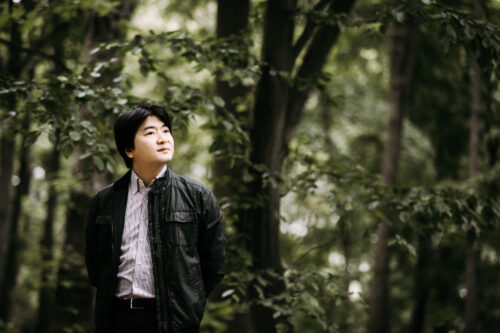
I am not necessarily suggesting that the Cleveland Orchestra should kidnap Kazuki Yamada and prevent him from returning to his conducting duties in Europe. After all, we’ve reviewed many candidates here for a future music director and have more coming. But when lightning strikes…
Folklore claims that lightning never strikes the same place twice. Science tells us otherwise, and so do Cleveland Orchestra concerts. The orchestra has a long and honored tradition with Robert Schumann’s Symphony No.2, a work that buries considerable moody emotion beneath its surface gleam. George Szell recorded it multiple times in Cleveland, the last time in his own highly edited version of the score. Christoph von Dohnányi came to town in the 1980s and proved that the work could sound noble without completely rewriting Schumann’s score. Just two years ago, English conductor Daniel Harding went against his reputation as an expert in modern music and delivered a deeply felt performance.
As a critic, I was happy to have heard two great performances of the piece in my time (Dohnányi and Harding), and I figured it was unlikely I would ever hear anything better. And then Kazuki Yamada came to town. Last year, he debuted in Cleveland with a skilled and professional presentation of Sir Edward Elgar’s First Symphony, not an easy work to bring off, particularly with an ensemble that gets few opportunities to play the great English symphonies. But Yamada did it with assurance. When he returned earlier this week, it felt like a reunion of friends, and he positively claimed ownership of the Saint-Saëns ‘Organ’ Symphony. Just two days later, he headed out to Blossom, delivered this difficult program like it was the most natural thing in the world and exuded a sheer joy for music as he did so.
The concert opened with the Cleveland Orchestra premiere of Japanese composer Tōru Takemitsu’s 1981 work Dreamtime, inspired by a performance the composer witnessed by Australian Aboriginal dancers and singers. It is one of a series of works Takemitsu wrote in the 1980s on the theme of dreams that incorporate tonal and atonal elements. Instead of attempting any sort of narrative, Takemitsu’s music floats, freely associating from one idea to the next, meditative and elusive. What wasn’t elusive was Yamada’s conducting. While assuring that the orchestra evoked Takemitsu’s diaphanous soundworld, his baton was deployed with minute flicks to give cues. Conducting at a broad pace with simple gestures, Yamada would subdivide his beat at tricky junctures to let players know exactly where to enter. The result was a spellbindingly beautiful performance but one with a definite shape. The piece was about fifteen minutes in performance but was handled with such certainty that it felt like a single breath in and out. So powerful was Takemitsu’s dreamscape, the composer even managed to introduce a stereotypical harp glissando at one point and make it feel absolutely earned. That is skilled writing and Yamada was at one with it.
Hardly less spellbinding was Igor Stravinsky’s Symphony of Psalms, featuring the Blossom Festival Chorus polished to a crystalline shine by Lisa Wong. Coming from an entirely different belief system from Takemitsu’s meditations on Aboriginal dreamtime, the symphony nonetheless occupies a similarly remote, otherworldly atmosphere, a feeling intensified by the orchestral absence of any higher strings, with two pianos in their place. Even the chatty ladies sitting in front of me – who kept a running commentary between themselves the whole night – were brought to awe-stricken silence by the rapt third movement. Yamada caught the sense of joy in the boisterous passages as well, achieving a sense of timelessness as the work unfolded. Again, as he did on Thursday downtown at Severance, Yamada achieved a remarkable balance between encouraging the orchestra to play out with bold color and open sound while almost simultaneously dovetailing the orchestral passages so that the warmth of the featured voices sailed out above the orchestra. That is the kind of thing that doesn’t take care of itself but Yamada made no grandstanding gestures. He was vigorous when the music was vigorous but never performative. All his gestures were practical moves to guide the performers and every tiny flick could be heard reflected in the playing.
That is all well and good, but what does any of it have to do with Schumann’s 1846 Symphony No.2 in C major? More than you would think, it turns out. Just as Takemitsu’s piece was a study of dream consciousness and Stravinsky’s was about the mental state of prayer, Schumann’s symphony is an astonishing study of the mixed emotions of mental health recovery. The work tries over and over again to evoke happiness with the bright key of C major but finds that brightness sitting uneasily on foundations built on quicksand. Brightness turns to nervous energy, to the point that halfway through the finale the music feels close to surrendering to the darkness.
Yamada drew attention to the multiple layers of emotions at the beginning of the symphony, highlighting the rising fanfare in the brass while making sure that the restless strings undermined the fanfare’s positivity with subtly nagging accents. Schumann himself said that he didn’t feel like himself until halfway through the finale and Yamada caught that kaleidoscope of anxiety, mixed with purely delightful moments along the way. When the audience burst into applause after the first movement, he glanced back, nodding. Don’t worry about stuffy rules, he seemed to say, this music is here to entrance you. Turning to the violins, Yamada even wiggled with delight as they prepared to launch into the Scherzo which was daredevil fast and giddy. With reflective trios, the range of emotion covered in the Scherzo alone was astonishing. In the coda he pushed the strings to the absolute brink, barely conducting at all, simply shifting his balance back and forth and trusting these brilliant players to nail it, which they did with alacrity.
The Adagio flowed at an ideal tempo, keeping an urgent lyrical momentum while at the same time digging deep into the aching climaxes that never quite release the building tension. Yamada continually conveyed a sense of understanding where the music was going, right down to the end of the Adagio where he didn’t try to force a feeling of resolution to music that the composer must have known felt unfinished at its close. Afendi Yusuf (principal clarinet) and the other woodwind players curled around Schumann’s tender phrases exquisitely.
Yamada launched into the finale with high energy which made me wonder if he would piledrive through the end of the piece, but I had no need to fear. Yamada clearly thinks about where the music is going and what it means. He used that wild energy to fuel the sudden gut-punch disintegration of the music after the second theme has run its course, led again by Yusuf’s clarinet. He let the music wind down into its dark pit without self-consciously ticking the beat like a metronome. Instead, in an absolutely human way, he let us feel the moment. After a pause, he then began the slow but inexorable rise of the music from the pit to paradise, never rushing or attempting to force a facile excitement but letting it well up with tremendous warmth and emotion. Yamada made the ending radiant and grand, proving that those who put down Schumann’s orchestral works have not yet understood them. This was genius music, performed with glorious warmth by one of the world’s greatest orchestras under a conductor who positively communes with music.
So, on second thought, yes: I am suggesting that the Cleveland Orchestra should kidnap this conductor and keep him here.
Mark Sebastian Jordan