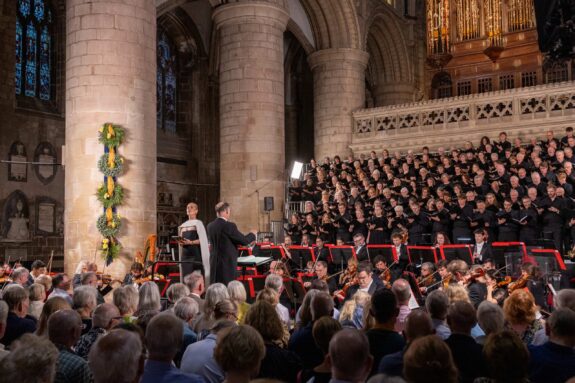
 United Kingdom Three Choirs Festival 2026 [13] – Wagner, Elgar: Niamh O’Sullivan (mezzo-soprano), John Findon (tenor), David Ireland (bass-baritone), Jonathan Hope (organ), Three Choirs Festival Chorus, Philharmonia Orchestra / Adrian Partington (conductor). Gloucester Cathedral, 1.8.2026. (JQ)
Wagner – Parsifal: Prelude, Act I
Elgar – The Dream of Gerontius, Op.38
On the last evening of the 2026 Three Choirs Festival, it was standing room only for Elgar’s The Dream of Gerontius.
Adrian Partington replicated the programme he had given at the 2013 Festival by prefacing the Elgar with the Prelude to Parsifal (review here). Wagner’s music here received a spacious, glowing performance. The Philharmonia was on magnificent form; the composer’s long lines unfolded with all the time in the world for the music to breathe and I admired the fine terraces of dynamics. The majestic chorale-like brass passages were sumptuously voiced. It was perceptive to programme this piece ahead of Elgar’s masterpiece because it demonstrated in spades the influence which Wagner exerted on Elgar’s music, especially when it came to Gerontius and here we had a Prelude which gave a patient, satisfying exposé of the leitmotifs that would be heard in the music-drama; the Prelude to Gerontius fulfils exactly the same function.
After this superb Wagner performance, I wasn’t in the least surprised to find that the Philharmonia carried the same refulgent form into the Elgar. The Gerontius Prelude was unfolded with consummate understanding by Partington, and the Philharmonia backed him up with playing that brought out every nuance in the score. This wonderful standard of playing was maintained throughout the whole work – the Prelude to Part II, for example, was delivered with luminescent refinement. I imagine that engaging the Philharmonia takes a substantial amount of the Festival’s budget. From a listener’s point of view, I can only say it is worth every penny to have a world-class orchestra playing with such distinction at these concerts. While discussing the instrumental side of the performance, it’s pertinent to mention that Jonathan Hope ensured that the cathedral’s organ made a wonderfully deep and sonorous contribution at several key junctures.
I have been hugely impressed by the Festival Chorus every time I have heard them this week. Indeed, I think this is one of the finest – if not the finest Festival Choruses that I have heard. Tonight, though, they reserved their best for last. I was greatly encouraged when they first sang (‘Holy Mary, pray for him’) to find that the attention to detail, not least in terms of dynamics, which had been sadly lacking when they sang Mozart’s Requiem on the previous evening (review here) was now fully on display.
In the recent volume of essays The Importance of Elgar, recently published by The Elgar Society and formally launched at the festival, one of the contributions is by the conductor Edward Gardner. In it, he recalls something which John Sanders said to him while Gardner was a chorister at Gloucester Cathedral. Speaking of the copious markings in Elgar’s scores, Sanders said: ‘It is Elgar just saying “take care of my music”.’ Under Adrian Partington’s scrupulous direction, the Festival Chorus – and indeed all the other musicians – took great care of Elgar’s music. Elsewhere, the choir consistently impressed me. In ‘Be merciful’ the attention to detail and the quality of the singing lifted the music off the page. ‘Rescue him’ was voiced with compelling urgency. In Part II the Demons’ Chorus was really well done. The choir’s singing had tremendous impact; they snarled unpleasantly – their cries of ‘Ha ha!’ were harshly malevolent – and as I listened I thought that I wouldn’t want to encounter any of these demons on a dark night. That is just how the chorus should sound but too often it doesn’t. I loved the light purity of the ladies’ voices as the Angelicals; the lead-up to ‘Praise to the Holiest’ was very well done. Then, at ‘Praise to the Holiest’ itself, the choir’s outburst hit us like a wall of sound; the voices blazed, as did the brass section. What follows in this chorus can sometimes fall a bit flat; not here. Once again, scrupulous attention to the markings ensured that Elgar’s choral writing made its proper effect and the double chorus passage built cumulatively in speed and fervour. To crown their performance, the Festival Chorus made a fine, warm contribution to the closing tableau.
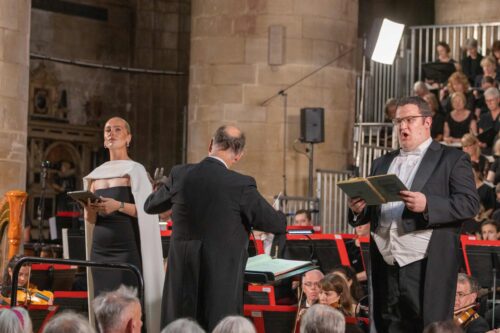
Three excellent soloists had been engaged. They all sang from the traditional place next to the conductor’s rostrum. Very often in performance, whether live or on disc, one feels that the roles of the Priest and the Angel of the Agony aren’t ideally suited to the same singer. Thankfully, David Ireland proved to be an exception. He sang ‘Proficiscere’ in a splendidly patrician fashion; fired by his example, the whole of the concluding episode in Part I became an earnest prayer of farewell and committal. In Part II he was commanding as the Angel of the Agony. But he went beyond command, compassionately interceding for Gerontius and all other souls in Purgatory. In this episode, the key test for me is how the singer delivers those wonderful phrases beginning at ‘Hasten, Lord, their hour’. Ireland was marvellous here. I greatly enjoyed his contribution.
I had not previously encountered Niamh O’Sullivan and I believe that she was making her role debut. Perhaps that is why there were a few occasions when I sensed that she got slightly out of synch with the conductor. Also, it seemed to me that she rushed her fences a little in ‘Praise to His Name’, which was a pity. Thankfully, Partington’s experience ensured that such blips were momentary. That said, O’Sullivan gave a moving account of the role of the Angel. In her very first solo (‘My work is done’), the Angel sings ‘Alleluia’ on three occasions; each time she sang these on a thread of sound and the effect was wonderful. She entered into a genuine dialogue with Gerontius and I found the sound of her voice per se and her expressiveness very affecting; she communicated with the audience, just as she did with Gerontius. Perhaps ‘A presage falls upon thee’ was not voiced with the same degree of lyrical compassion that one associates with the greatest exponents of this role, but that will come with time. On the other hand, her warning to Gerontius (‘There was a mortal’) was very well delivered. At the very end, her singing of the Farewell was poised, serene and reassuring. This was an auspicious role debut and I would like to hear her sing it again.
I have heard John Findon as Gerontius before. He sang the role on a 2024 live recording conducted by Nicholas Collon (review here). Then, I wasn’t fully convinced; I admired many elements of his performance but said that overall, I found his interpretation a bit generalised. Perhaps I made insufficient allowance for the fact that he was a late replacement for an indisposed colleague; having made a deliberate decision not to listen to that recording in the run-up to this performance, I must now return to it to see if I feel the same way, because I now had no reservations whatsoever about his performance; Findon was outstanding. He began impressively, suggesting the frailty and fear of the dying Gerontius. Immediately, it was obvious that his singing would be clear-toned, exceptionally well projected and characterised by admirable diction. As Part I unfolded, I came to admire more and more the ring in his voice and I also noted that, like the other performers, he was absolutely scrupulous in his observance of Elgar’s markings. ‘Sanctus fortis’ was superb. In the opening section of this demanding aria – for that is what it is – he sang with ringing ardour; ‘To the God of earth and heaven’ was thrilling. Later, Findon was audibly gripped by fear and at ‘I can no more’ he sounded mentally and physically drained. His anguish at ‘O Jesu, help!’ was palpable and then his performance reached a literal pinnacle with a top B-flat on ‘In thine own agony’ which, while marvellously sung, also sounded as if the cry had been wrenched from him. By contrast, he floated ‘Novissima hora est’ exquisitely. In Part II the tenor is required to sing in a completely different fashion. I thought that Findon exhibited great sensitivity here; his part in the dialogue with the Angel was sung most imaginatively. As apprehension grew into fear, he and Partington ensured that ‘I go before my judge’ was properly a moment of awe. He saved his best for ‘Take me away’. I thought the opening phrase, starting on a top A and taken in one glorious breath, was going to last for ever, so well did Findon sustain it; he mixed anguish and ecstasy in one thrilling span. He then sang the rest of the solo with great conviction and eloquence; it was very moving to hear. Overall, this was an exceptional performance of the title role.
Knitting all these elements together was Adrian Partington. I felt that all the performers thrived under his leadership. I had a clear view of him conducting the performance and to say that he galvanised everyone would be to risk understatement. He ensured that all the key passages – ‘Praise to the Holiest’, for example – made their mark, but time and again I spotted him making a gesture to ensure that a point of detail registered. This was the work of a conductor who knows the score inside out, understands the Elgar idiom perfectly, and knows exactly what he wants and how to get it. Elgar’s masterpiece was in the safest of hands tonight. My only regret was that there was an interval after Part I. I am sure there were practical reasons for this – though I don’t recall that an interval was taken in 2013. However, that’s a counsel of perfection and an interval didn’t spoil a memorable performance in any way.
This superb Gerontius set the seal on what has been an outstandingly successful Festival. The programme was as attractive as any that I can remember and in consequence, all the events I have attended – and many others, I understand – have attracted large audiences: a case, surely of ‘build it and they will come’. The artistic standard has been very high indeed and, as I have recorded in several of my reviews, the new arrangement whereby the orchestra is positioned at floor level (with the woodwind and brass slightly elevated on risers) has been an overwhelming success. The seating plan allows the orchestra more space, which I am sure they have welcomed, and the balance between orchestra and chorus has been excellent. I do hope this arrangement is here to stay at all three cathedrals: it’s a winner. True, the seating plan caused some issues when it came to the positioning of the vocal soloists, but I am sure there are ways round this.
There has been one unfortunate feature of the Festival, though. I have been attending Three Choirs events for well over thirty years and it used to be the case that the audience were far better behaved than in most other concert venues. Sadly, (post-pandemic?) that’s no longer the case. This year, the concerts that I have attended have been almost invariably disrupted by coughing and other extraneous noises, most of them generated by the audience. The first and last nights were especially bad in this respect. At the opening concert the hushed end of the first movement of Elgar’s First was marred by an explosive sneeze. Tonight, perhaps even more damagingly, just as the last chord of Part I of Gerontius was slowly subsiding, someone dropped a heavy object causing a great crash from the left off-stage; the atmosphere which the musicians had worked so hard to create was shattered. Such careless behaviour is deeply disrespectful to the performers, to the rest of the audience, and to the music.
But it would be wrong to end on a negative note. The festival has been memorable and it has been readily apparent, just from observing my fellow audience-members that it has been greatly enjoyed. The Festival Chorus and Philharmonia Orchestra have been consistently excellent; mostly, the soloists I have heard have been very good – and in several cases, better than that; and the new Nicholson organ has made exactly the sort of impact that was hoped. While I have enjoyed all the concerts I attended, some have truly stood out. These were (in chronological order); Elgar’s First Symphony and Walton’s Belshazzar’s Feast (review here); Rachmaninov’s All-Night Vigil (review here); the recital by Thomas Ospital (review here); the traversal of Winterreise by Mark Padmore and Christopher Glynn (review here); and, of course, tonight’s concert.
The 2027 Three Choirs Festival, to be held at Worcester, promises much, including Britten’s War Requiem, Beethoven’s Missa Solemnis, the Vaughan Williams Sea Symphony and premieres of works by Dobrinka Tabakova and Associate Composer, Gavin Higgins. In addition, the identity of the next Associate Composer has just been announced: Grace-Evangeline Mason will start her three-year term next year. Full details will be announced in March 2027, and you can get the advance information here.
John Quinn
Featured Image: Mezzo-soprano Niamh O’Sullivan, Three Choirs Festival Chorus, Philharmonia Orchestra and conductor Adrian Partington © TCF/James O’Driscoll