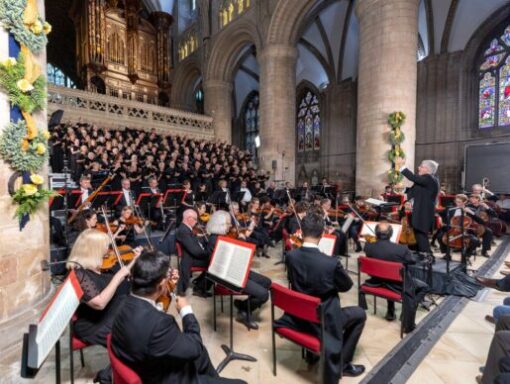
 United Kingdom Three Choirs Festival 2026 [11] – Mozart: Zsolt-Tihamér Visontay (director/violin), Scott Dickinson (viola), Aoife Miskelly (soprano), Annabella-Vesela Ellis (mezzo-soprano), Gwilym Bowen (tenor), Alex Jones (bass), Three Choirs Festival Chorus, Philharmonia Orchestra / Andrew Reid (conductor). Gloucester Cathedral, 31.7.2026. (JQ)
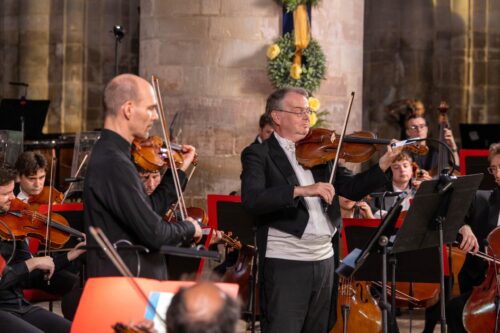
Mozart – Sinfonia Concertante for Violin, Viola and Orchestra, K 364; Requiem K 626
In the first half of this concert a slimmed-down Philharmonia accompanied two of their principal colleagues, leader Zsolt-Tihamér Visontay and principal violist Scott Dickinson in Mozart’s Sinfonia Concertante. Vistonay also directed the performance. I had expected that he might give a beat from time to time with his bow, or else indicate some entries but I detected none of that. Instead, he and Dickinson played in some of the tutti passages and Vistonay occasionally gave a glance in the direction of his orchestral colleagues. Clearly, all the necessary work had been done in rehearsal and Vistonay – very rightly – trusted his fellow musicians to deliver on the night. This they duly did; the performance was immaculate. Throughout the performance, the orchestra was collectively attentive to dynamics – particularly in the slow movement – while entries were crisp and clear.
In the first movement, Allegro maestoso, the tempo was ideally chosen; we heard an urbane performance which had just the right degree of vitality. Both soloists were elegant and stylish and it was most interesting to watch them work together. Perhaps it is only when you see a performance of this work that you fully realise that Mozart gave the violist equal prominence with the violin. Vistonay and Dickinson were true partners in this endeavour, not least in the cadenza, where they displayed not just technical prowess but also wit. The second movement, Andante, received a sophisticated performance. I was delighted to note the delicacy with which the members of the Philharmonia accompanied their two colleagues. The cadenza was, arguably, the highlight of the entire performance; it was as if we were eavesdropping on a conversation between two old friends. The finale is an ebullient Presto; here, it was given a spirited performance. I got the distinct impression that all the musicians enjoyed this performance; the audience certainly did.
After the interval we turned to Mozart in a much more serious vein with a performance of his Requiem. Mozart left the score unfinished and tonight we heard it in the familiar completion by his pupil Franz Xaver Süssmayr. This was the Three Choirs Festival concert debut of Andrew Reid, the new Director of Music at Hereford Cathedral.
A good team of soloists had been assembled. They were positioned centrally, behind the orchestra and in front of the choir, and their voices carried to where I was seated in mid-nave without difficulty. All four made excellent contributions, both individually and collectively; I especially admired the ringing voice of tenor Gwilym Bowen. I am afraid, though, that some of the quartet passages were taken at speeds which, I felt, were a little too brisk and which allowed the soloists insufficient space in which to do full justice to their music. This was noticeable in the Recordare and again in the Benedictus. The soloists did well but I think they would have achieved even more if Reid had just given them a bit more time and space in which to phrase.
The choral side of the performance got off to a good start with strong, impressive singing from the Festival Chorus in the Introit and Kyrie. This is a group of accomplished and experienced singers; I wonder how many performances the member of the choir have notched up between them; several hundred, I strongly suspect. That experience showed tonight; there was unanimity and purpose in the singing. Passages like the start of the Dies Irae and the opening of the Sanctus had all the weight and sonority one could desire and in fugal passages, such as the Kyrie and ‘Quam olim Abrahae promisiti’, I could hear all four parts distinctly. Unfortunately, as the performance unfolded, I began to have increasing concerns about the dynamics. I have sung in this work many times and from my knowledge of the music I was surprised that we didn’t experience more in the way of soft singing tonight. If I am honest, I don’t think we heard a dynamic below mezzo piano at any stage in the performance. I have heard the Festival Chorus enough during the course of this week to know that they can sing quietly when required so I can only presume that they were encouraged to sing out by the conductor. Perhaps the idea was to present what I might term ‘big’ Mozart in the large acoustic of Gloucester Cathedral. I greatly admired the full-toned choral singing in the places where that was specified but I soon came to find the lack of genuine dynamic contrast rather wearying. I should say, though, that apart from the couple of instances noted above, I thought Reid paced the music very well. The performance was well received by the audience but I would have welcomed greater light and shade.
John Quinn
Featured Image: Andrew Reid conducts the Mozart Requiem at the Three Choirs Festival © TCF/Dale Hodgetts