
 United States ‘BalletNOW, Superstars of Paris’: Dancers of Paris Opera Ballet, Elena Bonnay (piano), Julie Sévilla-Fraysse (cello). Walt Disney Concert Hall, Los Angeles, 1.8.2026. (JRo)
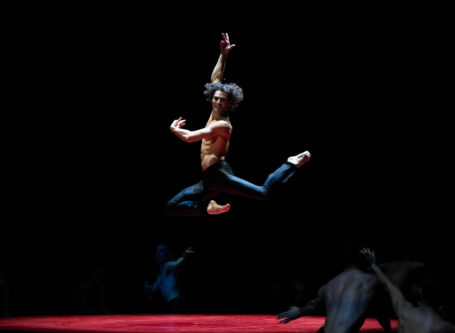
Dancers: Hugo Marchand, Germain Louvet, Dorothée Gilbert, Marc Moreau, Hannah O’Neill, Léonore Baulac, Antonio Conforti, Letizia Galloni
Lighting – Shutter Cut Lighting
A handpicked group of Paris Opera Ballet dancers (six principals and two soloists) was presented at Disney Hall in a program entitled ‘Superstars of Paris’. Hugo Marchand, the striking and charismatic étoile chose the dancers, the programming and the setting. After performing in unusual spaces such as chateaux, vineyards and gardens, he was drawn to the beauty of Disney Hall with its inviting interior. A dance floor was laid over the stage and a piano positioned at the back.
Marchand gave audiences an assortment of ten highly entertaining selections that showed off his stars and their gifts. The dancers exemplified the French school as practiced by the august Paris Opera Ballet – their dancing featuring an elegant carriage of the upper body, clean lines and precise footwork. They were also adept at projecting the drama inherent in choreographers such as Roland Petit and Angelin Preljocaj. From the classical purity of the opening pas de deux by Paris Opera Ballet director José Martinez to the dance drama of Petit to the modernism of Carolyn Carson, the dancers were unvarying in their commitment to the choreographers’ visions.
The Delibes Suite by Martinez (with recorded music drawn from Delibes’s La Source and Coppélia) was a glittering catalogue of classical steps, danced by Letizia Galloni and Antonio Conforti. Michel Fokine’s The Dying Swan was performed by the astonishing Dorothée Gilbert whose interpretation was pure poetry, accompanied by pianist Elena Bonnay and cellist Julie Sévilla-Fraysse. Marchand’s solo, À corps ouvert (choreography by Jean-Guillaume Bart), danced to Bach, Rachmaninoff and Fauré and performed by Bonnay and Sévilla-Fraysse, followed. The piece in three distinct parts demands shifts of mood and presentation from melancholy to ebullient. The ‘hero’ in despair during the Bach, seemed to regain his purpose, coming to life with the music of Rachmaninoff’s Prelude in G minor. Suggestions of Spanish and Russian dance flavor the section, and Marchand’s impeccable technique and intense physicality were on display. With the final Fauré music, the poetic ‘hero’ lapsed back to his brooding state.
The opportunity to see Roland Petit’s work, rarely danced in the United States with the exception of American Ballet Theatre, was welcome. Pas de deux from Carmen and Le Rendez-Vous were performed. Carmen, danced by Hannah O’Neill and Conforti, channeled the legendary performance of Roland Petit and his wife, Zizi Jeanmaire. Wearing the original costume design of black bustier and a wig of short black hair identical to Jeanmaire’s own cut and color, O’Neill embodied the sensual and fierce heroine. Conforti, whether prancing like a toreador or under Carmen’s spell, was compelling. Petit’s choreography mixes neo-classical style with theatricality, which creates abrupt and startling transitions from classical technique to raw and almost acrobatic movement. There were heightened dramatic moments in Carmen when I felt as if I was watching Olympic figure skating pairs. Like Carmen, his Le Rendez-Vous, choreographed in 1945 with a haunting (recorded) score by Joseph Kosma and libretto by Jacques Prévert, was a dramatic tour-de-force. Taken out of the context of the one-act ballet, the pas de deux was harder to grasp but wildly entertaining. Gilbert as the femme fatale and Marc Moreau, her ill-fated prey, were spellbinding. She pushed his shoulder, sending him spinning; then coddled his head, allowing a kiss only to coldly toss him aside. As Moreau partnered her, Gilbert’s legs alternately extended and bent, like the movements of a spider mesmerizing its prey. The complete ballet, created in 1945 after World War II, reflected the existential mood of postwar Paris. The story presents the femme fatale as the personification of death, so when Gilbert enacted the slashing of Moreau’s throat with a switch blade, which suddenly appeared, the LA audience gasped in surprise.
The most unique performance was Gilbert and Marchand in Angelin Preljocaj’s pas de deux from Le Parc to the recorded Adagio from Mozart’s Piano Concerto No.23. The ballet is set somewhere in the 17th or 18th centuries, and the pas de deux features lovers who, escaping the rigid rules of courtship, abandon themselves to a night of passion. Costumed in a short ruffled white silk nightshirt, her hair wild about her face, Gilbert rushed headlong into the role of the woman awakening to love. Together, Marchand and Gilbert folded and melted into each other with an overarching tenderness. He lifted her high overhead then released her, catching her in his arms. Her abandonment to passion and trust in her partner was palpable. The choreography illustrated sensual abandon without resorting to cliché or overt mannerisms. In a famous sequence – an extended flying kiss – Gilbert wrapped her arms around Marchand’s neck and, while she held her lips against his, he spun in place causing her outstretched legs to rise higher and higher in the air until they were parallel to the floor.
Balanchine’s Sonatine to Ravel’s Sonatine for Piano was beautifully rendered by Bonnay and performed by Germain Louvet and Léonore Baulac. Baulac danced the twelve-minute piece like the consummate Balanchine ballerina – line, footwork, economy of movement and sprightly grace were all in accord with his choreography. Louvet was the perfect cavalier and theirs was an elegant partnership. Created in 1975 with French dancers Violette Verdy and Jean-Pierre Bonnefoux, the ballet is an appropriate vehicle for Paris Opera Ballet dancers and, in particular, the finesse of Baulac and Louvet.
Other excerpts in the program included L’Esprit du Bleu from Signes, a modernist work by American Carolyn Carson, a former student of the avant-garde choreographer Alwin Nikolais, who has spent the bulk of her career in Europe. Trois Gnossiennes, tenderly played by Bonnay with choreography by Hans van Manen, was danced by the luminous Baulac and Marchand. The ballet featured surprising juxtapositions of classical lines with geometric eccentricities like flexed feet and bent knees, emphasizing the architecture of bodies in space. Marchand’s dancing and physical power put me in mind of Balanchine’s 1928 ballet Apollo. Marchand’s presence lent an Apollonian cast to the piece as he lifted his muse or manipulated her legs into position. Like Balanchine, van Manen favors plotless ballets, letting the piece grow out of the music which is very much present in Trois Gnossiennes.
The program ended with a classical pas de deux performed by Moreau and Galloni and choreographed by Moreau, followed by a finale with the full company, set to music by Édouard Lalo. Dressed in white tutus and wearing crowns, the ballerinas were partnered by their cavaliers, also in brilliant white, leaving a glowing final impression of these consummate artists.
Jane Rosenberg
Delibes Suite
Choreography – José Martinez
Music – Delibes
Dancers – Letizia Galloni and Antonio Conforti
The Dying Swan
Choreography – Michel Fokine
Music – Saint-Saëns
Piano – Elena Bonnay
Cello – Julie Sévilla-Fraysse
Dancer – Dorothée Gilbert
À corps ouvert
Choreography – Jean-Guillaume Bart
Music – Bach, Rachmaninoff, Fauré
Piano – Bonnay
Cello – Sévilla-Fraysse
Dancer – Hugo Marchand
Carmen Pas de Deux
Choreography – Roland Petit
Music – Bizet
Dancers – Hannah O’Neill and Conforti
Le Parc Pas de Deux
Choreography – Angelin Preljocaj
Music – Mozart
Dancers – Gilbert and Marchand
Sonatine
Choreography – Georges Balanchine
Music – Ravel
Dancers – Germain Louvet and Léonore Baulac
Le Rendez-Vous Pas de Deux
Choreography – Roland Petit
Music – Joseph Kosma
Dancers – Gilbert and Marc Moreau
Trois Gnossiennes
Choreography – Hans van Manen
Music – Satie
Piano – Bonnay
Dancers – Baulac and Marchand
‘E’Esprit du bleu’ from Signes
Choreography – Carolyn Carson
Music – René Aubry
Dancers – O’Neill and Louvet
Adage en blanc
Choreography – Marc Moreau
Music – Édouard LaloPiano – Bonnay
Cello – Sévilla-Fraysse
Dancers – Moreau and Galloni
Finale with full company