 United Kingdom BBC Proms 2026 [20] – Britten, Mozart, Musgraves, Elgar: Felix Klieser (horn), Amy Harman (bassoon), Academy of St Martin in the Fields / Benjamin Marquise Gilmore (leader). Royal Albert Hall, London, 23.8.2026. (LJ)
Britten – Simple Symphony, Op.4 (1934)
Mozart – Horn Concerto No.3 in E-flat major, K.447 (1787) and Symphony No.35 (‘Haffner’) in D major, K.385 (1782)
Thea Musgraves – Bassoon Concerto Out of the Darkness (2026, BBC commission and world premiere)
Elgar – Romance for bassoon and orchestra in D minor, Op.62 (1909-10)
An intriguing logic belonged to the Academy of St Martin in the Fields’s (ASMF) late-morning BBC Proms. It asked what a singular instrumental voice can evoke within an orchestra. In the first half, Felix Klieser played the French horn for Mozart’s Horn Concerto No.3 in E-flat major (1787) and, after the interval, bassoonist Amy Harman made her Proms debut with the world premiere of Thea Musgrave’s Out of the Darkness (2026) and Elgar’s Romance for bassoon and orchestra in D minor (1909-10). Of the two halves and the two instruments during this concert, the bassoon was the much more interesting instrumental voice. This can be simply attributed to Harman, whose performance was majestic. Indeed, I remember hearing Harman perform with the Kaleidoscope Chamber Collective at the Wigmore Hall fondly, which I reviewed last March (click here).
Indeed, this was a concert of two halves in more ways than one. During the first half, which began with the ASMF performing Britten’s Simple Symphony (1934), the music did not hold together as well as it did in the second half. Dynamics and tempo were not what they needed to be for this piece, which seemed more of a nerve-settler than an opening gambit. Even though Britten composed this piece by cobbling together ‘some quite nice little tunes’ that were ‘sitting in a cupboard’, the orchestration signposts Britten’s controlled orchestral writing and, as such, the Simple Symphony needs to be performed with corresponding focus. Whilst the Playful Pizzicato second movement raised a smile amongst the audience and the third movement (Sentimental Saraband) was full of lyricism and lilt, the first and fourth movements sounded uneven in both dynamics and tempo.
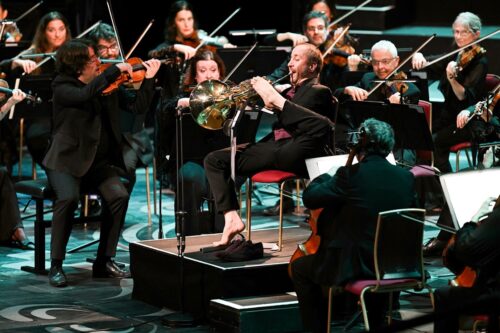
This was followed by Klieser’s performance of Mozart’s Horn Concerto No.3. Though skilled – he performs his horn using the toes of his left foot to operate the valves – Klieser’s performance lacked the diction to lift the piece. There also seemed to be limited dialogue between Klieser and the ASMF which made some sections lack the conversationality and buoyancy synonymous with Mozart. The work consists of challenging scales and chromatic passages that require controlled augmentation of notes. Klieser successfully managed to create this more muted tone by altering the airflow from his mouth. Overall, however, the performance was not as memorable as the second half of this concert.
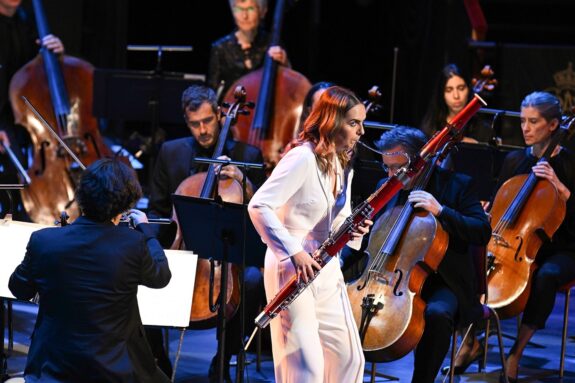
After the interval, lights came up on Amy Harman wearing a brilliant white outfit (with silver shoes) and standing, not front and centre, but at the back of the orchestra, behind the percussion. This was the beginning of Thea Musgrave’s Bassoon Concerto Out of the Darkness, which was composed for Harman. In the programme notes, Musgrave describes the piece as ‘a dramatic presentation in which the soloist moves around the orchestra’ and supplies a diagram of Harman’s movement from the percussion section to the trumpets, double basses, downstage left, and, finally, downstage centre. Harman began in an ominous mood accompanied by percussion and bass clarinet with only the first violin offering contrasting lightness. As the music, and Harman herself, moved from one station to the next, different sections of the orchestra were brought into dialogue with the bassoon, including strings, marimba, timpani, and brass. The bassoon never emerges into the light (that would be far too glib), but it does confront darkness in a way that points in the direction of hope rather than despair. Harman’s virtuosic command of the bassoon will make her one of the instrument’s flagbearers. Her subtlety and range in both the higher and lower registers, dynamic flexibility, and breath control were astonishing throughout.
Whilst Musgrave pushed the boundaries of the bassoon, Elgar’s Romance for the instrument gave Harman an opportunity to evidence its high tenor and deep bass registers. Here, the ASMF accompanied Harman beautifully. Their support elevated the bassoon without opposing Harman’s line. Qualities of restraint emerged from both soloist and orchestra, making this short piece (it generally lasts only 5 minutes) the stand-out performance of the recital.
For the final performance, the ASMF played Mozart’s Haffner Symphony, written in 1782 for the Haffner family in Salzburg. The piece would be familiar to Proms afficionados with it being the third most-played Mozart Symphony at the festival (of course, first and second place go to Symphony No.40 in G minor and the Jupiter Symphony). The Haffner requires elegance, propulsion, clarity. Whilst the ASMF sounded radiant in places, they would have benefited from stronger direction and less hesitancy on the timpani. Leader, Benjamin Marquise Gilmore, was animated throughout, but perhaps more purposeful motions would have given yet more precise direction to each section of the orchestra when needed. If readers were to remind themselves of Bernard Haitink conducting this piece with the Royal Concertgebouw Orchestra in March 2009, the difference in focus and intent would become event.
Ultimately, the concert prompted the audience to consider what happens when a musical voice demands our attention by stepping out of the darkness. This question was asked by Klieser in his performance of Mozart’s Horn Concerto and answered by Harman in her performances of Musgrave’s Out of the Darkness and Elgar’s Romance. For interested readers, this Prom is now available to watch on BBC iPlayer.
Lucy Jeffery
Featured Image: Amy Harman (bassoon) with the Academy of St Martin in the Fields © BBC/Chris Christodoulou