 United States Blossom Music Festival [7] – Various: Nelson Goerner (piano), Cleveland Orchestra Youth Chorus (chorus director: Daniel J. Singer), The Cleveland Orchestra / Antonello Manacorda (conductor). Blossom Music Center, Cuyahoga Falls, 22.8.2026. (MSJ)
Debussy – Prélude à l’après-midi d’un faune; Nocturnes
Ravel – Piano Concerto in G major; Ma mère l’Oye
Encore: Chopin – Nocturne No.20 in C-sharp minor, Op.posth.
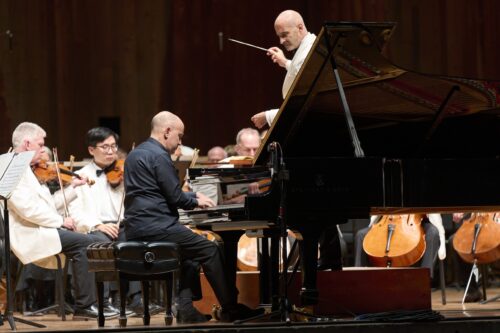
Stormy weather tore through northeast Ohio in advance of this concert, but the audience members who defied the elements and crowded into the Blossom Pavilion were rewarded with a mostly fine concert that featured the return of acclaimed guest conductor Antonello Manacorda, and the Cleveland Orchestra debut of a prominent pianist who had somehow missed us before now. If Nelson Goerner’s performance of Ravel’s Piano Concerto in G is anything to judge by, we certainly hope it won’t be his last visit. The piece is a popular one, and we have heard some great performances of it here over the years, including memorable versions by Hélène Grimaud and Tom Borrow. But Goerner’s was equal to the best of them.
The Argentine pianist offered plenty of scintillating brilliance in the playfully virtuosic passages of the work, but the performance was characterized by the poetry of the quiet moments, where Goerner – ably abetted by conductor Manacorda – captured a sense of spellbound magic that drew the listener inward. The balance between sizzling and floating moments in the first movement was ideal, capturing both aspects of the work without ever losing momentum. The slow movement was poised, with Goerner at one point seeming to dovetail his dynamics and hold up slightly on a cadence to let a soft roll of distant thunder register. The toccata finale flew briskly, with Goerner giving shape to Ravel’s cascades of notes, making it sound not just bright but coherent. He spun out the spellbinding music-making with an encore of a Chopin Nocturne.
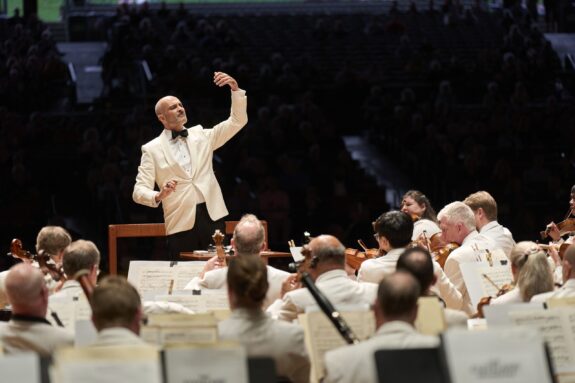
Manacorda captured two of the three orchestral works on the program ideally. The opening performance of Debussy’s Prélude à l’après-midi d’un faune quickly established Manacorda’s way with so-called ‘Impressionist’ music (a term that both Debussy and Ravel detested). Instead of Impressionist fog, Manacorda was reminiscent of Boulez in his precision of bright, sorted textures but with a coherent shaping of phrases that was anything but Boulezian. He allowed ample space for the work’s many solos, led by principal flutist Joshua Smith. It was a little startling when one was looking at Smith on the pavilion’s screens and the cameras cut back to Manacorda – at first glance it looked like the same person was in both roles. The two men could almost be taken for twins separated at birth. At any rate, their wonder powers activated an exquisite performance that captured a sense of wonder without ever drifting aimlessly. The piece is by no means a concert rarity but this performance eclipsed others.
Equally masterful was a radiant performance of Ravel’s Mother Goose Suite which felt both technically polished and narratively shaped. Manacorda created moments that allowed solo players to shine, including principals Afendi Yusuf on clarinet, Frank Rosenwein on oboe and first associate concertmaster Elizabeth Fayette on violin. Particularly delightful was a memorably gnarled contrabassoon solo – the beast in the ‘Beauty and the Beast’ section – from Jonathan Sherwin who is retiring at the end of the Blossom season after a long and distinguished tenure.
Two details are worth mentioning to highlight Manacorda’s work at its finest. First, many conductors get antsy with Ravel’s succession of mostly slow movements, and they take off briskly in the third movement, ‘Laideronette, Princess of the Pagodas’, because it has a scherzo-like liveliness. But Manacorda rightly had a long view of the piece. He paced that third movement fast enough to evoke a sense of whimsy but at a moderate enough pace that allowed the solemn middle section to create a spell wondrously overlain by the return of the opening figurations at the end. The second detail was Manacorda’s careful building of the climax which closes the suite. Most performances capture the loveliness of the string-laden sonority Ravel used to evoke the enchanted garden of the title, but it is surprising how often careless performances arrive at the percussion-speckled closing without making a transition. Manacorda made sure that the sound of the symbols welled up from beneath the strings, opening the door, as it were, to the other percussion instruments.
Oddly, the performance of Debussy’s three Nocturnes was not on the same level. Here, perhaps, Manacorda’s taste for clarity led him to take very measured tempos for the outer Nocturnes, often beating every eighth note with his baton to keep all the players aligned. Does this have something to do with Manacorda’s stated Germanic repertory focus? Slower tempos in these outer Nocturnes have been more of a non-French phenomenon over the years, whereas famous recordings by the likes of Ernest Ansermet, Jean Martinon and Pierre Monteux tend to emphasize a flowing pace, to the music’s benefit. For the middle one, Manacorda attempted to establish an exciting pace, but the orchestra was determined to articulate every passage in their characteristic manner and tugged the tempo back down to a more standard speed. Again, in the visionary procession in the middle of the movement, Manacorda set a faster pace and the orchestra resisted. The movement still reached a satisfying, resounding climax, sounding marvelously throughout the Blossom Pavilion, so the minor tug-of-war wasn’t a major issue though it was noticeable.
The least effective element of the performance was the substitution of the Cleveland Orchestra Youth Chorus for Debussy’s stated women’s chorus. Don’t get me wrong, the youths sang gorgeously, having been meticulously prepared by director Daniel J. Singer, but the silvery sound of young voices is a very different timbre from the golden voices of adult singers. And, more distressingly, the entire movement was titled ‘Sirènes’ by the composer: it’s an evocation of the old mythological tale of sirens luring sailors at sea with their sensual, sexy voices. To substitute youth voices for adult female voices in this context is wrong-headed at best. Between the inappropriateness of the timbre and the concept, it was a jarring choice, made worse by being amplified to a state of too much presence by the microphones toward the back of the orchestra which took away any chance of the composer’s desired elusiveness. All of these elements made the performance of the Nocturnes a non-starter, the first flat-out misstep we have heard from Manacorda. He has proven to be one of the outstanding guest conductors in Cleveland in recent years, and he remained so for three-fourths of the concert.
Mark Sebastian Jordan
Featured Image: Antonello Manacorda conducts The Cleveland Orchestra © Roger Mastroianni/TCO