 United States Aspen Music Festival [9]: Harris Concert Hall, Klein Music Tent, Aspen. (HS)
17.8.2026, Recital: Percussion Ensemble / Jonathan Haas (conductor). Harris Concert Hall
Takuo Kochi – Movement I from Nirai Kanai Folk Suite for Percussion Ensemble
Stewart Copeland/Jonathan Haas & Sean Statser –Gamelan D’Drum
Gamelan, the Indonesian musical form that mixes melodic percussion with drums and community, has inspired some great Western music. Jonathan Haas, who heads the percussion department at the Aspen Music Festival and School, referred to Debussy’s Pagodes and pieces by the American maverick composer Lou Harrison as examples. For sheer excitement, Gamelan D’Drum by Stewart Copeland tops them all and, before Monday, it was heard live only once.
It deserves more exposure. Haas and Sean Statser, his colleague at New York University, updated Copeland’s score for a 2011 performance by the Dallas Symphony and percussionists in Texas’s D’Drum, the group that created a set of gamelan instruments tuned for Western music. Copeland, drummer for the rock band The Police and an accomplished composer for film and orchestra, blessed the new version which replaces the orchestra with a percussion ensemble rife with marimbas and other melodic mallet instruments.
There is a much longer story behind the piece, but to focus on this performance let us just say if you haven’t heard the gloriously beautiful sound a roomful of marimbas can produce you are missing one of music’s true thrills. The immensely talented group of young percussionists – five of them choreographed to handle all the gamelan instruments and another dozen or so replacing the orchestra – wove delicate beauty with urgent rhythms and astonishing virtuosity into an intoxicating 35 minutes.
A movement from Japanese composer Takuo Kochi’s Nirai Kanai Folk Suite served as a sort of amuse-bouche to demonstrate how the essential instruments in a gamelan can play nicely with Western instruments. Then the main piece took it to greater lengths. Another performance is scheduled for December in New York.
18.8.2026, Recital: Edgar Meyer (double bass), Amy Yang (piano). Harris Concert Hall
Haydn/Ruyssen/Piatigorsky (ed. Edgar Meyer) – Divertimento in D major (after Baryton Trios)
Bottesini – Romanza patética; Fantasia Cerrito
Edgar Meyer – ‘Pickles’, ‘Great Green Sea Snake’, ‘Canon’, ‘Untitled’, Movements from unfinished piece for double bass and piano
Arty McGlynn (arr. Meyer) – Six Jigs
The incomparable double bass virtuoso Edgar Meyer has collaborated in Aspen with jazz bassist Christian McBride, fellow Appalachian musicians Béla Fleck and Chris Thile, the late tabla master Zakir Hussain and, most recently, trios with violinist Tessa Lark and cellist Joshua Roman. Meyer’s recital this time introduced the accomplished pianist Amy Yang. The pairing was, as hoped, magical. The program progressed from classical pieces for bass and piano to jazz- and bluegrass-influenced Meyer originals, finishing with a medley of six Irish jigs. All of it displayed a command of an unwieldy instrument to yield moments of delicacy and outbursts of virtuosity.
Meyer hasn’t played a recital here with piano in 20 years, and he got busy adapting music by Haydn by way of Piatigorsky (a cellist), Bottesini (a renowned 19th-century bassist) and his own setting of Irish jigs dating from a 1990s visit to Ireland. The latter was a ‘template’ for a third movement shaping up as a finale for a sonata he started in 2007 for bass and piano. Even in its unfinished state, it was a whiz to hear.
The classical pieces, restrained but beautifully played, opened the program. The originals emerged with greater flair. Yang got into the groove, adding her own sensitive touch to Meyer’s ‘Canon’ (a piece written to play with Fleck and Hussain) and another untitled solo that developed into a cheeky duet.
20.8, Recital: Marc-André Hamelin (piano). Harris Concert Hall
Weinberg – Piano Sonata No.5
Chopin – Piano Sonata No.2 in B-flat minor
Enescu – Carillon nocturne from Pièces impromptues
Debussy – Images, 2e série
Gershwin/Wild – Seven Virtuoso Etudes (based on Gershwin songs)
Encore: Chopin/Liszt – ‘My Joys’ from Six Polish Songs
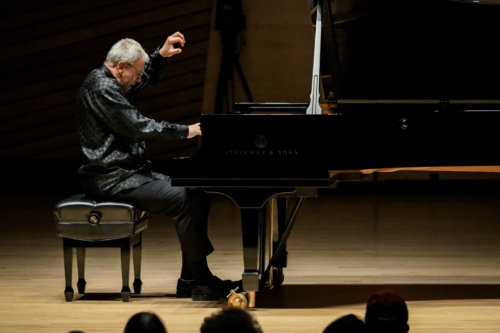
For a pianist whose technique dazzles and whose instincts so often pay dividends in deftness and elegance, the first half of Hamelin’s recital on Thursday felt almost like an assault. Weinberg’s Piano Sonata began with a crash-bang and only occasionally let up, and Chopin’s Sonata No.2 (the one with the famous funeral march) was louder, even in the funeral march.
The second half, fortunately, revealed the finesse in his hands, starting with Enescu’s charming distant chiming in the Carillon nocturne which led immediately into Debussy’s Images,2e série – three quiet mini-tone poems culminate with a sleek and subtle Poissons d’or. To finish the evening, he executed the complex challenges of Earl Wild’s ‘Seven Virtuoso Etudes based on Gershwin songs. The elaborate ‘takes’ by the mid-century pianist, known for his Gershwin solo piano work, wrap exotic flourishes around familiar songs such as ‘Oh, Lady Be Good’ and ‘Embraceable You’.
The encore focused on the lyricism of Liszt’s arrangement of ‘My Joys’ from Chopin’s Six Polish Songs, simplicity from the usually expansive Liszt.
21.8: Mozart, The Magic Flute (semi-staged): Soloists of Aspen Opera Theater and VocalARTS, Kantorei (chorus director: Joel M. Rinsema), Aspen Ensemble / Patrick Summers (conductor). Klein Music Tent
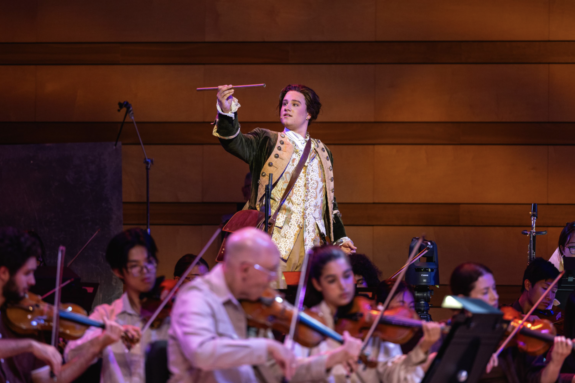
The Magic Flute was an unalloyed triumph. Everything worked in a production that made all the possible negatives of the 2100-seat music tent into pluses. Director Paula Suozzi (executive stage director at the Metropolitan Opera) turned the inherent limitations of putting singers and orchestra on the same stage into gold, with one smart twist after another. Patrick Summers conducted the regular Friday Chamber Symphony with vigor, deftness and balance and the all-student cast delivered Mozart’s timeless music with pizzazz. Hank Burns-Pavlik’s remarkably clear and unobtrusive audio design helped immensely too, the best use of amplification I have heard in the music tent, ever.
Replacing dialogue and recitative with a witty narration, delivered well by festival CEO Alan Fletcher, kept the momentum going from aria to ensemble throughout the 2½-hour running time. All the comedy aspects worked while the singers burrowed into the emotional core of the story. With neither the budget nor the stage machinery to mount a showy production, Suozzi had the props made out of cardboard, even the dragon monster in the opening scene. Tamino’s flute and Papageno’s magic bells were delivered by members of the orchestra who provided the actual music.
Both lyric soprano Chea Kang’s soulfully expressed Pamina and coloratura soprano Binny-Supin Lang’s crisply authoritative Queen of the Night delivered on their big arias. The same was true for lyric tenor Brett Michael Hunter as Tamino and Jacob O’Shea as a bumbling but lovable Papageno. The sopranos who made up the trios of Ladies who serve the Queen and Spirits who help guide Tamino made things flow nicely. The lower voices, among them Sarastro and his associates in the temple, were solid.
Production:
Director – Paula Suozzi
Costumes – Sharne’ van Ryneveld Nel
Lighting – Josh Hemmo
Original narration – Jonathan West
Cast:
Tamino – Brett Michael Hunter
Pamina – Chea Kang
Papageno – Jacon O’Shea
Queen of the Night – Binny-Supin Lang
Papagena – Antonia Cácere
First Lady – Clothilde Bénard
Second Lady – Alexandra Rose Hotz
Third Lady – Isabelle Kosempa
First Armored Man – Yulin Wang
Second Armored Man – S Joshua Sheppard
First Spirit – Tiara Thankam Abraham
Second Spirit – Nicole DiPasquale
Third Spirit – Dana Mays
Sarastro – George Jiayi Baolin
Monostatos – Nathan Romportl
Speaker – Jamie Felix-Tolls
Narrator – Alan Fletcher
22.8, Recital: Anton Nel (piano). Harris Concert Hall
Haydn – Piano Sonata in C major
Schubert – Drei Klavierstücke
Chaminade – Thème varié
Scriabin – Prelude No.13 in G-flat major
Shostakovich – Prelude No.10 in C-sharp minor
Prokofiev – Prelude No.7 in C major
Rachmaninoff – Prelude No.5 in G major
Chopin – Andante Spianato et Grande Polonaise Brillante
Encores: Sibelius – Romance No.9 in D-flat major; Handel – Air and Variations from Suite No.5; Beethoven – Bagatelle in B-flat major
On Saturday, three-decade faculty pianist Anton Nel delivered a stunning recital. Nel showed how he can execute anything elegantly when he needs to, but the focus remained on what the music wants to tell us. He billed it as a collection of his favorite pieces to play, but I noticed a hidden theme: music that reflected what makes these composers instantly recognizable but not pieces you might expect.
Preludes by Russian composers Scriabin, Shostakovich, Prokofiev and Rachmaninoff showed a heartfelt presence but none of their show-off tendencies. Haydn seldom shows up on a piano recital, but Nel caught the Sonata in C major’s rhythmic flair and humor to open the proceedings. Chaminade is not heard often today, but her Thème varié was a favorite of Nel’s mother and his tender rendering was charming.
Schubert’s Drei Klavierstücke may be familiar to piano fans, but Nel’s refinement and urgency made it special. Chopin’s Andante Spianato et Grande Polonaise Brillante managed to exemplify both the composer’s lyricism and virtuosic bluster, and Nel played it to a thrilling climax. His encores – a romance by Sibelius, an air and variations by Handel and a bagatelle by Beethoven – extended the unspoken theme.
23.8: Various: Key’mon Murrah (countertenor), Ana María Martínez (soprano), Kelley O’Connor (mezzo-soprano), Issachah Savage (tenor), Ryan McKinny (bass-baritone), Kantorei (chorus director: Joel M. Rinsema), Festival Orchestra / David Robertson and Ken Yanagisawa (conductors). Klein Music Tent
Verdi – Overture to La forza del destino
Bernstein – Chichester Psalms
Beethoven – Symphony No.9 in D minor
Sunday’s orchestral season finale lived up to its promise in a brilliantly executed program that neatly summarized the season’s theme, ‘For All’. It celebrated the 250th anniversary of the Declaration of Independence by focusing on American composers and those who came to the U.S. from elsewhere – or music from anywhere that expressed ideals associated with this country and its history. Beethoven’s Ninth Symphony with its ‘Ode to Joy’ and calls for freedom and brotherhood qualified. Preceding it on the program was Chichester Psalms, Leonard Bernstein’s settings of joyful Old Testament songs of praise, which also fit the description.
The program opened with Verdi’s Overture to La forza del destino (The Force of Destiny) – make of that what you will given today’s politics. Ken Yanagisawa, the festival’s assistant conductor, led with laudable precision if a bit short on urgency.
David Robertson, who conducted a notable Brahms Symphony No.2 on August 15, stepped in when music director Robert Spano left due to an illness in his family. Robertson’s energy reminded me of Leonard Bernstein at his most physically active, and he found the essence in Bernstein and Beethoven. The music oozed authenticity, great tempos and balances, leading to full-throated climaxes. The 7-beat and 5-beat movements in the Psalms danced refreshingly and, as the Beethoven unfolded, long phrases and sudden shifts gathered momentum.
Vocally, the Denver-based chorus Kantorei sang with elevated precision and resonance, and the soloists achieved the highest standard. Countertenor Key’mon Murrah, a gold shawl draped over his shoulder, voiced the 23rd Psalm with angelic beauty. The Beethoven benefited from the limpid soprano of Ana María Martínez, the rich mezzo-soprano of Kelley O’Connor, the power and warmth of tenor Issachah Savage and the commanding bass-baritone of Ryan McKinny. Although positioned at the back of the orchestra, every essential phrase from these voices was clear
When the familiar final minutes of the ‘Ode to Joy’ landed, the roar from the audience registered even louder. It was a superb way to end the season.
Harvey Steiman
Featured Image: Tenor Brett Michael Hunter as Tamino in Aspen’s semi-staged Magic Flute © Blake Nelson