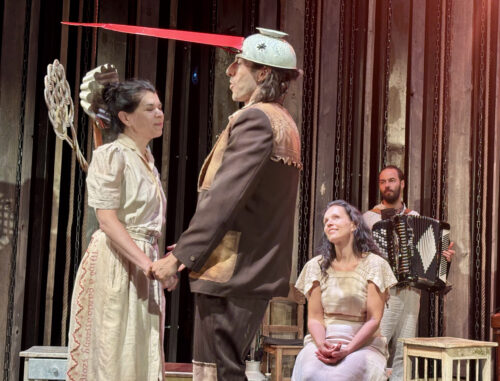
 Hungary Závada-Mohácsi: Egy piaci nap (One Day in the Market): Komáromi Jókai Színház, Városmajor Theatre, Budapest, 25.8.2026. (AK)
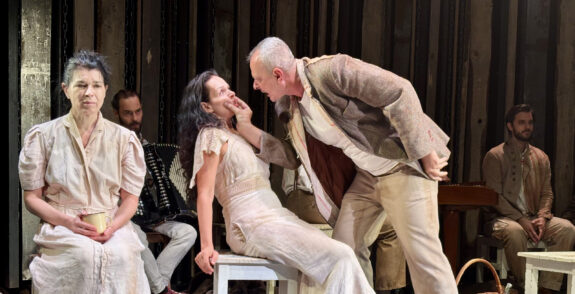
History in all dimensions weighed heavily on the excellent performance of Egy piaci nap (One Day in the Market).
Performed by the Komáromi Jókai Theatre of Komárno, one is reminded of the Trianon agreement of 1920 which resulted in Hungary losing more than two thirds of its territory to neighbouring countries (Austria, Slovakia, Romania, Yugoslavia).
The northern part of the town Komárom was allocated to Slovakia and renamed as Komárno, with the river Danube separating the two parts. However, a century later, Hungarian language and culture still live on in the Slovakian part, hence this Hungarian theatre company named after the 19th-century Hungarian writer Mór Jókai.
In its 74th season, the company now took on the Pál Závada, István Mohácsi and János Mohácsi Egy piaci nap (One Day in the Market) drama. In 2016, for his novel Egy piaci nap, author Závada used a real event from 1946 when, a year after the war ended, the population of a Hungarian village rebelled against the return of surviving Jews from Auschwitz and, in a hysterical pogrom, murdered them on a market day. In his novel, Závada includes this pogrom as well as the subsequent attempt to bring the perpetrators to justice.
Shortly after the publication, István Mohácsi adapted the novel for a theatre play and his brother, theatre director János Mohácsi, staged it for several performances at the Radnóti Theatre of Budapest between 2018 and 2022.
I am new to the production and several days after seeing it, the shock is still overwhelming.
Mohácsi presented the horror of the catastrophic event and its aftermath in what I can best describe as an opera for our time. Music is a significant part of the staging: klezmer-type music starts the play, the finale is a chorus by all and music contributes to many scenes all way through.
There is a great deal of polyphony with and without music. Two women friends (Mária and Irén) discuss their versions of past and present while the rest of the cast contribute to the presentation of the events. Thus, the two women act as a Greek chorus but they also act as participants of the story. Their own story and friendship are shaped not only by the events but, crucially, by their husbands’ standing on opposite sides of the tragic arguments. The two women are victims although on different levels from other victims in the drama.
Mohácsi’s presentation is gripping throughout. The play is long, two and half hours without any break: by having to focus from the beginning to the end, the audience becomes a part of past dark history. But is this only past history?
Participating actors are taking multiple parts from opposing sides of the horrific events. Is this a question of trying to keep the number of actors at a manageable size or is it a warning that we are all capable of turning according to our interests? And that, as our current time shows, previously oppressed people can turn into oppressors?
All actors speak with crystal-clear Hungarian while, presumably, they are all fluent in Slovakian too. For sure, at this performance, all actors represented excellence and performance unity.
Costumes, design and lighting are all in harmony with Mohácsi’s concept which is timeless and geographically neutral.
The music is integral and contributes to many of the scenes. All four instrumentalists are on the stage throughout, and many other actors also present musical sounds/rhythms by, for instance, knocking on the steel structure of the stage design and using gongs for sound effects. It is of note that not only do actors contribute to these sounds but the musicians also perform characters in the play. The final chorus, with participants singing non-verbal sounds, surely stand on the level of great operatic finales. The klezmer violin in the middle of the stage, bringing the performance to a close, was a marvel to behold.
Agnes Kory
Featured Image: Závoda-Mohácsi’s Egy piaci nap (One Day in the Market)
Production:
Director – János Mohácsi
Composer and Director of Music – Márton Kovács
Design – Zsolt Khell
Costumes – Kriszta Remete
Lighting – Sándor Baumgartner
Musicians:
Violin – Márton Kovács
Harmonica, Bagpipe – Ádám Móser
Clarinet, Bass clarinet – Ferenc Illés
Cymbalom – Márton Béhr (also playing three characters in the play)
Cast: Krisztina Holocsy, Viktor Szabó, Szilvia Kiss, István Olasz, Xénia Molnár, Katalin Holocsy, Tamás Bernáth, TiborSkronka, Attila Mokos, Tibor Fabó, Márton Béhr, Attila Matusek, Fanni Hostomský, Dániel Szebellai