
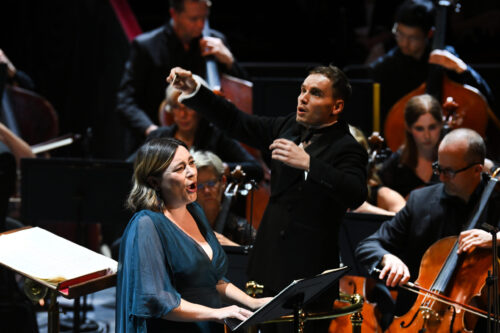
 United Kingdom BBC Proms 2026 [29] – Henze, Schubert, Mahler, and R. Strauss: Natalya Romaniw (soprano), BBC Scottish Symphony Orchestra / Paweł Kapuła (conductor). Royal Albert Hall, London, 9.9.2026. (MB)
Henze – Erlkönig: Orchestral Fantasy on Goethe’s Poem and Schubert’s Op.1
Schubert – Symphony No.8 in B minor, ‘Unfinished’, D.759
Mahler (arr. Britten): What the Wild Flowers Tell Me
Richard Strauss – Four Last Songs
September is a month of melancholy. Temperatures drop. Nights draw in ever more markedly. We return to work, studies, ‘normal life’, insofar as we have ever been away. The last gasp of the summer festival season draws to a close. For the BBC Proms, this comes ultimately with the notorious ‘Last Night’. Occasionally I have wondered about giving it a try, if only to say that I have, but adventure takes one only so far. This year, Four Last Songs, its own ‘September’ and all, seemed a good time to bow out: Malven notwithstanding, Richard Strauss’s farewell to the world, the Lied, the orchestra, and, in eerie familiarity once again, to a civilisation that had long since given up the ghost.
Here, we worked up to that final farewell, first of all with a composer for whom the murderous, genocidal taint of that civilisation, from which he could nonetheless never break free, would condemn it for many years to come: Hans Werner Henze. His centenary this year has been extraordinarily muted. The buzz of his Erlkönig was better than nothing, but frankly the Proms, like many other organisations, could and should have done more. From the BBC Scottish Symphony Orchestra and Paweł Kapuła, it made for an urgent, typically abundant, and ultimately involving concert opener, very much what it said on the ‘orchestral fantasy’ tin, Schubert recomposed by one who would like to be more Stravinskian than Schoenbergian, yet cannot help who he is — and at the last, does not even wish to. It drew one in with a hint of Romantic magic and devilry.
The concert moved to Schubert proper, in an unusually intimate, yet compelling account of the ‘Unfinished’ Symphony, emblematic of that German Romanticism to which Henze continued to be drawn. Its first movement was relatively swift, yet never unduly driven, urgency and chiaroscuro rightly emerging from the material, sonata form ‘becoming’ rather than merely ‘being’. The fearful hush of its liminal passages sent shivers down the spine, building thereafter in Gothic horror, albeit without exaggeration. The second movement flowed as a drama in itself that was both consequent to the first and mysteriously, ‘unfinished’ or not, a satisfying finale, even farewell, with nothing left to say. It invited us to listen and rewarded us for doing so.
The second movement from Mahler’s Third Symphony, rescored by Britten, was for me the only disappointment. It feels strange to hear this on a smaller orchestra, perhaps stranger than a more radical arrangement, but I do not think it was only that. Kapuła showed a tendency to fussiness, overtly moulding Mahler’s lines. Balances, especially earlier on, sounded odd, even on occasion inside out. Tempi never seemed quite in proportion, either a little too fast or a little too slow: not necessarily intrinsically, but in relation to one other. Later on, a welcome sense of irony tentatively asserted itself, but its motivation remained elusive.
And so, Natalya Romaniw joined orchestra and conductor for the Four Last Songs, in the hall in which they were premiered (in 1950, by Kirsten Flagstad, the Philharmonia, and Wilhelm Furtwängler). What struck me in the orchestral introduction to ‘Frühling’ was how much the sound took its cue from the Schubert performance in the first half, detail and urgency again to the fore, neither rushed nor maudlin. (None of this should be, of course, but certainly not an evocation of spring, however backward-looking.) Romaniw was crystal clear, verbally and musically, perhaps with a slight musical ‘accent’, bringing the music closer, say, to Tchaikovsky than to Mozart, but there is no one way with these songs, nor should there be. In a programme interview, she said she intended ‘to make the meaning as clear as possible to listeners, even if they don’t understand German,’ which she certainly accomplished, adding the unquestionable truth that ‘the orchestra’s music says so much as well,’ which again it did here. From soloist, orchestra, and conductor alike, there was a sense of beginning — even if the beginning of the end.
Our month, ‘September’, followed on ‘naturally’, however much art may conceal art here (an echt-Straussian idea in itself). Mood may have been changing and, more fundamentally, time passing, but this was the turning of the year (and life), nothing abrupt. The celebrated horn call was tender, moving, and paved the way for a darkened rather than dark close. Here, I am afraid I must register unhappiness with the audience, a good part of which insisted on applauding between every song, doing its damnedest to break mood and continuity. An elephantine sneeze, heard from the opposite side of the hall, was not the ideal introduction to a ‘Beim Schlafengehen’ that was nonetheless beautifully judged, imploring, and led but not determined by Hermann Hesse’s words. An exquisite violin solo soared, however soiled the cliché, like the ‘soul, unguarded … free in flight’, preparing the way for a noble close, beyond good and evil, as the avid Nietzschean composer would have understood. The final sunset of ‘Im Abendrot’ was painted in just the right colours. It lingered, yet justly no more than a little. Voice and words, moreover, were part of it, distinction between various forms of text dissolved. Larks sang, solo violin, orchestral horns, and more made their valedictory bows. It was a song, perhaps, closer to a verbal tone poem than to anything from the operas. Radiant, dignified, and beckoning a beyond in which Strauss may have claimed not to believe, it was, premature applause notwithstanding, a true last song.
Mark Berry