
 Ireland Bacewicz, Tchaikovsky, Rachmaninov: Emanuil Ivanov (piano), National Symphony Orchestra Ireland / John Wilson (conductor). National Concert Hall, Dublin, 2.10.2026. (RB)
Grażyna Bacewicz – Overture
Tchaikovsky – Piano Concerto No.1 in B-flat minor, Op.23
Rachmaninov – Symphony No.3 in A minor, Op.44
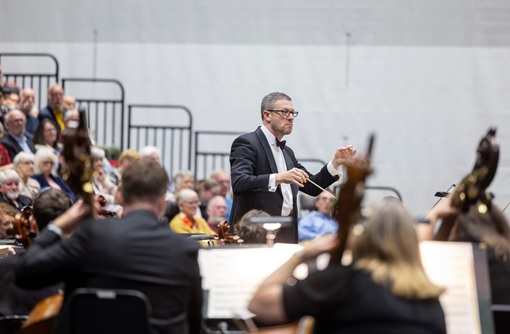
The National Symphony Orchestra Ireland (NSOI) were joined by guest conductor, John Wilson, for this concert of Russian Romantic masterpieces. The young Bulgarian pianist, Emanuil Ivanov, was the soloist in Tchaikovsky’s B-flat minor Concerto.
The concert opened with Grażyna Bacewicz’s Overture, which was written in 1943 under gruelling conditions in Nazi-occupied Warsaw during World War II. The work features a repeated rhythm in the timpani which spells out the letter V in Morse Code. This was of course the Allied signal for Victory during World War II, so the work was a symbol of defiance in the face of Nazi tyranny. Wilson and the NSOI gave a highly energetic and upbeat performance. The strings brought drive and momentum to the rapid semiquavers which open the work while the brass fanfares injected brilliance into the orchestral fabric. Catriona Ryan played the central flute solo beautifully while Philip Hughes ensured the V for Victory code coursed through the work in a seamless way. This was a great opening to the concert.
Emanuil Ivanov won first prize at the Busoni International Piano Competition in 2019. He recently performed Busoni’s Piano Concerto, which is a notoriously difficult work, so he clearly has a big technique which was on full display in this performance.
A glorious horn fanfare sounded the call to arms before the entry of the soloist. Ivanov injected weight and depth of sound into the opening chords while Wilson and the NSOI brought breadth and grandeur to the famous melody. Ivanov balanced the poetic and lyrical aspects of the music with the charged volatility of the writing. At the climax points he unleashed several incendiary technical displays, and his playing really caught fire with the double octave fusillades. The NSOI upped the ante by responding with unbridled incendiary playing of their own. In the cadenza I was struck as much by the beauty of Ivanov’s flickering soft playing as by the adrenaline-inducing passagework. My one minor reservation was that occasionally some of his pianistic effects sounded a little too calculated, particularly in the early part of the performance.
Ivanov brought a cultivated sensibility and gleaming tone to the opening section of the slow movement. The music had a wonderful sense of flow and the exchanges between piano and woodwind created an intimate fairy tale atmosphere. Ivanov displayed extraordinary lightness of touch and breathtaking fingerwork in the prestissimo middle section. The speed of the playing was staggering; I don’t think I have heard anyone play it quite as fast as this in a live performance. In the finale Wilson ensured the soloist and orchestra stayed in lockstep in the Ukrainian dance material. Ivanov once again treated the audience to a high-octane virtuoso display while at the same time ensuring clarity of line and articulation. Wilson kept a tight grip on proceedings, watching the soloist like a hawk as the tempo slowed in the coda before Ivanov unleashed virtuoso fireworks one final time. The orchestra and soloist were not completely together in the final few bars but the excitement of the playing more than made up for that. The audience responded with rousing cheers and a standing ovation. Ivanov performed Medtner’s Primavera as an encore.
The concluding work on the programme was Rachmaninov’s Third Symphony. Following its premiere in 1936, critics were divided over whether it sounded too modern or too nostalgic (Elgar faced a similar reaction at the premiere of his Second Symphony). Nowadays, the symphony is viewed as a deeply personal, transitional score, blending Rachmaninov’s characteristic lyricism with a leaner, more economical style. It blends brooding introspection with rhythmic energy and radiant orchestral colour. It is not performed as frequently as some of the composer’s other works but conductors such as Previn, Ashkenazy and Pletnev have left acclaimed recordings and made a strong case for it, as has Wilson himself in his own, more recent recording (review here).
Wilson and NSOI succeeded in leaving their own mark on this work. The first movement opened very quietly with a solemn Russian Orthodox chant before the full orchestra entered with bright, energetic rhythmically vibrant playing. The movement has a freewheeling quality as the music moves between sweeping, lush Romanticism, high-octane rhythmic energy and lyrical introspection. Wilson deftly handled the changes in tempo, dynamics and mood, creating an integrated musical narrative. He seemed to find the right balance between the Romantic and more modernist aspects of the music.
Jake Parker on horn and Elaine Clarke on violin played their solo entries beautifully at the start of the slow movement. The NSOI’s performance became increasingly heady and rapturous as the movement progressed. The transition to the central scherzo was well handled and Wilson ensured the rapid orchestral entries were precise and tightly coordinated. The woodwind, strings and percussion brought a mercurial lightness to the scherzo and dispatched the virtuoso demands with aplomb.
The finale was a whirlwind of driving rhythms, intricate counterpoint and orchestral brilliance. Wilson was at pains to balance the brilliance of the more combustible orchestral writing with the bittersweet nostalgia and melancholy that infuses the music. It is a curiously fragmented movement with multiple changes in tempo, and I was not completely convinced that Wilson and the NSOI succeeded in creating an integrated whole. Having said that, there was some very fine playing throughout. The final acceleration in the coda was a tour de force which succeeded in bringing the audience once more to their feet.
Great performances all round and Ivanov is clearly a prodigious talent.
Robert Beattie