 United States Gluck, Orphée et Eurydice: Soloists, Pittsburgh Opera Chorus and Orchestra / Antony Walker (conductor). Pittsburgh Opera, Byham Theater, Pittsburgh, 14.11.2026. (SJ)
Christoph Willibald Gluck’s operatic retelling of the Orpheus legend was a landmark in its day, pointing to a new direction for opera that favored directness of expression and classical economy. Essentially music about music, it is ideal subject matter for an opera that reaches back to the medium’s incipience with Claudio Monteverdi. Pittsburgh Opera’s new production, directed by José Maria Condemi, was a welcome opportunity to hear the Gluck work which has somewhat fallen out of vogue. The production opted for the substantial revision undertaken by no less than Hector Berlioz. Dating from nearly a century after the original premiere, the Berlioz version is faithful to Gluck’s original conception, but it transposes the vocal ranges and rewrites the orchestration to align with more modern convention, opts for the French text and recasts Orphée as a trouser role.
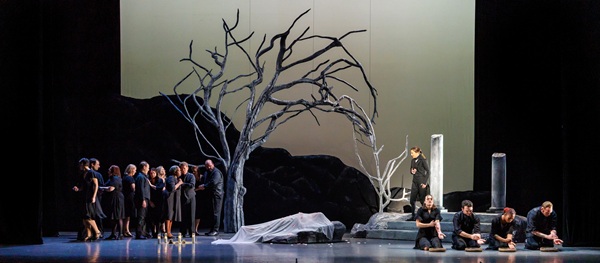
The Byham Theater made for a more intimate setting than Pittsburgh Opera’s usual home at the cavernous Benedum. Frescoes with classical imagery adorn the theater, certainly apt for an opera set in Ancient Greece. Under Antony Walker’s refined direction, there was a warm immediacy of orchestral sound in the overture, given with crisp articulations and an ebullient energy. The first vocal appearance came from the chorus, bringing somber depth to Eurydice’s funeral procession. Mezzo-soprano Stephanie Doche was an expressive presence as Orphée, delivering the heartfelt words with genuine feeling. In the aria ‘Objet de mon amour’, she lamented the ‘lifeless trunks of trees’, an image depicted literally in the barren Act I set conceived by designer Steven Kemp.
The role of L’Amour was sung by soprano Léa Nayak, a current member of Pittsburgh Opera’s distinguished Resident Artist Program. Providing comic relief, she was clad in silvery sequins and entered the stage on a golden bicycle. Her light, limpid tone was charismatic and seductive, easily convincing Orphée to descend into the underworld in an attempt to resurrect Eurydice. Orphée accepted the challenge, and Doche impressed with the flexibility of her vocal range in some of the most acrobatic singing of the evening.
The second act opened to a striking rendering of the underworld. Ballet has a longstanding tradition in French opera, and the dramatic ‘Dance of the Furies’, featuring choreography by Pittsburgh’s Attack Theatre, brimmed with Sturm und Drang intensity. The ‘Dance of the Blessed Spirits’ took us to the Elysian Fields, bathed in a warm orange glow. Eurydice was shown to be at peace, quite a contrast from the strife of Orphée. A delicate flute solo was an especially touching moment. This is perhaps the most recognizable melody from the opera, not in the least due to a piano transcription by Giovanni Sgambati which has become a favorite encore piece of many pianists.
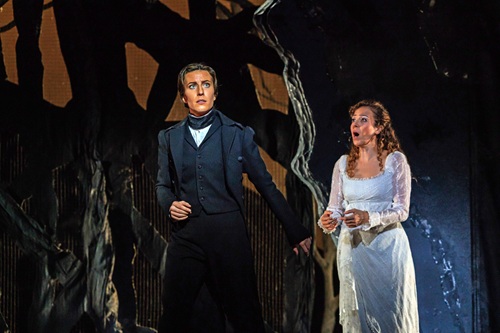
Soprano Lauren Snouffer was powerful and arresting as Eurydice and particularly commanding during the heart-wrenching duet ‘Viens, suis un époux’. Her growing desperation eventually broke Orphée’s resolve, prompting him to turn around and condemn her to the underworld once again. Though most retellings end here on a tragic note, in Gluck’s version L’Amour is moved enough by Orphée’s devotion to bring Eurydice back to life once again.
A joyous finale with the full cast and chorus brought to mind the closing scene of Mozart’s Don Giovanni, another opera whose concluding ensemble offers an unexpectedly cheerful coda after a tragic climax. While purists of classical mythology might find this ending a bit contrived, at Pittsburgh Opera it made for a lovely conclusion to a moving performance that found profoundly human emotions beneath its mythological setting.
Sam Jacobson
Featured Image: Mourners lament Eurydice’s death © David Bachman Photography
Cast:
Orphée – Stephanie Doche
Eurydice – Lauren Snouffer
L’Amour – Léa Nayak
Production:
Director – José Maria Condemi
Sets – Steven Kemp
Costumes – Robert Perdziola
Lighting – Mary Ellen Stebbins
Choreography and Dancers – Attack Theatre
Chorus master – Mark Trawka