
 United Kingdom Beethoven, Elgar: Clara-Jumi Kang (violin), Bournemouth Symphony Orchestra / Mark Wigglesworth (conductor). Lighthouse, Poole, 25.2.2026. (CK)
Beethoven – Violin Concerto
Elgar – Symphony No.2
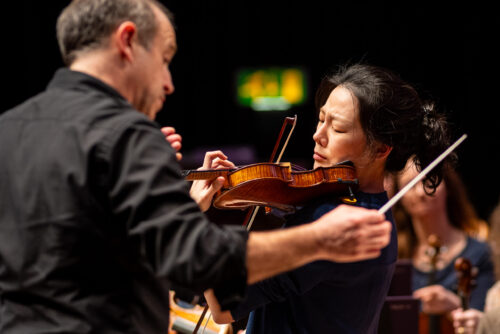
‘I am completely unable to do justice to Clara-Jumi Kang’s performance, or to the way in which [Mark] Wigglesworth and the orchestra partnered her. At the end her first reaction was to applaud wholeheartedly the musicians behind her: rightly so.’ I wrote that rather lame comment in May last year, about Kang’s performance with the Bournemouth Symphony Orchestra of Britten’s Violin Concerto: and I find myself in exactly the same position now, vis-à-vis her performance with them of Beethoven’s Violin Concerto at Poole’s Lighthouse (repeated, I have no doubt equally outstandingly, at Bristol Beacon on Thursday).
It was, in every way, a magnificent performance – but that adjective suggests grandeur, splendour, majesty: and Kang’s playing was sublime in a different way. This was Beethoven caught, as it were, on the wing: clarity, purity, beauty, and a lightness that kept the music aloft through the full forty minutes; it never became earthbound. Her touch is so fine that top notes are merely glanced, brushed, so it seemed, by a single hair of the bow. Her playing in the cadenzas sounded now like birdsong, now like a shower of raindrops. The lightness was maintained through the Larghetto, and it was impossible not to notice the delight with which Kang launched the finale: a cautious or ‘sensible’ tempo here can make the music sound ever so slightly pedestrian, but there was no chance of that here: we were up, up and away.
The orchestra was with her all the way: I loved the chortling horns in the finale, and Tammy Thorn’s characterful bassoon playing rightly earned her a solo bow. Kang’s encore – the Sarabande from Bach’s Partita No.2 in D minor – was thoughtfully, beautifully played. The classical music firmament is blessed with a great many superb violinists: if I were restricted to hearing only one, I might choose Clara-Jumi Kang.
Mark Wigglesworth began his tenure with the BSO with a fine performance of Walton’s First Symphony, repeating it at the BBC Proms; this performance of Elgar’s Second Symphony was, to my ears (and heart), even finer. So complete was Wigglesworth’s identification with the music’s extraordinary imaginative and emotional range that it sounded like a personal testament. He adopted a different platform arrangement – lower strings to the left, horns to the right with the heavy brass – as he had done for Brahms after Kang’s performance of the Britten concerto; and the decision to augment the usual strings – an extra desk of cellos and double basses, and additional violins and violas – paid off handsomely in the depth, warmth and richness of tone that he drew from them. He also contributed a thoughtful and stimulating essay in the programme book, relating Elgar’s unease about the Empire to the misuses of nationalism in our own day: ‘He knew that the pride of patriotism could be hijacked by the ignorance of xenophobia and he was deeply troubled by many of the choices he saw being made.’
Commentators on the symphony are apt to see two sides to it, the personal and the public (the second movement, for instance, expresses national mourning after the death of Edward VII as well as private sorrow). In this performance, from first note to last, the symphony sounded emphatically, even agonisingly personal. This was the first time I have been totally convinced – nay, swept away – by the first movement (and I am old enough to have seen Boult and Solti conduct it): Wigglesworth shaped its ebb and flow with great naturalness, and the orchestra responded with a wonderfully rich and full Elgarian sound (horns to the fore). It was – as Elgar described it – a passionate pilgrimage: through its twists and turns tension never sagged, and the central climax was magnificently paced.
The slow movement was the most moving music I have heard in a long time: I even felt tears pricking my eyes – that doesn’t happen very often. It was impossible not to notice, here and throughout the symphony, the importance of the two harps (and how wonderful to have harpists with Celtic names – Eluned and Anwen). The third movement’s scherzo was fast and fantastical, sounding at times like the first movement in a distorting mirror; the finale spacious and humane, that gently undulating theme flowing like a river to who knows where; the epilogue glowing and – it seemed to me – transformative.
This was a special performance. I have to confess to moments of agnosticism about Elgar’s standing as a great composer: they are not likely to trouble me again for a long time. How wonderful it would be if Wigglesworth and the BSO could play it again at the BBC Proms.
Chris Kettle