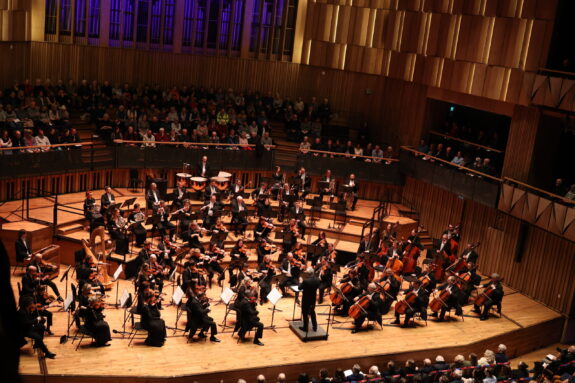
 United Kingdom Janáček, Bruch, Dvořák: Jennifer Pike (violin), Czech Janáček Philharmonic Orchestra / Daniel Raiskin (conductor). Bristol Beacon, 14.2.2026. (CK)
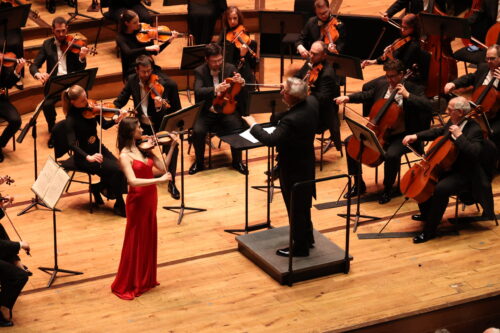
Janáček – Prelude & Pantomime from The Cunning Little Vixen
Bruch – Violin Concerto No.1
Dvořák – Symphony No.9 ‘From the New World’
Suppose a Russian orchestra is touring the UK and is due to give a concert at a hall near you. The main work on the programme is Tchaikovsky’s Fifth Symphony. Do you feel (a) disappointed that they haven’t been more adventurous in their programme choice – performances of this work are two a penny – or (b) excited at an opportunity to hear the symphony played by Tchaikovsky’s proud countrymen?
There is of course another reason for hearing the Fifth: it is a magnificent work. And the same is true of Dvořák’s Ninth Symphony, ‘From the New World’, which was the main work on the programme for this concert in Bristol, given by the Czech Janáček Philharmonic Orchestra, on tour with their conductor Daniel Raiskin. The orchestra is based in Ostrava, in the east of the Czech Republic, near the Polish border.
One of the joys of hearing a visiting orchestra – especially one from Central or Eastern Europe – is the sound they make: different, often, from the streamlined, homogenised sound of orchestras of the West. As soon as the Czech Janáček Philharmonic started to tune up it felt as if as a refreshing breeze was wafting from the stage: a reedy, open-air sound, perfect for Dvořák.
We began though with Janáček, the orchestra’s eponymous composer: quite right too. Raiskin had put together what he called a ‘teaser’ of Janáček’s music, consisting of the Prelude to his opera The Cunning Little Vixen, and the orchestral Pantomime which occurs soon after: seven minutes of music. More of a tormentor than a teaser: like opening a door onto the magical world of this lovely opera, then shutting it again. Just a glimpse of the Dragonfly, the Cricket, the Grasshopper, the Mosquito and the Frog, with tiny, vivid detail touched in by the first flute, the leader and co-leader of the first violins, the cor anglais. If anyone experienced Janáček withdrawal symptoms – as I did – they were soon assuaged by what followed.
Bruch’s Violin Concerto, like the two symphonies mentioned above, might be – has been – described as a warhorse: regular topper of Classic FM polls, and so on. It wasn’t the only one he wrote: I remember seeing the manuscript in the Pierpont Morgan Library in New York, with a curator’s testy comment alongside: violinists only want to play this one!
In Jennifer Pike’s hands the concerto didn’t sound anything like a warhorse. In an elegant rose-red dress (I hope she won’t mind my saying this) she had something of the otherworldly beauty of Rossetti’s Lizzie Siddal: and her playing had something of the same quality. Plenty of virtuosity, but no showmanship; a finely spun line from the thoughtful, meditative opening, through the episodes of the Vorspiel and into the glories of the Adagio, played with refinement and feeling. The finale – Bruch ending with an energetic Hungarian Dance, as Brahms was to do in his concerto, ten years later – was a continual delight, the orchestra perfectly scaled to her performance: clearly they know each other well. Her encore – a Polish folk dance, performed in concert with the leader and co-leader – gave further evidence of her quality and her rapport with the Czech players.
And so to Dvořák’s Symphony ‘From the New World’. The performance was all of a piece, played con amore but kept moving at a natural pace: conductor Raiskin didn’t seem to want to impress us with a radical view of the work, but neither did his direction, or the orchestra’s playing, sound at all routine. It sounded an entirely natural whole – evergreen, fresh, inspiriting – and I see no need to take it to bits in order to pad out this review. I will, however, mention the delicious playing of the woodwind choir (and the admirable stillness of the cor anglais player in the first movement, waiting – as we all were – for his moment in the Largo): they made the Trio section of the third movement sound as airily sublime as the corresponding section in Schubert’s Ninth.
The whole concert provided splendid and appropriate entertainment for the evening of Valentine’s Day: a full house at the Beacon evidently felt the same.
Chris Kettle
Featured Image: Daniel Raiskin conducts the Czech Janáček Philharmonic Orchestra © Janáček Philharmonic Ostrava
What does the heart learn from a magnificent concert? What does it tell us about the world we can create?
Last night (18th Feb ’26) The Czech Janáček Philharmonic’s centrepiece at the Cadogan Hall, London, was Shostakovich’s 10th symphony. The filling either side was Janáček’s Prelude to a Cunning Little Vixen and a joyful finale of Janáček. Janáček’s composition reflects the deepest threads of Czech societal and folk heritage.
I delighted in Jennifer Pike’s performance, immediately before the interval, of Bruch’s Violin Concerto, a fusion of her individual expression with the unifying power of the orchestra in complete harmony with that expression. Playing in solidarity with it, perhaps of shared philharmonic love and harmony, in which the individual and collective are one and the same.
Shostakovich used the signature notes of his name in the Tenth Symphony to assert his self and personal identity, of his individual significance, alongside his depiction of Stalin the person and the oppressive state he created. The ‘love’ he felt for Elmira Nazirova is given musical form too, a relationship lived against the backdrop of Stalinist power. The contrast between the unification of individual and collective expression and harmony in the Bruch, and love, life, and personal significance, lived against the background of an oppressive state was given breath-taking musical form.
One cannot understate the significance of a Czech orchestra, playing music from deep inside the heart of its performers, a product of the society of which they are a part, in a programme including Polish folk inspired themes and those composed by a German romantic. I think l could see the Ukrainian colours emerging from breast pockets, but my vision is poor. With a leading role played by a British violinist.
These societies and countries were all dominated by Stalin’s Russia, or as in Britain, lived with the fear of not-so-cold war. The music of those who feel this threat today is far greater than the sum of its notes, it is a call for togetherness and the solidarity of all who seek ‘love’ and harmony, and of freewill, in their societies, to confront those who would take us back to a past, of statist dominance and conflict. This ‘battle’ of values, between societies built on human connection, and those who disregard our human and societal rights is global, not confined to Europe.
My heart heaves with the impact of last night’s concert. What it tells us about the world we can create, is that the individual and collective can be one. Unified by common human values and ideals. The music we live by, like that performed last night, is, as l wrote above, far greater than the sum of its notes. Its not just the tune but the landscape it inspires. Of a world where l retain my personal significance but that l am also significant as part of something bigger, the society in which l live.