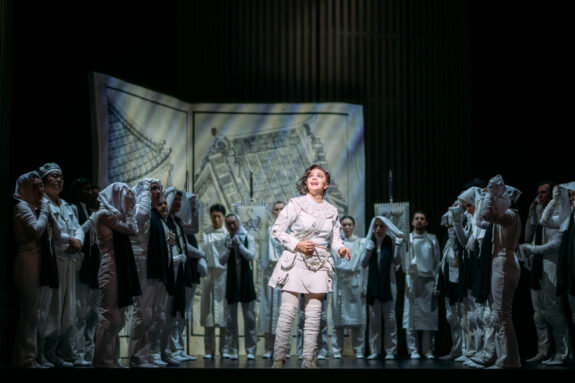
 United Kingdom Fujikura, The Great Wave (world premiere): Soloists, Chorus of The Great Wave and Orchestra of Scottish Opera / Stuart Stratford (conductor). Theatre Royal, Glasgow, 12.2.2026. (GT)

This opera about the great Japanese artist Hokusai (1760-1849) is the creation of the Scottish writer Harry Ross and the Japanese composer Dai Fujikura in a unique collaboration celebrating the beautifully evocative paintings of Japanese nature. The painter’s most famous artwork, ‘Under the Great Wave of Kanagawa’, has captivated art lovers around the world for many decades. Regrettably, Hokusai was never recognised in his lifetime. In recent years, Hokusai has become celebrated through successive exhibitions at the British Museum and worldwide; his work is so popular in his homeland that his art decorates Japanese passports.
There is in Hokusai’s work a timelessness that makes his art unique, and its affinity with nature gives an appeal that also typifies Japanese culture. Japanese culture has been best expressed and falsely, through Gilbert and Sullivan’s Mikado and Puccini’s Madama Butterfly, captivating the hearts of audiences, yet evoking the colonial treatment of Japan by Western art with a sentimentality completely foreign to this new opera. This narrative of a neglected artist reflects upon Hokusai’s will to follow his own original path. Despite many political restrictions, Hokusai managed to find freedom to create his unique artwork.
Japanese art was first recognised in the 1862 London Exhibition and had a huge influence, particularly on Debussy, whose La mer was inspired by Hokusai’s ‘The Great Wave of Kanagawa’, and Art Nouveau was influenced by the beauty of ukiyo-e’s style. Ukiyo-e literally means ‘pictures of the floating world’ and his prints captured urban life, kabuki theatre, mythological and historical scenes, and festivals. The ‘floating world’ evokes the Buddhist transient concept and eternal constants of beauty and joy. Japonisme became part of Western culture and was followed by Monet, Degas, Van Gogh, and Whistler. Japanese art evinced by ukiyo-e influenced Western art in its fresh perspectives, bold outlines, and decorative patterns using asymmetry and rhythmic space.
The evening opened with a beautifully colourful collage of Hokusai’s artwork, and as it disappeared, at the stage centre was a memorial to Hokusai as artists and actors entered to place flowers in his memory. A lonely solo lament on the Japanese instrument, the shakuhachi (a Japanese longitudinal flute played off-stage), was accompanied by Hokusai’s spirit on the stage, invoking the tragedy of Hokusai’s death. The mood was continued by Ōi, his daughter, singing a lament in her father’s memory. The overwhelmingly sad mood often prevailed throughout, with the shakuhachi played by Shozan Hasegawa returning in the final fifth act as if to close the circle of Fujikura’s opera.
The five acts depicted Hokusai’s life in retrospective from his death through to his childhood and the invention of his own artistic style. The stage movement by Akiko Kitamura was often effective and among the highlights was in dramatising the diverse elements of the wind and rainfall by actors and dancers swiftly crossing the stage with umbrellas. These dramatic scenes were interrupted by the problems of Hokusai in gaining recognition, added to by the poignant portrayal of the artist’s neglect by society and suffering. The death of Hokusai was depicted by a great lightning strike with an explosion of percussion. The set was dominated by two great vertical semi-circular chambers which at times would open to reveal Hokusai’s artworks. The most striking vision of the evening was the opening out of two chambers to reveal the artist’s greatest painting.
The costumes of neutral white by Kayo Takahashi Deschene were simple yet more western tailored than Japanese traditional dresses, with a distinct difference in Hokusai and his daughter’s traditional Japanese clothes of Prussian blue. The costume designs depicted the different classes in society with the more fashionable attire for the aristocrats and merchants.
One negative in Junpei Kiz’s scenography were prolonged scenes which often extended beyond necessary and removed their incisiveness, typical of which were several crowd scenes that simply went on and on diminishing their dramatic moment, and most of all in the final act with the visually beautiful dancing of dragons that quickly lost its impact through the constantly repetitive action.
Of the singers, the outstanding baritone of Daisuke Ohyama as Hokusai was the most impressive both in his singing and superb characterization, while Julieth Lozano Rolong was outstanding as Hokusai’s daughter Ōi. Of note too, was the soprano of Chloe Harris as Hokusai’s second wife, Koto, in an outstanding interpretation. The Collin Shay’s countertenor as von Siebold was equally outstanding as the cunning German merchant trying to sell Prussian blue to Japanese markets when it was banned. Luvo Maranti as Hokusai’s grandson was excellent too, while Hokusai’s publisher Yohachi sung by Shengzhi Ren was another highlight for his astute portrayal, and also his doubling up as the confectionary shop owner Mr Tozaki. An unsung role as Hokusai’s spirit by Dan Armstrong was a frequent ghostly observer overseeing the unfolding action on the stage.
Throughout, the visual projections by Sho Yamaguchi were a highlight with beautifully exotic pictures by Hokusai, while Yuka Hisamatsu’s lightning was often spectacular and an essential element in the whole show, while the sets by Satoshi Miyagi were simple and allowed the story to unfold.
If one has watched the films of Akira Kurosawa, then one will be familiar with the orchestral picture composed by Dai Fujikura. The UK-based Japanese composer has written a modernist monotonic score with delicately nuanced strings creating a sheen of sound backed by beautifully expressed woodwind and often shattering percussion. The influence comes from Masaru Sato and Akira Ifukube who wrote scores influenced by Western classical music yet were embellished by Japanese traditional and Ainu folk music.
Throughout the evening, the Scottish Opera orchestra were on top form, led by their conductor Stuart Stratford, with every department outstanding in accompanying the action there was. The chorus directed by Susannah Wapshott was excellent, and a highlight too was the singing of the children’s chorus. This production was a joint project with KAJIMOTO and tours to Edinburgh’s Festival Theatre on 19 and 21 February.
Gregor Tassie
Featured Image: Julieth Lozano Rolong (Katsushika Ōi) in The Great Wave © Mihaela Bodlovic
Production:
Libretto – Harry Ross
Direction – Satoshi Miyagi
Scenographer – Junpei Kiz
Costume designer – Kayo Takahashi Deschene
Lighting designer – Yuka Hisamatsu
Video and Props designer – Sho Yamaguchi
Choreographer – Akiko Kitamura
Chorus director – Susannah Wapshott
Cast:
Katsushika Hokusai – Daisuke Ohyama
Katsushika Ōi – Julieth Lozano Rolong
Mr Tosaki / Nishimura Yohachi – Shengzhi Ren
Eirakuya Toshiro – Takai Kozan
Koto – Chloe Harris
Hokusai’s Grandson – Luvo Maranti
Dr Philipp Franz von Siebold – Collin Shay
Tokai Kozan – Edward Hawkins
Child – Audrey Tsang
The Spirit of Hokusai – Dan Armstrong
Dancers – Ching Chen, Kim Francey, Alex Henderson, Amy Hollinshead, Grace O’Brien, Ken Sugiyama, and Malcom Sutherland
Children – Daisy Holden, Cooper Laird-Jones, Eleanor Paterson, Sava Tripkovic