
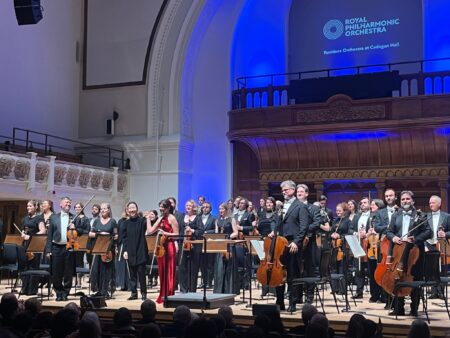
 United Kingdom Boulanger, Prokofiev, Rachmaninov: Alexandra Tirsu (violin), Royal Philharmonic Orchestra / Eun Sun Kim (conductor). Cadogan Hall, London, 4.2.2026. (AV-E)
Lili Boulanger – Marche gaie (1916)
Prokofiev – Violin Concerto Op.19 (1917)
Rachmaninov – Symphony No.2 in E minor, Op.27 (1907)
The Royal Philharmonic Orchestra ignited their programme with a prismatic flourish, launching light-heartedly into Lili Boulanger’s Marche gaie with a virtuosic vitality that felt like a shattering of Smoky Quartz crystal.
The Mendelssohnian ‘Wedding March’ wink didn’t just arrive; it glinted like a Sapphire caught in a strobe light, only to fade out into a Wagnerian ventriloquism, whilst the solemn soundworld of Boulanger blossomed forth. And this luminous phantasmagoria instantly transforming the Cadogan Hall into a vortex of spectral fire where every note acted as a fluorescent spark hitting a rotating prism. Rather than a traditional march, this was a ‘chameleonic’ dance of sound, a radioactive rainbow of ornate orchestration that sent streaks of electric indigo and molten gold cascading through the air and scorching the audience with red-hot coals of delinquent delight. The audience were visibly singed and stirred.
The Moldovan violinist Alexandra Tirsu is internationally celebrated for her immaculate intonation and shimmering sonority of sound that was clearly evident in her impeccable performance of Prokofiev’s Violin Concerto No.1 – which was also an extraordinary exercise in sonic alchemy.
The opening Andantino began with a melody so fragile it seemed to fly effortlessly into high and low registers as a translucent incantation. Tirsu’s vivacious vibrato carried an electric charge, spinning a web of sound that felt like gossamer spun from cold silk. The violin’s sognando (dreaming) tone was appropriately other-worldly. Or, as as Tirsu aptly said of the work: ‘The whole concerto feels like in-between the worlds.’
In the Scherzo, Tirsu pivotally shifted the evening’s atmosphere, replacing the opening movement’s ethereal glow with an evil intensity. Often described as a ‘bracing splash of iced water’, her interpretation embraced the movement’s biting, ‘grotesque’ irony with remarkable athletic precision. Tirsu’s ‘lightning-fast fingers’ navigated the movement’s trademark technical hurdles – from the grinding, percussive spiccato passages to the pinpoint accuracy of the high-register harmonics – with a sense of ‘naughty’ spontaneity. Under the graceful guide of Kim, the interplay between the soloist and the RPO remained taut and high-voltage, capturing the exact moment where Prokofiev’s ‘fairy-tale’ charm curdles into a modern, mechanical wit. Tirsu showed herself to be as much a master of Prokofiev’s sarcasm as she is of his lyricism.
The final Moderato brought a return to sunlit serenity, but the breezy air remained thick with horrendous musical hallucinations. Here, Tirsu navigated the movement’s clockwork-like structure with tight rhythmic discipline. Where others might lean into the eccentricities, she maintained a vibrant and steady ‘motoric’ drive, allowing the bassoon’s initial ‘ticking’ theme to lock in perfectly with her suave solo line.
As the concerto reached its ethereal close, Tirsu’s 1717 Stradivarius shed its earthly weight, its silvery tone thinning into a vibrant shimmer. Her final stratospheric trills possessed the delicate, high-frequency shimmering of a hummingbird’s wings — a blur of motion that seemed to hover perfectly still in the air before finally vanishing into the rafters.
It was a virtuoso feat of restraint, leaving the audience to wonder if the sound had truly stopped or if it had simply transcended the reach of the human ear and played out into space for eternity. Tirsu’s playing was perfection. Tirsu’s conception was immaculate. A star is born.
Under the eminent Korean conductor Eun Sun Kim’s concise and vigorous direction, the dialogue between the soloist and the RPO was a masterclass in collaborative precision. Tirsu, Kim and the RPO were avidly applauded by an appreciative audience.
Aided and abetted by the venerable Vasily Petrenko, the RPO are ‘tailor-made’ for playing Rachmaninov (and Shostakovich) in having the appropriate dark and brooding intonations required: the ‘digging in’ of the weighted bowing, the Cuivré of the ‘brassy rattle’, and the pointedly ‘plaintive’ woodwind solos.
Kim gave us a ‘newly minted’ rendition of that ‘old war horse’, Rachmaninov’s Second Symphony. It was delightfully devoid of its customary maudlin wallowing in a saccharine sludge of sickly sentimentality. Kim gave us a ‘classical’ rather than a ‘romantic’ reading, which was far closer to how Klemperer would have conducted it, with a focus upon structure rather than sentiment.
In the opening Largo – Allegro moderato, Kim’s exquisite economy of gesture provided a swifter, sharper, and tauter rhythmic contour. For her approach brought a sense of kinetic inevitability to the score, carefully demarcating the transition from the dark introduction to the sweeping main theme without letting the structure lapse into episodic fragments: Kim totally grasped the forward-thrusting flow of the music.
The Scherzo showcased Kim’s attention to orchestral ‘pinpointed’ detail, as well as orchestral balance, and it went hand in hand with her ability to communicate complex syncopations with minimal effort. In the frantic fugal sections, her economy of gesture was surgical; a mere flick of the wrist sufficed to ‘pinpoint’ specific entries in the brass. This expressive economy allowed the restless energy to feel disciplined rather than chaotic, highlighting intricate inner-part details that are often muddled and congested in more flamboyant readings. The fugal section, often a point of orchestral congestion, was handled with a controlled velocity that never sacrificed clarity for speed. It was ‘swift’ in the truest sense: aerodynamic and precise.
In the Adagio. Kim kept the music on the move without dragging things out and eschewed ‘milking the score’ of its savoury sweet tooth tendencies. Where most conductors succumb to sentimental languor, Kim’s understated majesty was most effective with its restraining of engulfing emotions by sounding subdued and reserved. For by maintaining a tauter and tighter thread, Kim allowed the emotional flow to sound like a naturally unfolding stream of tears, rather than a cascading tidal wave: there was no tsunami of excessive emotions here. Kim’s tasteful restraint created a sense of architectural integrity, proving that the movement’s molten lingering ‘line’ is more powerful when guided by a swift, sombre and steady unsentimental hand. The RPO’s principal clarinet, Katherine Lacy, delivered the famous solo with a ‘vocal’ quality that also eschewed saccharine sentimentality in favour of a haunting homelessness.
In the symphony’s concluding Allegro, Kim’s characteristic exquisite economy of gesture was translated into a relentless, rapid drive that propelled the orchestra toward a cataclysmic climax. Rather than allowing the music to settle into a series of disconnected episodes, she maintained a tauter rhythmic line that lent the finale a sense of kinetic inevitability. This athletic approach ensured that the ‘celebratory pealing of bells’ never felt heavily over-indulgent; instead, it surged forward with a piercing velocity and high-speed clarity. By balancing spaciousness with intense rhythmic definition, Kim transformed the complex score into a singular, aerodynamic arc of energy, ensuring the work’s final resolution was both structurally sound and exhilaratingly unstoppable: and it was just that. Throughout, Eun Sun Kim’s conducting was impeccably incisive and elegantly economic. Kim is Music Director of San Francisco Opera and another genuine star.
As the final chords struck with a percussive finality, the audience was instantly seized by a seismic roar of euphoria. This unalloyed surge of acclaim manifested in a relentless fusillade of clapping, sustaining a fever pitch of collective ebullience. An evening to remember.
Alexander Verney-Elliott