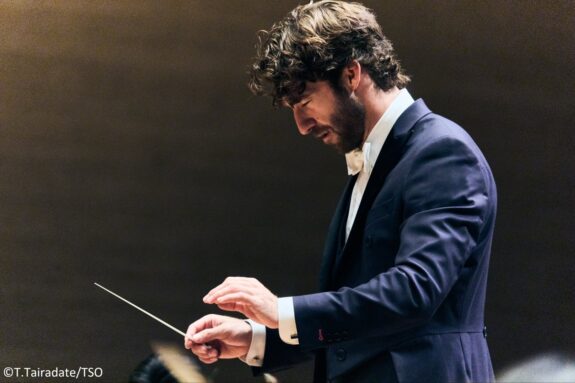
 Japan Beethoven and Mahler: Tokyo Symphony Orchestra / Lorenzo Viotti (conductor). Muza Kawasaki Symphony Hall, Kawasaki, 17.5.2026. (MY)
Beethoven – Symphony No.1 in C major, Op.21
Mahler – Symphony No.1 in D major, Titan
Under its new Music Director, the Tokyo Symphony Orchestra has made a remarkably impressive start. Yet because his predecessor’s achievements and popularity were truly exceptional, Lorenzo Viotti will now need time to deepen and mature his new partnership with the orchestra in the years ahead.
Succeeding a beloved and highly accomplished predecessor is an extraordinarily difficult task for any conductor. There is little doubt that the Tokyo Symphony Orchestra’s almost twelve years under Jonathan Nott represented a golden age in the ensemble’s history. During his tenure, he left audiences with unforgettable symphonic performances and concert performances of operas, while also producing an extensive discography featuring Beethoven, Tchaikovsky, Bruckner, Mahler, and others.
Just as importantly, Nott shared with the orchestra the hardships of the COVID-19 years. At one point, he even conducted the orchestra remotely over the internet; on other occasions, he traveled to Japan despite the government-mandated two-week quarantine, which he is said to have undergone three separate times in total, in order to continue making music in person. Through all of this, he consistently provided remarkable concerts for audiences starved of live performance.
In November 2025, Nott concluded his final subscription concerts as Music Director with a deeply moving and overwhelming performance of Mahler’s Ninth Symphony. Many lamented his departure. At the same time, since the Tokyo Symphony is a self‑governing orchestra without a parent organisation, there was considerable public interest and expectation surrounding their choice of successor, Lorenzo Viotti. Both of Viotti’s inaugural concerts sold out completely.
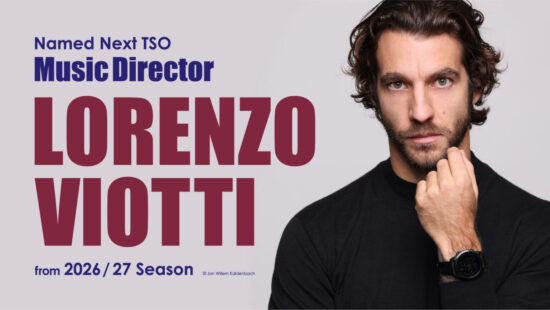
The son of conductor Marcello Viotti, Lorenzo Viotti was born in Lausanne, Switzerland, in 1990. He studied piano and percussion in Lyon before pursuing conducting in Vienna and Weimar. From 2021 to 2025, he served as Chief Conductor of the Netherlands Philharmonic Orchestra and the Dutch National Opera, establishing an international reputation in both symphonic and operatic repertoire. This June, he is scheduled to conduct the Vienna Philharmonic’s annual Summer Night Concert at Schönbrunn Palace. Beginning in August 2028, he will also succeed Gianandrea Noseda as General Music Director of the Zurich Opera House, confirming his status as one of the most promising young conductors on the international scene.
Viotti’s relationship with the Tokyo Symphony Orchestra began unexpectedly in July 2014, when he stepped in at short notice to replace Krzysztof Urbański, who had been forced to cancel his appearance due to injury. The programme on that occasion included Smetana’s Vltava from Má vlast, Dvořák’s Cello Concerto, and Tchaikovsky’s Fourth Symphony.
Remarkably, this concert was not only his Japanese debut — it was also the first time he had ever conducted a professional orchestra. In the years that followed, he returned to conduct the Tokyo Symphony periodically, appearing with the orchestra five times in total. Then, in August 2024, about ten years after that debut, he was named its next Music Director. His tenure officially begins with the 2026/27 season, under an initial three-year contract.
For his inaugural concerts, Viotti chose a straightforward yet highly astute programme: the First Symphonies of two of the greatest symphonists, Beethoven and Mahler. The first was in Tokyo and I attended the second performance at Muza Kawasaki Symphony Hall, the orchestra’s home venue and a vineyard-style concert hall internationally admired for its superb acoustics.
As anticipation in the audience mounted, Viotti strode confidently onto the stage. Tall, elegant, and impeccably stylish, he presented a striking contrast to his predecessor, whose slightly rumpled appearance, occasional vocal grunts, and highly idiosyncratic conducting style had long since become a distinctive part of his artistic persona.
The concert opened with Beethoven. Viotti did not adopt the recently fashionable historically informed approach, and vibrato was used naturally throughout. The orchestra itself was relatively compact, though the strings were seated in a conventional modern formation, with first violins, second violins, violas, cellos, and double basses from left to right.
That did not mean, however, a heavy or expansive performance in the manner of early- to mid‑twentieth‑century maestros. Tempos were brisk, accents sharply defined, and the overall impression was of a vibrant and thoroughly modern Beethoven. At the same time, Viotti drew an exceptionally polished sound from the strings, creating an orchestral balance of notable refinement and sophistication.
Viotti conducted Beethoven from memory, as he did the much longer and larger Mahler First Symphony after intermission.
From the extraordinarily tense, almost inaudible opening, controlled with immense care, through to the blazing, energy-filled climax of the finale, Viotti sustained the hour-long symphony with such dramatic continuity that it felt almost like a single-act opera, unfolding with such compelling force that one lost all sense of time.
The ovation at the end was ecstatic, making clear that audiences had embraced Viotti immediately as the orchestra’s new Music Director. Social media that evening overflowed with enthusiastic reactions.
On reflection, however, it should also be remembered that the Tokyo Symphony had already accumulated extensive experience performing Mahler under Nott, and Mahler’s First is, frankly speaking, one of those repertoire staples that can generate excitement almost regardless of who conducts it. In some ways, Viotti’s real achievement may have been demonstrated more clearly in Beethoven’s First Symphony, where his command over the orchestra’s sound and structure was unmistakable.
Looking ahead, one very much hopes that Viotti will resist the increasingly hectic lifestyle of the international star conductor — flying into Japan for minimal rehearsal time before immediately departing for engagements elsewhere — and instead devote himself patiently and seriously to building a long-term relationship with the Tokyo Symphony Orchestra, much as his predecessor did.
If he fully embraces the privilege of working closely with an orchestra of such flexibility and technical capability, and if together they commit themselves carefully to both core repertoire and more adventurous programming, the results could be artistically rewarding in the long term. Such collaboration would not only satisfy Japanese audiences; it would also allow Viotti himself, still young as a conductor, to develop further as an artist, ultimately carrying him to even greater heights in his international career.
Motoyasu Yamazaki
Featured Image: Lorenzo Viotti conducting the Tokyo Symphony Orchestra