
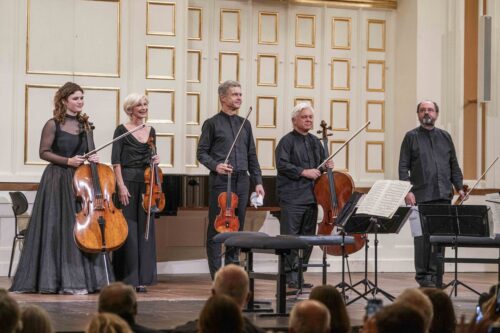
 Germany Dresden Music Festival 2026 [5] – Beethoven, Haydn, Schubert: Hagen Quartet (Lukas Hagen, Rainer Schmidt [violins], Veronika Hagen [viola], Clemens Hagen [cello]) with Julia Hagen (cello). Palais im Grossen Garten, Dresden, 27.5.2026. (MC)
Beethoven – String Quartet No.16 in F major, Op.135
Haydn – String Quartet in G major, ‘Tost’ Op.54/1, Hob.III:58
Schubert –String Quintet in C major, Op. posth. 163, D.956
This chamber recital, titled ‘Farwell Tour of a Quartet Legend,’ signified the culmination of the distinguished career of the Hagen Quartet. The quartet comprises of three original Hagen siblings, first violinist Lukas, violist Veronika and cellist Clemens, and second violinist Rainer Schmidt who joined in 1987. Established back in 1981 the ensemble prepares to retire from the concert stage in 2026.
Having previously attended performances by the Hagen Quartet at the Palais im Grossen Garten, I approached this bittersweet event with considerable anticipation. There was sadness at not being able to hear the quartet play again and joy at having had the opportunity to the hear the quartet perform on two occasions.
Haydn, Mozart Beethoven and Schubert are the leading figures of the Viennese School of composition. In this retirement year the Hagen have chosen works by three of those four luminaries of the Viennese chamber music tradition Haydn, Beethoven and Schubert.
Beethoven’s series of string quartets have become lynchpins of the chamber music repertoire. His quartets can be divided into three separate periods known as his early, middle and late. Although poorly received at the time as peculiar and over complex the late quartets are now regarded as amongst the greatest works ever written. In its farewell concert the Hagen performed his String Quartet No.16 in F major, Op.135 from 1826 the last quartet that Beethoven completed at a time when he was completely deaf and his health was failing.
The small-scale F major score is the shortest of the complete late quartets and it seemed over in a flash. It wasn’t that the Hagen were playing extra quick, it was in fact not wanting the work to end as both the music and the performance was top-drawer. The Hagen has mastered the art of balancing discipline with expression as displayed in the opening movement Allegretto and a furious passion was accorded to the second movement Vivace. Marked Lento assai, cantabile e tranquillo the third sounded like a prayer in music. The very slow tempi adopted by the Hagen seemed an impossible choice, yet it worked splendidly. It was something very special like observing a flower slowly opening. As an introduction to the Allegro Beethoven gave the finale a sort of conundrum titled Der schwer gefaßte Entschluss (the decision reached with difficulty). The writing tries to be jovial yet the constricted space due to the boundaries doesn’t allow the feeling to be fully released. It is a quite complicated movement for the listener not helped by the conjecture around the titles Beethoven gives to the finale.
The accolade that ‘Haydn was the father of the string quartet’ is fully deserved. Peter Cropper, the late leader of the Lindsay Quartet, explained how it was Haydn along with Mozart who ‘established the string quartet and it is their legacy that Beethoven inherited.’ Due to the success of Haydn’s six Op.33 string quartets from 1782 the demand for more from publishers was high. In the period 1788-90 Haydn wrote twelve string quartets, sometimes known by the nickname ‘Tost’, after the virtuoso violinist, cum shady businessman Johann Tost as publishing middleman. These included opuses 54 and 55, two sets of three great quartets superb works of originality and creativeness. Here the Hagen chose to perform the String Quartet in G major, ‘Tost’ Op.54/1.
This was a dedicated and superbly managed performance by the Hagen providing ample measures of charm and romance. Brisk, warm and witty in the Allegro con brio the influence of Mozart was evident. Containing siciliano rhythms the Allegretto was lightly tinged with melancholy. Dance-like the Menuetto – Trio followed by the Finale. Presto had a spirited energy.
Schubert described by Liszt as ‘the most poetic of composers’ excelled in the field of chamber music producing several outstanding examples. A few months prior to his death Schubert aged just 31 years had written some of his greatest works. There are the last three piano sonatas D. 958, 959 and 960; the lieder collection Schwanengesang and his masterpiece of the chamber music repertoire his String Quintet in C major, described as ‘sublime and valedictory’. Scored for two violins, a viola and two cellos, the additional cello in the quintet was played by Julia Hagen the daughter of cellist Clemens Hagen.
Schubert’s lengthy first movement Allegro ma non troppo, sometimes described as mercurial, was filled with a range of moods, and the Hagen made a glorious sound. Time seemed to stand still in the famous Adagio although the turbulent middle section of angst provided some relief from the tension. The Scherzo movement provided a biting effect as the players dug hard. By contrast the trio section induced a poignant rather reflective mood. In the manner of a Hungarian dance the final movement Allegretto – Più allegro was rousing but never brash and bordered more on the refined.
Polished and unified yet fresh in performance I will certainly miss the Hagen Quartet.
Michael Cookson