
 Germany Mozart, The Magic Flute: New Philharmonic Orchestra Westphalia / Johannes Klumpp (conductor). Musiktheater im Revier, Gelsenkirchen, 25.5.2026. (DM-D)#
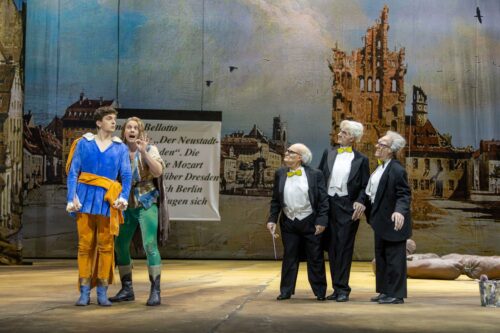
Part of the Musiktheater im Revier (MiR) is a laboratory dedicated to researching, in the practice of selected MiR productions and related activities, the application of digital technologies for opera production. This an outreach initiative seeking to involve the community of Gelsenkirchen. In the current 2025/26 season, MiR artistic director Nora Krahl directed The Magic Flute. She and her large team conceptualised the opera as an Open World Simulation with Prince Tamino as the real-life person entering and playing the game and becoming part of the world created for him, populated by the other characters/players.
In this world Sarastro is the ruler, a rule not at all ideal, rife with slavery, torture and misogyny. The sides were unambiguously defined: Sarastro and his men on the one side, and the Queen of the Night as Sarastro’s major adversary on the other side. She was presented, in the world of the Game, as an opera diva beyond her prime. For her first aria, she was surrounded by extras carrying over-sized record covers, clearly those from the record label Deutsche Grammophon, of famous recordings of The Magic Flute, with digital projections of the faces of eminent operatic sopranos of the 20th century who came to prominence with the role of the Queen of the Night. Her three ladies were famous 20th century conductors of DG fame, von Karajan, Böhm and Klemperer (some critics identified Furtwängler instead of Klemperer). They were interested in Tamino for professional reasons, his wonderful voice as a potential crowd magnet they wanted to be associated with and profit from. The slaves under Sarastro’s command wore different kinds of costumes, suggesting that some reference to historical figures may have been intended here as well. A further major instance of how the history of the arts was wittily foregrounded was the way the production interpreted the evil snake that threatens Tamino at the beginning of the opera. A very over-sized, and obviously cardboard, version of The Queen of the Night’s small dog rose above Tamino and defecated on him, with Tamino ending up covered by a large sausage of excrement. This is most likely a quite robust reference to a major 2023 scandal in the German art world: at the opening night of a new ballet production at Hannover State Opera, dance critic Wiebke Hüster was stopped in the foyer by the choreographer, who not only insulted her verbally: he whipped a pouch full of his dog’s excrement out of his pocket and smeared her face with it.
Monostatos, too, sided with the Queen of the Night, his name also on a DG record cover, suggesting he was a product of this old regime against which he was now seeking to rebel. His position as an outsider, in the original achieved by making him a person of colour, was shown by having him wear a mask suggesting bloody wounds as if he had just been subjected to severe physical torture. Sarastro punished him, not by 77 strokes on the soles of the feet but 77 cuts with a blade. Surrounded by Sarastro’s men and a razor blade, Monostatos uttered a gut-wrenching scream. He emerged even more blood-stained after that. In keeping with the image of the record label, the magic flute was in fact a golden disk, and Papageno’s magic instrument was not a glockenspiel but rather a bowl of magic bird feed.
All of these details, and many more, were part of an environment of monumental wide-screen sets including massive pyramids and other constructions, some intact, some in ruins, created with images painted on cardboard, frequently lowered from and raised to the fly tower. In addition there were two LED screens projecting images, AI-enhanced comments on the context and computer game instructions. At some point, when the different pieces moved at great speed and obviously arbitrarily, a message flashed on one of the screens: ‘Attention: system hacked’. An LED curtain, designed and developed as a world-first by the MiR lab team, expandable to 10m x 8m, allowed for the projection of images created by two different tracking systems – infra-red cameras and LiDAR. The only moments that jarred were when the curtains on the side of the stage opened for the huge white horse statue on which Sarastro was seated to be wheeled out, as backstage staff could be seen bustling about.
The contents created for this computer game world was thus more than full of stimuli of all kinds, including additional electronic music composed by Arno Waschk. Some of it made sense in terms of traceable logic, some did not – just as our human world would probably appear to an outsider looking in!
Visually, the production was thus exceptionally imaginative and rich. This made up for minor musical shortcomings. Adam Temple-Smith had some vocal problems with Tamino – perhaps an indisposition was not announced. Philipp Kranjc was reliable as Sarastro, but he lacked some depth in the lower range of the voice. Heejin Kim (Pamina) combined wonderfully smooth, blooming singing with some shrill sounds at the top of her vocal range. Sebastian Schiller was excellent in the comic acting of Papageno, and he sang very well, but his is a voice trained for musicals rather than opera, which was obvious and clashed with the operatic voices. Urban Malmberg sang very gently as the Speaker, some of the spoken dialogue from several of the performers was near-inaudible in the fifth row of the stalls. Rebecca Davis, Lina Edlin and Almuth Herbst coped well with their full facial masks to represent the conductors, and they sang with gusto. Martin Homrich fielded a strong, ardent tenor for Monostatos, different from the more squeezed character tenor sounds often associated with the role. The outstanding achievement of the evening was that of Yeeun Yeo as the Queen of the Night. She is currently a member of North Rhine-Westphalia Opera Studio and hers are certainly a voice and name to look out for! She sang with absolute precision, pure intonation, perfect pitch and the exposed coloratura sounded fresh, well-rounded, and effortless. Johannes Klumpp and the New Philharmonic Orchestra Westphalia offered a lively and straightforward reading of the score.
Daniel Meyer-Dinkgräfe
Featured Image: (Act I) Monostratos reports the capture of Pamina and Papageno to Sarastro © Pedro Malinowski
Production:
Director – Nora Krahl
Set and Costume design – Martin Miotk
Lighting design – Patrick Fuchs
Head of Digital arts – Barış Pekçağlıyan
3D-artists – Lex Rütten, Darius Tödtmann
AI-artists – Balkan Karışman, Felix Meermann
Creative coder – Daniel Molnar
Dramaturgy – Larissa Wieczorek
Digital dramaturgy – Domikik Hallerbach
Chorus director – Alexander Eberle
Cast:
Papageno – Sebastian Schiller
Pamina – Heejin Kim
Tamino – Adam Temple-Smith
Queen of the Night – Yeeun Yeo
Sarastro – Philipp Kranjc
First Lady / Conductor – Rebecca Davis
Second Lady / Conductor – Lina Edlin
Third Lady / Conductor – Almuth Herbst
First Boy / Creature – Lea Ostgate
Second Boy / Creature – Valentina Jurju
Third Boy / Creature – Laura Kriese
Monostatos – Martin Homrich
Papagena – Tamina Bieber
Speaker – Urban Malmberg
First man in armour – Khanyiso Gwenxane
Second man in armour – Simon Stricker
Old woman – Birgip Klemp