
 United States Various, LyricaFest 2026 [3]: Musicians of the Lyrica Program. Lyrica Boston, Lincoln, Massachusetts, 26.5.2026. (LV)
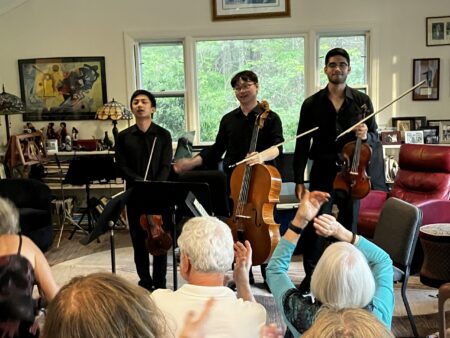
Ernő Dohnányi – Serenade in C major, Op.10 (Thompson Wang [violin], David Carreon [viola], Zac Fung [cello])
Shostakovich – Two Pieces for String Octet, Op.11 (Emma Joyce, Noah Ghosh, Jessica Helie, Addie Oracion [violins], Abigail Benzinger, Ben Garrett [violas], Adam Kremer, Nate Aistrup [cellos])
Mendelssohn – String Octet in E-flat major, Op.20 (Sicong Chen, May Tang, Laura Gonzalez, Kaitlyn Lien [violins], Quinn Robinson, Yulia Price [violas], Max Healy, Umi Neal [cellos])
The evening concert on the final day of LyricaFest’s summer session brought together three works and three entirely different casts, closing a festival that had reflected, in virtually every bar, the founders’ conviction that legacy is not a museum piece but a living force – the means by which music composed centuries ago or yesterday can arrive at a listener’s ears as if for the very first time.
Thompson Wang, David Carreon and Zac Fung, who had taken no prisoners in Beethoven that afternoon, returned for Ernő Dohnányi’s string trio in C major and immediately demonstrated their range. Where Beethoven had demanded ferocity, Dohnányi rewards a lighter touch, and the trio found it at once: the bold but disarming simplicity of the opening, the colors and pizzicatos Dohnányi deploys to vary his melodic lines, the sense of a composer who knows exactly how much charm to deploy and when. Carreon’s solo over elemental triplets in the fourth movement was one of the evening’s finer individual moments, and the fifth was an intoxicating free-for-all.
Shostakovich’s Two Pieces for String Octet arrived with a warning that was also an invitation: the first violinist promised hard rhythms and fugal writing ahead. It all transpired, not to mention a viola wailing in the night and cellos rubbing glissandos together before breaking into a screeching, full gallop. The ensemble of violinists (Emma Joyce, Noah Ghosh, Jessica Helie and Addie Oracion), violists (Abigail Benzinger and Ben Garrett) and cellists (Adam Kremer and Nate Aistrup) made Shostakovich’s youthful savagery entirely their own, reveling in its abrasive pleasures.
Then came Mendelssohn’s String Octet with an entirely different cast: Violinists Sicong Chen, May Tang, Laura Gonzalez and Kaitlyn Lien; violists Quinn Robinson and Yulia Price; cellists Max Healy and Umi Neal. The first movement was a revelation of ensemble thinking: interior and exterior lines rising and falling together, transitional riffs handed off seamlessly between players, larger sequences assembling themselves across shifting textural landscapes as if one could hear the music forming in Mendelssohn’s head. Unisons arrived occasionally that were the kind you dream of. Chen, as first violinist, became the ensemble’s gravitational center – not by dominating but by tracking Mendelssohn’s quicksilver circuitry, responding with obvious pleasure as each of the other seven had their moments and pacing their return to the recap with anticipation of the loveliest kind.
The ensemble moved through the curious, contrasting moods of the second movement with poise and dexterity and their Scherzo had moments that were gossamer, mercurial. They took the finale at a full sprint, every player committed to getting to the last bar together and on time. A glissando in the violins near the close seemed to arrive from another world entirely, perfectly setting up the final stretch. After that, the crowd’s warm response said everything that needed to be said.
Laurence Vittes