
 United States Gabriela Lena Frank, El Último Sueño de Frida y Diego: Metropolitan Opera Chorus and Orchestra / Steven Osgood (conductor). Metropolitan Opera, New York, 22.5.2026. (RP)
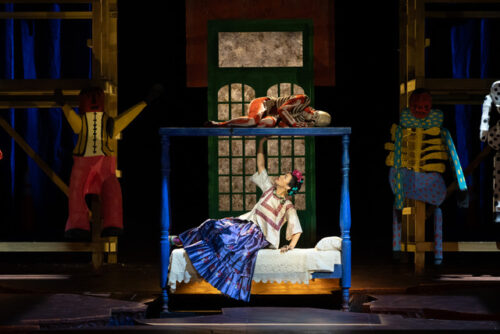
The Metropolitan Opera is ending the season as it began, with an eye-catching, audience-friendly production of a twenty-first-century opera. In September, Mason Bate’s The Amazing Adventures of Kavalier & Clay (review here) was so popular that extra performances were added. In May, composer Gabriela Lena Frank and librettist Nilo Cruz’s El Último Sueño de Frida y Diego had its house premiere and has likewise proved to be a hit.
Frank and Cruz had no interest in creating a bio-opera about Frida Kahlo and Diego Rivera, who were as famous for their art as their passionate, tumultuous romance. Instead, their story casts them as a latter-day Orpheus and Eurydice. On the Day of the Dead in 1957, the dying Diego, who was married five times to four different women, longs for one final moment with Frida. She was his fourth wife, whom he subsequently remarried, and they were together until she died in 1954.
Catrina, the Keeper of the Dead in Mictlan, the Aztec world of the dead, tells Frida that Diego is summoning her spirit so that they may have one final moment together. Frida is reluctant to do so: she is at peace and pain-free in death, as she was not in life, but she consents. The visit will last only 24 hours, and Frida is not allowed to touch the living, including Diego, just as Orpheus was forbidden to turn and look at Eurydice as they left the underworld.
Upon returning to the world of the living, Frida finds that she is unencumbered by pain and fully embraces her return to life. Reunited with Diego, she tries to paint but, unable to summon her own image, she cannot. Diego comforts her, and she impulsively embraces him. Her pain instantly returns, but she can now paint. Nonetheless, Frida must return to the underworld, and Diego wishes to follow her. Mictlāntēcutli, the god of the dead, grants his request, and Frida and Diego are united forever in the underworld. At least in this telling, Aztec gods are far more benevolent than their Greek counterparts.
The opera’s most fanciful creation is Leonardo who dresses as Greta Garbo in her film role as Queen Christina. He desires to return to earth as Garbo to grant the wish of a fan of the great film star who awaits her return each year on the Day of the Dead. With Frida’s assistance, Leonardo overcomes the inconvenient hurdle that Garbo is still alive and accomplishes his mission. Flush with success and chuffed that he pulled off a starring role, Leonardo returns willingly to the underworld.
Kahlo’s 1949 self-portrait, The Love Embrace of the Universe, the Earth (Mexico), Myself, Diego and Señor Xolotl, was a source of inspiration for Cruz in writing the libretto. The painting’s bleak landscape is also reflected in Deborah Colker’s production, with a blood-red, leafless tree at its center. The tree, with its gnarled trunk, limbs and roots, represents Frida’s broken body and serves as a conduit between the realms of the living and the dead.
The production is awash in color. The cemetery that Diego visits is decorated with marigolds, whose vibrant colors and pungent scent guide the spirits of departed loved ones to return to visit their families on the Day of the Dead. The costumes of the living are bright and bold, but those of the dead are lurid red skeletal figures for whom Colker has created wonderful, sinewy, eerie choreography.
Kahlo’s signature dress style, inspired by traditional Indigenous Mexican garb, was faithfully recreated. The artist’s clothing served the dual purposes of asserting her cross-cultural identity and as a practical armor to conceal the medical devices she wore. In the opera, in addition to attire, they also serve as stage elements. Their most fanciful incarnation was as lanterns hovering over the stage.
With her hair arranged in Frida’s distinctive way and attired in her signature style, Isabel Leonard bore a remarkable resemblance to the artist. Leonard’s Frida had a placid veneer that the artist’s conflicted emotions shattered in an instant. There is never a touch of aloofness in Leonard’s lustrous, classy voice which expressed Frida’s complex emotions in a myriad of subtle vocal colors.
Carlos Álvarez’s Diego also bore a remarkable likeness to the artist, including his rotund belly. In the opera, as in life, Frida and Diego affectionately refer to each other as ‘Palomita’ or ‘Little Dove’ and ‘Little Toad’. Diego was pale and lethargic as he yearned for Frida’s return, but his persona was transformed and his voice full of passion once they were united.
As completely as Leonard and Álvarez inhabited Frida and Diego, their characters seemed to be in a state of suspended animation, with neither having breakout arias. Gabriella Reyes’s Catrina and Nils Wanderer’s Leonardo filled the void. Reyes stalked the stage attired in ghoulish glamour, her luxurious soprano crackling with wit and wickedness. Wanderer’s physique is somewhat larger than was Garbo’s in her heyday, but the sweet-voiced countertenor wore Queen Christina’s green velvet costumes with a drag queen’s bravura and glee.
Frank’s dynamic, colorful score was inspired by Mexican folk music traditions and infused with classical operatic structures. The marimba, introduced to Latin America during the slave trade and Mexico’s national instrument, is heard throughout. Steven Osgood was in the pit for this performance, with Yannick Nézet-Séguin having conducted the premiere and all other performances. Osgood is a trusted hand at the Met, and he led the Met Orchestra and Chorus in a perfectly paced and balanced performance that released all of the color and magic in Frank’s scintillating score.
Rick Perdian
Featured Image: Gabriella Reyes (Catrina) © Marty Sohl/Met Opera
Production:
Director and Choreographer – Deborah Colker
Sets – Jon Bausor
Costumes – Jon Bausor and Wilberth Gonzalez
Lighting – Adam Silverman
Chorus director – Tilman Michael
Cast:
Frida – Isabel Leonard
Diego – Carlos Álvarez
Catrina – Gabriella Reyes
Leonardo – Nils Wanderer
Guadalupe Ponti – Lianne Coble-Dispensa
Young Man – Angel Raii Gomez
Villagers – Paul Corona. Angel Raii Gomez, Scott Conner
Frida Images – Kresley Figueroa, Mary Beth Nelson Zaros, Cecelia McKinley