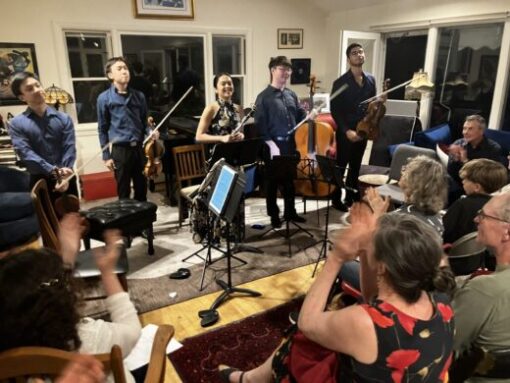
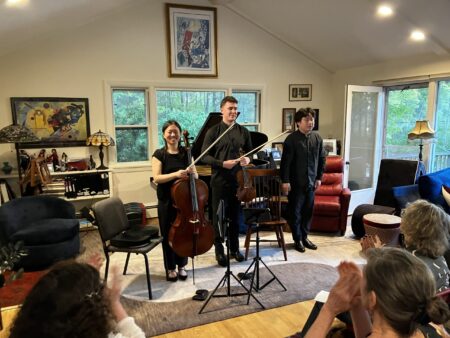
 United States Various, LyricaFest 2026 [1]: Musicians of the Lyrica Program. Lyrica Boston, Lincoln, Massachusetts, 25.5.2026. (LV)
Schoenberg – Verklärte Nacht, Op.4, arr. Eduard Steurmann for piano trio (Trio Laval, Jordan Bartel [violin], Sarina Zhang [cello], Sean Yang [piano])
Brahms – Clarinet Quintet in B minor, Op.115 (Carla Fortmann [clarinet], Thompson Wang, Darwin Chang [violins], David Carreon [viola], Zac Fung [cello])
Schubert – String Quartet in G major, Op.161, D.887 (Amelia Posner-Hess, Matthew Adams [violins], Josue Negrete [viola], Benjamin Doane [cello])
Summer in Lincoln arrives at its own unhurried pace – never mind that temperatures had touched 93 degrees the previous week. LyricaFest, now in its 26th edition, operates on much the same terms. As sunset spread across the pond and through the backyard stands of maples and other trees, the evening’s first notes confirmed once again why this small, tuition-free summer festival, an hour’s stroll from Walden Pond, continues to matter in ways no amount of institutional prestige can manufacture.
Before the Schoenberg, festival friend Chris Brown offered a quietly revelatory introduction: his mother had been an organist who studied counterpoint with Schoenberg in 1949. Schoenberg, she recalled, believed passionately in the overlapping of music, poetry and visual art – and Verklärte Nacht is nothing if not that belief made flesh, its broad strokes of color and emotion surging and retreating like weather. That quality came through with surprising vividness when Trio Laval – violinist Jordan Bartel, cellist Sarina Zhang and pianist Sean Yang – gave a persuasive account of Eduard Steuermann’s piano trio arrangement. The three musicians made heroic attempts to fill the sonic space left by the missing strings of the original sextet, with Yang’s piano an occasional thundering interloper as much as a collaborator. By the closing pages the music had become almost painfully exquisite. The response that swept through the room was spontaneous and surprisingly fervent.
From that unexpected triumph, the evening moved to the more familiar ground of Brahms’s Clarinet Quintet. Carla Fortmann’s clarinet immediately humanized the strings: violinists Thompson Wang and Darwin Chang, violist David Carreon and cellist Zac Fung. Wang’s inspiring, instinctive leadership gave the ensemble its spine, marking him as concertmaster material in waiting, and together they formed an intimate, breathing partnership. Even at its most turbulent, the first movement remained coherent, never hastily phrased, the ensemble bobbing and weaving with rhythmic alertness from agitation into quieter, more static episodes. The second movement’s long-limbed melody was impeccably laid out, Fortmann’s figurations aching and luminous. As always at LyricaFest, the lower strings were a particular strength: Carreon’s big viola sound was gorgeous throughout, and Fung produced some razor-sharp playing, often larger than life. The third movement brought tender glances between Fortmann and Carreon – who are, as it happens, a couple off the stage as well – that carried the unmistakable warmth of something beyond musical rapport. The balance occasionally swelled too heavily against the clarinet in the fourth movement’s final solo, and the serene variation wanted more rapture – but these were minor shadows over an unforgettable account.
The Schubert Quartet in G major was my first hearing of this piece in more than ten years since the Apollon Musagète Quartet gave their first public performance on a remote estate near Konin, the Polish city where violinist Janusz Wawrowski was born. They had been living with the piece for more than a year, but the LyricaFest ensemble had had barely a week. Like that earlier first performance, there were hesitations and occasional missteps. I had grown up with the Vienna Konzerthaus Quartet’s 1950 recording, slow and luxurious; this was a more modern, forward-driven Schubert. It issued from a primeval shroud – taking its time, earning its way into the light – but the bubbling, irrepressible Schubertian energy eventually broke through. When it worked, it was a revelation. First violinist Amelia Posner-Hess was remarkable – blazing not stolid, the living embodiment of the tradition that Laura Bossert and Terry King have spent 26 years forging here. Violinist Matthew Adams, violist Josue Negrete and cellist Benjamin Doane gave spirited support throughout.
LyricaFest’s governing idea, as Bossert puts it, is that ‘the ink is wet’. On this May evening in Lincoln, the ink was still flowing – freely, unpredictably and with the collective joy that no conservatory curriculum can schedule.
Laurence Vittes
Featured Image: Amelia Posner-Hess, Matthew Adams, Benjamin Doane and Josue Negrete © Laurence Vittes