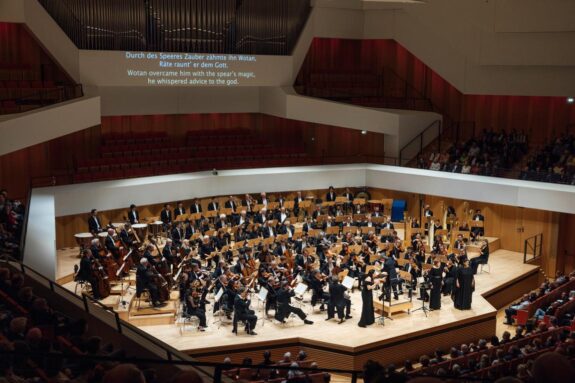
 Germany Wagner, Götterdämmerung: Dresden Festival Chorus of the Richard-Wagner-Academy, KlangVerwaltung Chorus, Dresden Festival Orchestra, Concerto Cologne / Kent Nagano (conductor). Philharmonie Cologne, 4.6.2026. (DM-D)
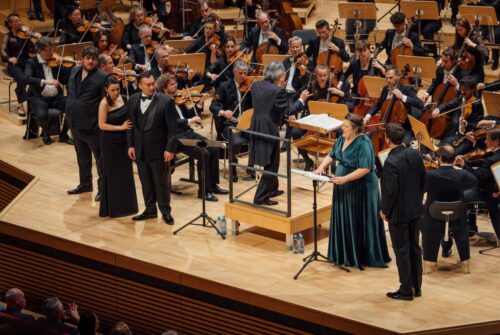
Cast:
Siegfried – Young Woo Kim
Brünnhilde – Åsa Jäger
Hagen – Patrick Zielke
Alberich – Daniel Schmutzhard
Waltraute – Olivia Vermeulen
Gunther – Johannes Kammler
Gutrune – Sophia Brommer
First Norn – Jasmin Etminan
Second Nor – Marie-Luise Dressen
Third Norn – Valentina Farcas
Woglinde – Ania Vegry
Wellgunde – Ida Aldrian
Flosshilde – Eva Vogel
This concert performance of Götterdämmerung brought to a conclusion the international project seeking to recreate what Wagner’s operas would have sounded like when they were first performed. The project was launched in 2017 and the first test performance of Das Rheingold was presented in 2021, followed by the four parts of the Ring in 2023 (Das Rheingold), 2024 (Die Walküre, see review here), Siegfried (2025) and now Götterdämmerung. In May 2027, all four parts will be presented at the Wiener Konzerthaus, with largely the same casts.
The contextual approach ensured particular attention to pronunciation in Götterdämmerung, which allowed us to understand the words without straining and without checking against the surtitles. Some moments on the stage came close to appearing semi-staged, with singers clearly playing their characters, in particular their emotions. This allowed strikingly essential insights. For example, the opposition of Brünnhilde and Hagen was foregrounded in their importance for the development of the plot: both were put on earth by their respective fathers, the initial opponents Wotan and Alberich, to carry on the feud beyond their deaths. Both Brünnhilde and Hagen were at their father’s mercy; Hagen in particular was aware of this and its impact on him. It was very moving indeed when Hagen revealed this to Alberich, along with the terrible realisation that it was he had inherited his evil nature, that he was aware of this but unable to do anything about it. So as to not increase his constant suffering by trying to fight his character, he lived it to the full in his plot against Brünnhilde and Siegfried. He was on the stage for most of the evening, watching the events as they unfolded, involved but also distant, with a sadly cynical expression on his face, hands in his trouser pockets. Siegfried was presented as well-meaning and naïve, ultimately an innocent victim of all the other’s intentions, of which he was oblivious. It was not until near the end that Brünnhilde realized what was going on, but once she did she immediately turned all her energy, which before was focused on her love for Wotan, then her love for Siegfried and then her hatred of Siegfried, into action: the immolation of Valhalla and the gods, herself included, to bring about a new dawn, to the tune of the redemption motif, first heard in Sieglinde’s exclamation ‘O hehrstes Wunder!’ in Die Walküre.
The depth of emotions in Götterdämmerung is monumental. The music has been composed to do that dimension justice. In productions of Götterdämmerung that do not use the historical approach, the stronger sound of contemporary instruments makes it challenging for any conductor to find a balance between intended intensity of the musical expression of emotions and maintaining a sound that does not become unpleasantly loud. Depending on their familiarity with the acoustics of the venue the opera is being performed in, conductors do not always succeed. The instruments used on this occasion overall do not produce as much volume as contemporary ones. In quiet passages, the impact is best for strong moments of a hushed mood. In tumultuous passages, of which there are many in Götterdämmerung, the nature of the sound inherent in the use of the historical approach, here due to the different instruments, is such that even if all instrument groups sound at full blast, individual nuances are still audible and the overall impact is never overbearingly that of ‘too loud’. This was also to a large extent due to Kent Nagano’s commitment to the project right from the start, and the intimate experience he has developed through this involvement. The sound from his orchestra was always carefully if imperceptibly shaped with attention to many minute nuances of interaction between instrument groups and orchestra as a whole, and singers and chorus. Nagano was particularly keen to foreground the leitmotifs in their different guises.
Such an approach only works as successfully as on this occasion with a cast of exceptional singers, as was the case here. Many productions of Götterdämmerung, at opera houses with a resident company will need to cast as many roles as possible from their ensemble, with only a few guest performers brought in, usually for the lead roles. While singers from the resident company will usually be very good, and their achievement will not let down the production in comparison to the guest artists, there is still a difference between that approach and being able to cast the smaller parts without financial restrictions. For Götterdämmerung, this is particularly true for the two trios of women, the three Norns and the three Rhinemaidens. Jasmin Etminan, Marie-Luise Dressen and Valentina Farcas sang the three Norns, full of individual nuances. There was no cross-casting with the three Rhinemaidens, who were sung by Ania Vegry, Ida Aldrian and Eva Vogel – again each bringing vocal subtlety to their roles, and each clearly ready to take on larger roles in any Wagner context. With her firm, rich voice, Olivia Vermeulen brought out particularly Waltraute’s urgency in her pleas, and her deep despair at Brünnhilde’s intransigence. Sophia Brommer and Johannes Kammler as Gutrune and Gunther were very convincing as brother and sister simply overrun by the person they considered their friend, oblivious to Hagen’s machinations, lagging behind any meaningful insight, realising what may have happened only when it is far too late. Daniel Schmutzhard gave Alberich some sad fatherly pride in his son Hagen, expressed in the way he sang ‘Hagen, mein Sohn’. Patrick Zielke was the omnipresent Hagen, cynically engineering the events and observing the impact of his intrigues with a twisted combination of satisfaction and horror.
Young Woo Kim made his role debut as Siegfried. His Wagner roles to date include Erik in Der fliegende Holländer and Siegmund in a children’s version of Die Walküre. He was completely unfazed by the weight, complexity and vocal demands of the role. His acting – here restricted predominantly to body posture and, in particular, to facial expression – demonstrated the high extent to which he identified with his character and his emotions. He also expressed Siegfried’s care-free nature in his approach to singing: in the best sense outright, free, never restricted or narrow, powerful without showing any sign of him following some overlaid technique, let alone limited by it. He was able to mould his voice to suit the emotional context, rather than engaging in acts more reminiscent of vocal weightlifting. A major discovery for the universe of Wagner opera!
Åsa Jäger’s voice has developed even further since her outstanding Brünnhilde in this project’s Die Walküre in 2024. She screamed where the project’s approach to the text demanded for it, but without sounding unpleasant. It was controlled and thus left no doubt it was intended and would never have come across as a flaw of her singing – nor as a danger to her voice. She was impeccable in the most mellow quieter moments and her fortissimo soared well above the orchestra, leaving the impression that she was still holding back a little. It is very rare to find a singer so much in control of her voice and able to produce her sound so effortlessly – and with so much joy underlying the range of emotions expressed.
Daniel Meyer-Dinkgräfe
Featured Image: Kent Nagano conducts Götterdämmerung (previously in Dresden) © Oliver Killig