 Bulgaria Wagner, Der Ring des Nibelungen: Singers, Chorus, Orchestra and Ballet of Sofia Opera and Ballet / Constantin Trinks (conductor). Sofia Opera, 26-31.5.2026. (GT)
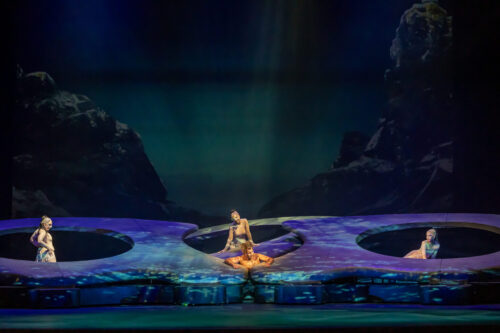
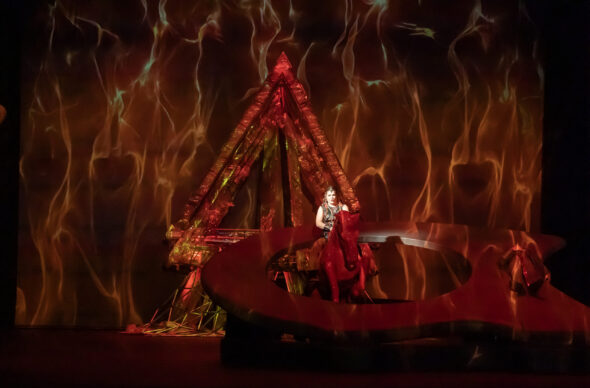
This revival of Plamen Kartaloff’s 2023 Ring cycle offers significant improvements in several areas. These are most clearly seen in striking visual projections, and in the small yet nuanced changes to scenes, and choreography lending greater momentum to the narrative of Wagner’s visionary operatic tetralogy. Many members of the cast remained from past stagings of Kartaloff’s Wagner productions. A common feature has been the hiring of singers to take the more difficult role of the bass-baritone Wotan. Only in the opening Das Rheingold did the role go to a native Bulgarian, while Aris Argiris assumed the task in Die Walküre, and the Hungarian Krisztian Czer was the Wanderer in Siegfried.
The opening of Das Rheingold began with the Rhinemaidens singing, dancing, and jumping on trampolines. Especially notable this year was the greater sensuality by the Rhinemaidens in enticing Alberich with openly explicit invitation by Alexandrina Stoyanova-Andreeva’s Flosshilde opening her legs before Alberich, as the others were frolicking around sharing in their bold and sexual invites, but all daringly withdrawn, all part of a tease.
In Das Rheingold, the Fricka of Vesela Yaneva was outstanding in her emotive singing, enhanced by eye, facial, and body movement. This portrayal of Wotan’s jealous, loving wife was a major triumph and a highlight of the whole cycle. Veselin Mihaylov’s Wotan was masterly both in voice and portrayal, and it is a pity he only appeared in the prologue of the cycle. The Alberich of Plamen Dimitrov was also a great success in voice and acting, and an advance on his past portrayals. His performance was more than equalled by the Loge of Daniel Ostretsov, who was magnificent both in voice and portrayal; again, every little eye and facial movement was artfully done revealing his barely hidden hatred of the gods.
Yaneva’s Fricka in Die Walküre was at the heart of the narrative – she completely captured this difficult and challenging part, one of the most demanding roles in the whole cycle. She will get even better as she has both ambition and desire. In Act III, Yaneva was Schwertleite as one of the Valkyries, completing a major performance. The Wotan of Aris Argiris was masterly, both vocally, in a complete portrayal, every bit as fine as two years ago. The Sieglinde of Alma Liza Bandalovska was outstanding, especially in her delicately nuanced acting from the opening scene through to the scene when she is totally distraught and protected by the Valkyrie against the wrath of Wotan. The Brünnhilde of Gergana Rusekova was outstanding, and it would be no exaggeration that this role belongs to her in another magnificent performance. The Siegmund of Martin Iliev was masterly in his assuming one of the most challenging heldentenor roles in the Ring. The veteran Kurt Rydl was magnificent as Hunding in eliciting every ounce of this challenging part and was in superb voice (at the age of 78). There were improvements in the choreography, allowing more meaning to the storyline. The orchestral playing under Trinks was magnificent; every ounce of colour was glittering and exciting, especially in the opening prelude to the opera and the Ride of the Valkyries in the third act.
At the heart of the second day of the tetralogy, the most challenging scene was dominated by that between Alberich, Mime and Siegfried. The Alberich of Plamen Dimitrov continued from his fine performance in Das Rheingold, while Martin Iliev in the title role was outstanding throughout as the narcissist teenager in the opening scenes and ultimately transforming into the lusty lover of Brünnhilde. Krassimir Dinev’s Mime gave another strong showing of the wicked possessor of the Ring and of his diminishing power over his custodian Siegfried. The Wanderer of Krisztian Cser was well performed, although the playing with the blown-up ball (depicting the world) became a slight distraction. His portrayal was at one stage somewhat one-dimensional. The Erda of Vesela Yaneva was another powerful performance reinforcing this singer’s remarkable development into a major Wagnerian singer. She is becoming a big star at Sofia Opera. The Woodbird of Maria Pavlova brought colour and movement to Act II. The scenes were superbly colourful, and the flames breaking out around Brünnhilde were intensely dramatic and exciting. The final scene of the awakening of Brünnhilde, here taken by the talented Radostina Nikolaeva, was slow to develop, yet the duet, accompanied by Trink’s direction, led to the triumphant climax
In Götterdämmerung, the Siegfried of Martin Iliev gave a faithful portrayal throughout and dominated with his magnificent voice and character. As with Iliev’s Siegfried, Buchkov’s Hagen was a complete portrayal of this challenging role. The Brünnhilde of Radostina Nikolaeva did not meet expectations, as both her vocal delivery and characterisation lacked the usual expressiveness and power. Bandalovska’s Gutrune was moving in her contrasting emotional expression from being Gunther’s faithful sister to the beloved of Siegfried. As in past cycles, Atanas Mladenov’s Gunther was outstanding both in voice and character. The Waltraute of Violeta Radomirska reveals a new star here, outstanding in voice and superbly acted as she was as Erda in Das Rheingold. Plamen Dimitrov’s Alberich constantly lurked in the background, seeking his gold ring. At the close, the Tree of Life rises with the Rhinemaidens enticing Hagen’s fruitless pursuit.
In this 2026 revival, among the most outstanding factors has been the magnificent singing by Bulgarian singers in the main roles, such as Alma Liza Bandalovska’s Sieglinde, the Brünnhilde by Gergana Rusekova in Die Walküre, and especially by Vesela Janeva as Fricka (she was also Schwertleite and Erda). One major performance throughout was Martin Iliev as Siegmund and Siegfried; showing with ease all the stamina required over the three operas, which together with his portrayals and heroic singing, was perhaps the most striking success of the whole cycle in Sofia.
This Ring cycle is the result of many talented people at Sofia Opera, among whom are Kartaloff’s assistant director Yulia Krasteva, the costume design of Hristiana Mihaleva-Zorbalieva, the choreography by Riolina Topalova, the scenery construction by Eng. Georgi Georgiev and Boryan Belchev, Hans Kudlich’s remarkable set design, the video projection team led by Elena Shopova and the lighting design by Andrej Hajdinjak, all combining in bringing out the magical, often fairy tale character of many scenes. Constantin Trink’s masterly direction was at the heart of this cycle, drawing out every nuance of Wagner’s richly embroidered score and making the outstanding musicians of Sofia Opera into a true Wagnerian orchestra.
The 2026 Sofia Wagner Festival continues with Lohengrin and Tannhäuser on 12 and 14 June, respectively. This year marked the 150th anniversary of Wagner’s Ring cycle and was attended by many Wagnerians from three continents. In 2028 Plamen Kartaloff will produce a new staging of Die Meistersinger von Nürnberg.
Gregor Tassie
Featured Image: The end of Sofia Opera’s Ring cycle (Götterdämmerung)