 United States Grant Park Music Festival 2026 [1] – Various: Grant Park Orchestra / Jeri Lynne Johnson (conductor). Jay Pritzker Pavilion, Chicago, 15.7.2026. (ZC)
William Grant Still – Festive Overture
Ravel – Piano Concerto in G major
Price – Symphony No.3 in C minor
For the nation’s 250th anniversary, Chicago’s Grant Park Orchestra has spent its summer festival surveying the American classical music tradition. The ensemble’s music directors have long possessed an appetite for discovery, unearthing obscure or overlooked corners of the repertoire. But the American works that have graced the Pritzker Pavilion in recent weeks suggest that this adventurous orchestra can still find fresh terrain to explore.
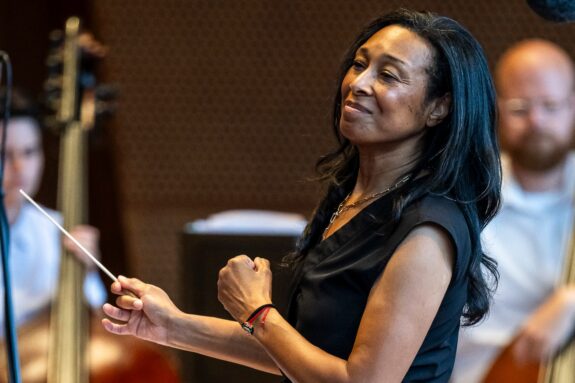
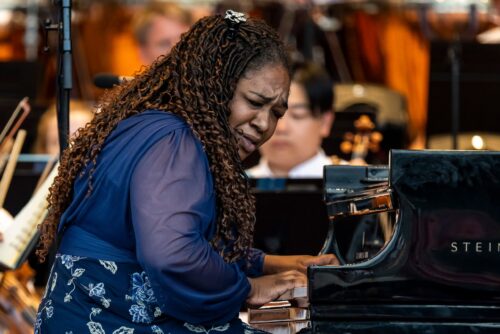
Wednesday evening offered a rich example of this. Guest conductor Jeri Lynne Johnson led a program that opened with William Grant Still’s Festive Overture, continued with Ravel’s Piano Concerto in G major, featuring pianist Michelle Cann, and concluded with Florence Price’s Third Symphony. Taken together, these works chart a Black American musical lineage in the first half of the twentieth century.
Ravel’s concerto is an unusual addition to the Grant Park Orchestra’s American survey. But though the composer was French, his 1928 tour of the United States fundamentally shaped this work. Jazz syncopations and colors seeped into the score, lending it an American accent that almost erases its Gallic origins. The first movement especially captures this hybrid energy: one could almost mistake passages for Gershwin’s Rhapsody in Blue, completed just three years earlier. In fact, Ravel and Gershwin were working in parallel, each discovering in American jazz a way to refresh the European classical tradition.
Cann understood this duality intuitively. Her playing was crisp and angular where the score demanded brightness and pivoted to soft and elusive tones elsewhere. She never let one element overwhelm the other, allowing the piece to breathe as both French salon music and American vernacular idiom.
The Grant Park Orchestra matched her intelligence, capturing Ravel’s jazzy inflections without caricature.
Price’s Symphony No.3 draws from a different thread of our national musical heritage. Her symphonic language was shaped in part by Antonín Dvořák, who famously urged American composers to look to Black spirituals for inspiration. The recent rediscovery of Price has been a major boon for the classical world: her accomplishment is undeniable, especially given the institutional racism and sexism that constrained her career. And now her works can – and are – shaping the current generation of American classical talent.
Yet aspects of Price’s music can feel frustrating at times. For thirty minutes, the Third Symphony remains mostly in low gear and rarely reaches moments of high excitement, instead unfolding through episodes colored by African American folk idioms. Its orchestral palette is dominated by dark, mysterious colors, which makes it more of an acquired taste. If the Ravel was snappy, Price’s symphony felt like a languorous, humid Chicago summer evening. But under Johnson’s baton, the orchestra skillfully gave generous shape and burnish to these weighty melodies.
Still’s Festive Overture, written four years after Price’s Third Symphony, threw this contrast into sharp relief. The two were contemporaries, yet Still received far greater institutional support. His overture wears its influences openly, echoing the breezy idioms of newsreel scores and light classical music. Where Price is ruminative, Still is extroverted. Where Still confidently inhabits the musical language of his moment, Price charts a more solitary path out of necessity.
How Price might have developed as a composer had her music been regularly championed by the likes of Serge Koussevitzky or Artur Rodziński remains a tantalizing ‘what if?’ Frequent performances build a composer’s confidence and establish a vital performance tradition, and greater advocacy might also have accelerated the rise of Black and female classical musicians decades earlier. Perhaps it is a bittersweet exercise to imagine this world but, on this milestone national anniversary, it is nonetheless worth considering, even amid the backdrop of celebrating what we have regained today.
Zach Carstensen
Featured Image: Jeri Lynne Johnson conducts the Grant Park Orchestra © Norman Timonera