 United States Berkshire Opera Festival – Donizetti, Lucia di Lammermoor: Soloists, Berkshire Opera Festival Chorus and Orchestra / Brian Garman (conductor). Mahaiwe Performing Arts Center, Great Barrington, 22.8.2026. (RP)
Tradition ruled in Berkshire Opera Festival’s compact, compelling production of Donizetti’s Lucia di Lammermoor – rare enough these days given the heavy directorial approach often encountered in the standard repertoire. It was all the more rewarding for its vibrant, youthful cast and the deft musical and dramatic contributions of BOF co-founders Brian Garman and Jonathon Loy.
In Donizetti’s opera, Lucia Ashton loves Edgardo di Ravenswood despite the bitter feud between their families. Enrico, her brother, forces her to marry Arturo Bucklaw and deceives her into believing that Edgardo has abandoned her. Enrico treats his sister’s marriage as a transaction combining family survival and political strategy while Lucia experiences it as the end of her hopes for true love and happiness. Driven to despair, Lucia kills Arturo on their wedding night and descends into madness in the famous ‘Mad Scene’. Edgardo, learning of Lucia’s death, takes his own life so that they may be reunited in death.
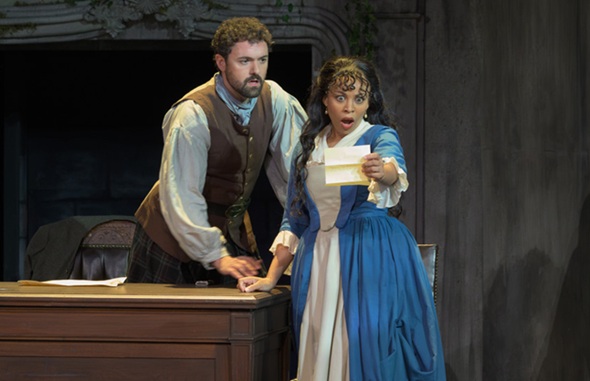
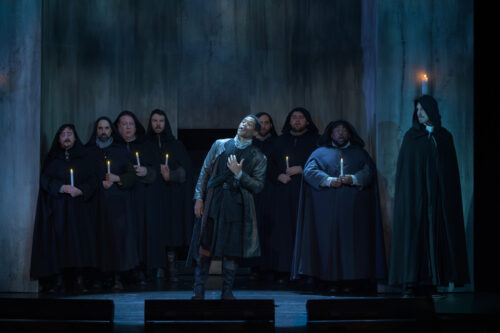
Loy sets the opera in Scotland near the end of the 17th century. The story unfolds in a stone Scottish castle with a strong Calvinist aesthetic, emphasizing restraint, discipline and sobriety. The main stage elements are a towering alcove with a large fireplace and a massive iron circle draped with moss and ivy. Lighting and stage smoke add to the atmosphere of tension, oppression and doom. It is simple but effective, and Loy does his best to keep the stage from appearing overcrowded, even at the cost of rather inert staging for the chorus. His one deviation from the libretto is having Lucia kill her brother.
Christine Lyons was a fascinating, dramatically compelling Lucia. Still numb from mourning her mother’s recent death, she can barely comprehend the demands her brother places on her. Lyons’s Lucia became flesh and blood in her scenes with Edgardo, when her voice filled with radiance and warmth, particularly in their Act I duet, ‘Verranno a te sull’aure’. In the ‘Mad Scene’, Lyons expressed Lucia’s escape from the horrors of her fate and actions with harrowing emotion, embellishing it with all the arrows in her bel canto quiver: trills, mordents, turns, runs and cadenzas that were no mere technical display but expressions of true emotion.
As Edgardo, Terrence Chin-Loy got off to a rocky start, his tenor lacking focus and squillo, the bright, ringing, penetrating quality that allows a voice to carry effortlessly over an orchestra. It settled sufficiently to partner effectively with Lyons in ‘Verranno a te sull’aure’ and was truly impressive in Edgardo’s Act III tomb scene, ‘Tombe degli avi miei’. As Chin-Loy’s voice gained in presence so did his acting, resulting in an ultimately heroic portrayal.
Baritone Dean Murphy has had an impressive and rapid rise from young American singer to established European ensemble baritone in Berlin and Zurich. As Enrico, his singing was as powerful – at times perhaps too much so – as it was imposing. Traces of self-doubt appeared beneath his character’s implacable veneer of self-interest, laced with desperation which made his portrayal all the more complex and compelling.
Garbed in the black robe and white clerical bands of a Calvinist cleric, Stefan Egerstrom’s clear, open bass brought authority to Raimondo. His impressive sound was matched by his compassion in the role, establishing Raimondo clearly as Lucia’s protector. Young mezzo-soprano Christina Grohowski, newly selected for the Metropolitan Opera’s Lindemann Young Artist Development Program, displayed an alluring, clear, penetrating voice as Alisa.
Scott Rubén La Marca was overpowered by the orchestra in the opening scene where his Normanno leads the search for an intruder on the Ashton estate. His gleaming tenor, however, soon revealed itself and his Normanno was particularly effective in conjuring the oppressive world in which Lucia is little more than a captive. Luke Norvell’s Arturo was as hearty in voice as in appearance.
Apart from the heavy-handed opening scene, Garman led an elastic, transparent and expressive reading of the score, giving the singers ample space for maximal expression. It was a particularly fascinating sonic experience because of the placement of the harp and glass armonica in boxes on either side of the proscenium.
André Tarantiles’s delicate harp playing created the shimmering, otherworldly atmosphere of Lucia’s fountain scene in which Lyons first demonstrated both the fragility of the young woman’s psyche and the intensity of her love for Edgardo. In the ‘Mad Scene’, Dennis James’s playing of the glass armonica, with light dancing off the instrument, was visually mesmerizing as were the sounds he made. His interplay with flautist Karen Bogardus and the frisson he created with the woodwind section as a whole were exquisite.
Rick Perdian
Featured Image: Dean Murphy (Enrico) and Christine Lyons (Lucia) © Matt Madison-Clark
Production:
Director – Jonathon Loy
Sets – Cameron Anderson
Costumes – Brooke Stanton
Lighting – Alex Jainchill
Assistant Conductor and Chorus master – Luca Antonucci
Cast:
Lucia – Christine Lyons
Edgardo – Terrence Chin-Loy
Enrico – Dean Murphy
Raimondo – Stefan Egerstrom
Arturo – Luke Norvell
Alisa – Christina Grohowski
Normanno – Scott Rubén La Marca