 Austria Salzburg Festival 2026 [1] – Bizet, Carmen: Soloists, Utopia Choir (chorus master: Vitaly Polonsky), Salzburg Bach Choir (chorus master: Michael Schneider), Salzburger Festspiele und Theater Kinderchor (chorus masters: Wolfgang Götz, Regina Sgier), Utopia Orchestra / Teodor Currentzis (conductor). Filmed (directed by Michael Beyer) at the Grosses Festspielhaus, Salzburg, on 8.8.2026 and streamed on STAGE+ on 9.8.2026. (JPr)
The origins of the story of Carmen – which has reputedly given the world its most popular opera – go back to Andalusia in 1830 when the French author Prosper Mérimée heard an anecdote about a girl killed by a jealous lover who was – as traditionally called then – a gypsy. With the experience of another fifteen years of travelling in Spain, as well as encountering and reading about gypsies, he published his novella Carmen in 1845. Mérimée’s story is about Don José Navarro, a Spanish soldier, passionately in love with Carmen; he deserts his regiment to follow a life of crime and murder for her. Because Carmen seems incapable of being faithful to him, Navarro kills her and whilst awaiting his execution for his crime recounts his story to the novel’s narrator. In Carmen, Mérimée creates one of the greatest femme fatales in all of literature; a woman exploiting her sexuality and mystique to further her own ends. Mérimée’s Carmen is ‘prettier than any gypsy’ with eyes that are both sensual and savage. Because she could not afford perfume she wore heavily scented flowers. She is faithful to her own people and cannot tolerate José’s possessive love for her. She loves her freedom above all else and faces death boldly, totally resigned to her fate, bringing her story to a tragic end.
It is unclear why Bizet chose Carmen, described as ‘a sober laconic lowlife story only slightly relieved by the exotic setting of Spain’, as the subject for an opera. Those he composed before this were romantic; whilst he had never been to Spain and knew little of its music. The management of the Paris Opéra-Comique objected to its assorted gypsies, prostitutes, thieves and cut-throats. Even his librettists, Henri Meilhac and Ludovic Halévy did not particularly care for the project and they revised the story – much to Bizet’s displeasure – to make it better as an opera and more acceptable to the mores of the day. They added Micaëla to symbolise the innocence of Don José’s village and included the toreador Escamillo to embody the type of man Carmen couldn’t resist. The 1875 premiere did not go well and the press were hostile. Bizet pronounced it ‘a definite and hopeless flop’; it made him ill and probably contributed to his early death. For others such as his fellow composer Massenet, it had been ‘a great success’ and Tchaikovsky later called it ‘a masterpiece’. There had been many mishaps when it premiered: the tenor Paul Lhérie had vocal problems; the cigarette girls, who were not used to smoking, choked in Act I; as Carmen, Celestine Galli-Marié lost her castanets and had to break a plate on stage and use that; also the timpanist misread his score and intruded loudly during the duet between Don José and Carmen. Yet from this poor start, Bizet’s Carmen has gained its enormous popularity over the years.
Despite that ‘popularity’ I understand Carmen has had new productions at the Salzburg Summer Festival only twice before: in 1967 with Grace Bumbry and Jon Vickers as Carmen and Don José, then in 1985 with Agnes Baltsa and José Carreras in those roles; with both productions conducted by Herbert von Karajan. (In a staging reprised from the 2012 Easter Festival it was also seen in Salzburg that summer with Magdalena Kožená and Jonas Kaufmann.) With Bizet’s early death we have no real idea what the ‘true’ Carmen is despite the vocal score he left behind. Paul Prevost’s new Bärenreiter-Verlag edition has – I understand – gathered all extant versions allowing companies to choose which they prefer.
Also, there is the problem of the spoken dialogue: Bizet clearly intended to provide sung recitatives and those Ernest Guiraud provided are often the solution to this. Where a lot of spoken French is included this can actually be a problem for the multinational casts common today: in Salzburg there is a Lithuanian Carmen (Asmik Grigorian), a Chilean-American Don José (Jonathan Tetelman), a Russian Micaëla (Kristina Mkhitaryan) and Italian Escamillo (Davide Luciano).
This lengthy preamble has two uses; firstly, to give some idea of the opera’s plot and secondly, some of the decisions director and choreographer Gabriela Carrizo (founder of the Brussels-based Peeping Tom dance company) and conductor Teodor Currentzis needed to address in a first Carmen for both of them. Though not a first for Carmen is the removal of the spoken dialogue which is replaced here by Raphaëlle Latini’s haunting soundscape – sometimes mere metallic sounds, sometimes indecipherable voices speaking, sometimes we hear singing – which did little to move the plot on. You will need to know the opera (who doesn’t perhaps?) to know who anyone is and what is going on.
Dancers from Peeping Tom are on the stage almost throughout the opera expressing through their movement the psychological turmoil and desires of the opera’s characters; or otherwise illuminating other aspects of the drama such as when we see a man physically abused by the soldiers during Act I. The repetitive physical jerks, contortions and off-kilter movement defeated the object. In Act II there is some dervish-style (drunken) twirling, while Escamillo has a dancer double in full bullfighter costume – with singer Davide Luciano seemingly in rehearsal clothes – revealing what happened if the bull got the better of him. This act also saw the appearance of Amparo Cortés, a traditional cante jondo flamenco singer, as Lilas Pastia singing an interpolated song; and a brief return to an old opera trope I had not seen for a little while as a chair gets thrown over!
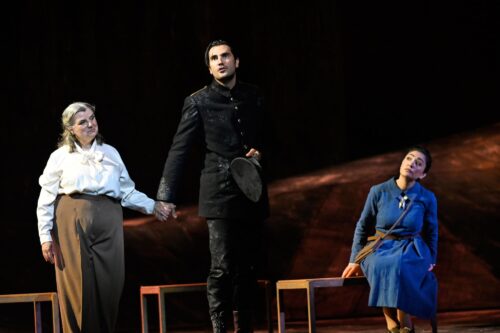
There are so many of these familiar tropes, as well as other oddities, as Carmen the opera fights (and loses out to) Carmen the ballet. Showing Don José’s mother – referred to many times in the libretto – on the stage is not new and these days there must be water on the stage too (initially for the cigarette factory girls to wash themselves of course). However, the two combined later for a naked girl to rise from the water as Carmen sings in the second act. Then in the following one – goodness knows why? – the veteran member of Peeping Tom, Eurudike De Beul (as the Don José’s mother), now fully naked, appears to be drowned in the water. Inexplicably there is a soldier in a fat suit at one point; a cabinet displayed with a bare torso gored by a bull; a Dia de Los Muertos-inspired religious procession with a skeletal relic; and a writhing Christ-like figure with a neon halo. Act III begins with two bare-chested men (there are a lot of bare-chested men on show) each with an antler on his head, entwining. Perhaps one of the better moments was when a male dancer dressed in a bullfighter’s jacket thrusts his groin – encased in Kylie Minogue gold hotpants – at Carmen as evidence of her burgeoning ‘hots’ (!) for Escamillo.
In general the gloomy landscape – despite an occasional golden glow and the all-pervading hot and sweaty atmosphere – looked for the most part like the Somme battlefield rather than Andalucía; the soldiers in their distressed uniforms reminded me of the ghostly crew in Wagner’s The Flying Dutchman and the street urchins appear direct from a production of Oliver! A small blond boy is shown wielding a rifle to murderous effect when he shoots three of the children: a very powerful image for 2026.
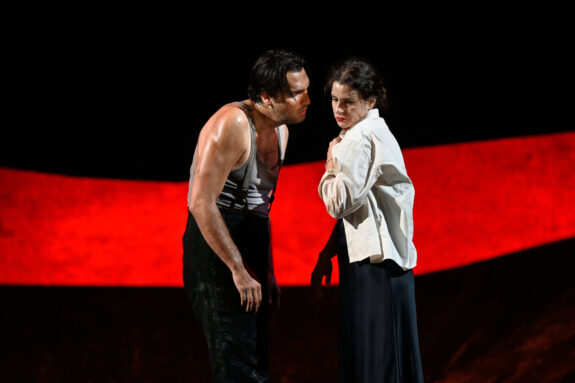
Act IV – even if musically filleted it seems – showed what could have been had the director/choreographer trusted Bizet’s vision more. With the stage glowing blood-red and appearing more oppressive than ever the chorus – most costumed as red devils – lined up across the front (not new) and there is no procession with Escamillo just coming round twice in his traje de luces. Left alone without any dancing ninnies (sorry!) this Carmen reaches another level. Knife-wielding and wide-eyed Mummy’s boy Don José has lost all sense of reason because of sexual jealously and Carmen resists – with fatal and bloody consequences – insisting she was born free and will die free. Jonathan Tetelman comes into his own here and he was frighteningly convincing even if his burnish tenor was perhaps a little more can belto than I would prefer. Asmik Grigorian is always an accomplished artist, but I have never seen her so relaxed in her magnetically intense singing and the volatility and raw emotion of her acting. This was her first Carmen onstage, and she brought her to genuine life; fickle modern woman, yes, ‘traditional’ predatory maneater, no. Blowing smoke rings, Grigorian’s seductive intimate second-act dance eschews castanets for smashed plates (a look back at the opera’s premiere perhaps?).
I cannot remember a better sung Escamillo than Davide Luciano’s with his commanding, dark-toned baritone voice and perfect balance of charisma and macho swagger. Kristina Mkhitaryan’s Micaëla was sung with a radiant vocal clarity and a touching youthful innocence, though her famous Act III showed her character’s inner strength. Everyone else was a mere cypher by comparison though Zuniga (Matthias Winckhler), Moralès (Liviu Holender), Frasquita (Iveta Simonyan), Mercédès (Anita Monserrat), Le Dancaïre (Michael Arivony) and Le Remendado (Mingjie Lei) sang and acted – what they were given to do – well. The vocal discipline of the combined chorus of Currentzis’s Utopia Choir, Bachchor Salzburg and Children’s choir brought colour and, where appropriate, dramatic tension to their involvement as unruly children, feral soldiers, lusty men, resourceful smugglers or a boisterous crowd ready for a bullfight
I understand Carmen is not Teodor Currentzis’s normal repertoire but helped by significant solo contributions from his fine Utopia Orchestra, this vibrant Carmen had high-octane energy, emotional weight and all the fiery passion you would wish for.
Jim Pritchard
Featured Image: Jonathan Tetelman (Don José) and Asmik Grigorian (Carmen) © SF/Thomas Aurin
Creatives:
Director and Choreography – Gabriela Carrizo (Peeping Tom)
Sets and Costumes – Christof Hetzer
Lighting – Tom Visser Lighting
Directing Collaborator – Raphaëlle Latini
Artistic Collaborator Choreography – Charlie Skuy
Dramaturgy – Christian Arseni
Cast:
Carmen – Asmik Grigorian
Don José – Jonathan Tetelman
Micaëla – Kristina Mkhitaryan
Escamillo – Davide Luciano
Frasquita – Iveta Simonyan
Mercédès – Anita Monserrat
Zuniga – Matthias Winckhler
Moralès – Liviu Holender
Le Dancaïre – Michael Arivony
Le Remendado – Mingjie Lei
Don José’s Mother – Eurudike De Beul
Lilas Pastia – Amparo Cortés
Fons Dhossche, Boston Gallacher, Balder Hansen, Chey Jurado, Seungwoo Park, Romeu Runa, Eliana Stragapede (Performers of Peeping Tom)
I like seeing the smashed plates — if you ever get around to reading Mérimée’s novella, his Carmen does this when dancing for Don José.