 Romania George Enescu Competition 2026 [1] – Various: Mayumi Kanagawa (violin), Yo Kitamura (cello), Roman Lopatynskyi (piano), Romanian Radio National Orchestra / Cristian Măcelaru (conductor). Romanian Atheneum, Bucharest, 23.8.2026. (ES-S)
Diego Santamaria – The Stone and the Ivy
Dan Dediu – Brahmsodia, Triple Concerto for Violin, Cello and Piano, Op.169
Encore: Brahms – Hungarian Dance No.6
Enescu – Symphony No.1 in E-flat major, Op.13
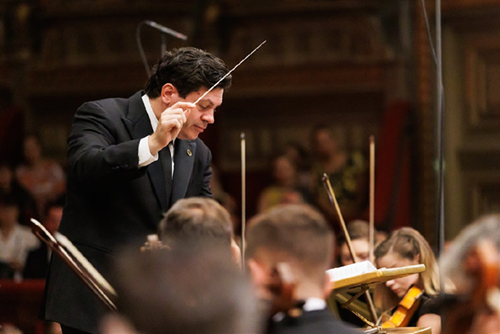
The twentieth edition of the George Enescu International Competition opened at the Romanian Athenaeum with a program that looked both backwards and ahead, drawing on musical history as well as the competition’s own recent past. Held every two years and alternating with the George Enescu International Festival, the competition is meant to bring outstanding young performers and composers to the fore. Cristian Măcelaru, Artistic Director of both Festival and Competition, led the Romanian Radio National Orchestra, juxtaposing a new orchestral work by Italian composer Diego Santamaria with Dan Dediu’s exuberant reimagining of Brahms and, after the interval, Enescu’s First Symphony.
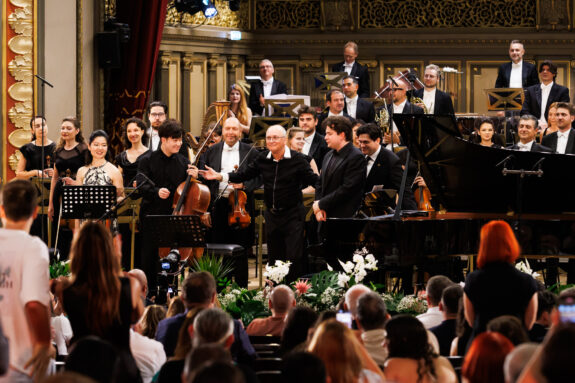
Dan Dediu’s Brahmsodia brought together violinist Mayumi Kanagawa, cellist Yo Kitamura and pianist Roman Lopatynskyi, the winners of their respective instrumental sections at the 2024 competition. The work itself has an unusual history. Written for the opening of the 2020 competition, it was heard then in an empty Athenaeum in a version for reduced orchestra adapted for pandemic restrictions. Dediu’s original 2019 version for full orchestra was performed for the first time on Sunday.
A prolific composer, Dediu has in recent years written a series of concertos for multiple soloists, allowing him to explore the interaction between chamber-music textures and large orchestral forces. Brahmsodia adopts the instrumental model of Beethoven’s Triple Concerto – violin, cello and piano against a full orchestra – but takes Brahms as its musical point of departure. In a 2020 interview, Dediu called it ‘music about the music of Brahms’, mixing quotations, arrangements and pastiche with music of his own. Dediu’s free treatment of Brahms belongs to a tradition stretching from Schnittke’s polystylism to Jörg Widmann’s more recent dialogues with the classical canon in which inherited music becomes material for distortion and reinvention.
Măcelaru gave this complex, reference-laden score a clear trajectory. The first movement, ‘Brahms Bulldozed’, begins with an adaptation of Brahms’s Intermezzo No.3 for the three soloists, before drawing on other late piano miniatures. Against this delicate Brahmsian world, march-like rhythms grow increasingly threatening though the opposition is never absolute: at times the orchestra absorbs and transforms material introduced by the trio. Măcelaru kept these changing relationships clear, allowing the orchestral clamor to become genuinely menacing without drowning out the Brahmsian material. The additional forces of Dediu’s original orchestration brought greater color and contrast to the exchanges.
‘Brahmsian Tardigrades’ turns the German composer’s motifs into musical counterparts of the resilient microscopic creatures of its title: fragments capable of surviving the preceding demolition and traveling through time. Kanagawa, Kitamura and Lopatynskyi now functioned less as a cohesive group but still formed and dissolved alliances while soloists and orchestra exchanged material without fully merging.
In the final movement, ‘BrahmStoker – Songs from a Bottle on the Ocean’, the march theme from the opening movement returns alongside familiar Brahmsian fragments, including references to the Wiegenlied and Hungarian Dances. At times the music evoked a fairground spectacle. Dediu’s wit was most evident here, though the musicians never played it simply for laughs. Fittingly, the three soloists followed Brahmsodia with an arrangement of Brahms’s Hungarian Dance No.6 as an encore.
The other link to the 2024 competition was Diego Santamaria’s The Stone and the Ivy, winner of its Originality Prize for composition. Premiered on this occasion, the three-movement symphonic work takes its title from the opposition between two elements: stone, static and lifeless, and ivy, alive, delicate and ornamental. Măcelaru and the orchestra brought balance and remarkable transparency to the slowly changing textures without losing the underlying tension. The work’s overall ritualistic character did occasionally bring Stravinsky to mind, while musical time seemed alternately to dilate and contract. The predominantly nocturnal atmosphere acquired a more hypnotic quality in the final ‘Nocturnal Dances’, where a stable rhythmic pulse continued beneath melodic hints that fluidly emerged, merged and dissipated.
After the interval, Enescu’s Symphony No.1 offered a different encounter with the Brahmsian musical inheritance. Written in 1905 when Enescu was only twenty-three, the symphony reflects the young composer’s dual formation in Vienna and Paris: its architecture is rooted in the Austro-German tradition while its sensitivity to orchestral color bears the imprint of his French schooling.
Măcelaru has already recorded the symphony with the Orchestre National de France as part of his recent Enescu cycle for Deutsche Grammophon. His reading favored forward momentum over monumentality, with breadth and urgency marking the first movement. The opening was a shade too loud for the Athenaeum’s acoustics but the conductor quickly tempered the sound. The Romanian Radio National Orchestra gave plenty of weight to the climaxes without obscuring the woodwinds which emerged clearly even from Enescu’s crowded textures.
The Lent brought supple strings, finely characterized wind solos and greater flexibility of phrasing. The musicians’ familiarity with Enescu’s idiom seemed to matter a great deal: phrases unfolded naturally, their rhythmic and expressive inflections allowed to speak for themselves. The finale recovered the energy of the opening movement, with Măcelaru patiently building layer upon layer toward a splendidly controlled conclusion.
Heard after Brahmsodia, the symphony brought the evening’s dialogue with the past into sharper focus. Dediu looks back at Brahms from the 21st century, taking his music apart and recombining its surviving fragments; the young Enescu encountered the Brahmsian tradition as a living presence, absorbing it while already transforming it into a language distinctly his own.
Edward Sava-Segal
Featured Image: Dan Dediu with the soloists of Brahmsodia and Cristian Măcelaru © Cristina and Petrica Tanase