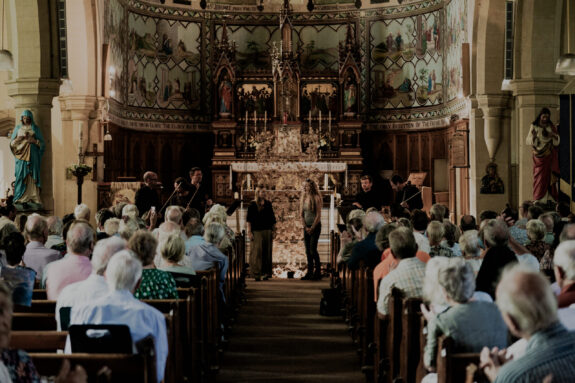
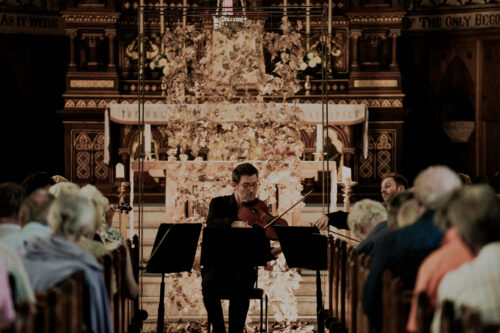
 United Kingdom North York Moors Festival 2026 – ‘The Dividing Line’: Alena Baeva, Benjamin Baker, Alessandro Ruisi and Charlotte Scott (violins), Sascha Bota (viola), Rebecca Gilliver, Tim Posner and Jamie Walton (cellos), Will Duerden (double bass), Ben Goldscheider (horn), Nicholas Daniel (oboe), Matthew Hunt (clarinet), Jonathan Davies (bassoon). St Hedda’s Church, Egton Bridge, North Yorkshire 13.8.2026. (PC)
Thea Musgrave – Dawn
Kurtág – Ligatura (from The Answered Unanswered Question)
Ives – The Unanswered Question
Charlotte Bray – That which you wove of lightest thread, I wear to honour stone (world premiere)
Schubert – String Quintet In C, D956
Entitled ‘The Dividing Line’, a reference to the boundary between earth and sky, a concert held as part of the North York Moors Festival offered polished accounts of new and enterprising repertoire for small forces and a gripping performance of one of the pinnacles of chamber music. The Grade II-listed Victorian Catholic church, with its ornate chancel, unadorned walls and high nave provided a welcome place of cool sanctuary on a sweltering summer afternoon. Besides the building’s architectural facets, an installation created by visual artist Caroline Burraway honouring the burial place of children in a forgotten refugee graveyard and incorporating leaves sewn together by the artist’s own hair formed a striking and compelling central background to the music-making.
The thoughtfully programmed first half of the recital consisted of four works, presented as a single, unbroken sequence. To begin, oboist Nicholas Daniel performed from on high behind the audience an evocative solo miniature written for him in 2012. Thea Musgrave’s Dawn unfolded in one, fluently shaped span from hazy daybreak to a sunshine-filled climax, making a perfect concert-opener and a welcome reedy alternative to the more ubiquitous off-stage curtain-raiser, Debussy’s Syrinx, for solo flute, of 1913.
Cellists Jamie Walton and Tom Posner and violinists Benjamin Baker and Alessandro Ruisi then gave a hypnotically spacious, deeply focused account of Kurtág’s Ligatura (from The Answered Unanswered Question), written in 1989. The work’s extended chordal phrases were warmly shaped and the separation between the two sets of instruments was deftly underlined by placing the pairs on either side of the captivating central installation. This elegiac string processional was rounded off by three delicate celesta chords, impeccably placed by Daniel Lebhardt.
It made perfect musical sense to follow Ligatura with the work it references, Ives’s The Unanswered Question in its original chamber ensemble scoring of 1908. For this evocative reading, considerable musical forces were required, consisting of an offstage Ben Goldscheider, who replaced the solo trumpet part with muted horn to haunting effect, violinists Benjamin Baker, Charlotte Scott, Alessandro Ruisi and Alena Baeva, violist Sascha Bota, cellists Tim Posner, Jamie Walton and Rebecca Gilliver, double-bassist Will Duerden and a woodwind group performing behind the audience and featuring oboist Nicholas Daniel, clarinettist Matthew Hunt and bassoonist Jonathan Davies. With cryptically repeated solo phrases, increasingly vexed and insistent woodwind responses and beautifully sustained, hushed strings throughout, the performance caught and savoured the mysterious, unknowable quality of Ives’s resonant writing.
Ben Goldscheider then joined violinists Benjamin Baker and Alessandro Ruisi, violist Sascha Bota and cellist Jamie Walton for the world premiere of Charlotte Bray’s That which you wove of lightest thread, I wear to honour stone, for horn and string quartet (2026). Commissioned by the North York Moors Festival, the piece takes its title from poetry by Paul Celan that contrasts the delicacy of a woven shroud with the weight of history and the dead. A further source of inspiration for the composer was Caroline Burraway’s installation that remained such an indelible presence during the concert.
Emerging out of silence, Bray’s broadly meditative and gently consoling single-movement piece created and inhabited a delicately poised soundscape featuring hushed, seemingly half-remembered, repeated figures, including several horn calls, before disappearing back into the stillness from which it appeared. Bray’s previous collaboration with Caroline Burraway resulted in the powerfully moving and variegated string quartet Ungrievable Lives of 2022. These two creative artists’ latest joint project, That which you wove of lightest thread, I wear to honour stone, was more reflective, though no less affecting and directly communicative. In a superbly committed first performance, the players were alert to the sparingly scored music’s subtle dynamic shading and responded poetically to the delicate interplay between the five instruments, ensuring that every gesture and shift in tempo counted.
After the interval, violinists Beava and Scott, violist Bota and cellist Posner and Gilliver gave an exhilarating, instinctive reading of Schubert’s String Quintet in C. With exposition repeat intact, the opening Allegro ma non troppo established the merits of the performance with an improvisatory freshness, attention to detail and a willingness to explore fully the music’s darker realms as well as its lyrical beauty. The stillness and serenity of the Adagio second movement’s framing sections were effectively contrasted with a vehement and vivid approach to the stormy central episode. The anguished, halting transition back to the expressive opening material was spaciously forged and poignantly frail and faltering. With an invigorating outburst of energy, the players brought a giddy dynamism to the rapid scherzo, set against a notably expansive, searching rendering of the central trio’s grave, chorale-like utterances. Relaxed and genial, the lilting Allegretto found the players at their most intuitive, responding to each other with a natural ease, though the occasional shadows which seem to fall over this closing movement were in no way underplayed. The coda’s dash-for-the-tape accelerando generated considerable visceral excitement and the final bar, with its crushing ‘leaning note’ was afforded due weight. Such an unfettered, no-holds-barred approach to the score had a captivating effect on the concertgoers and the hearty cheers and sustained ovation which followed the final note were well earned and warranted.
Paul Conway
Featured Image: composer Charlotte Bray (left, centre-stage) and artist Caroline Burraway (right, centre-stage) in front of her installation © Matthew Johnson