 United Kingdom Edinburgh International Festival 2026 [1]: (SRT)
10.8.2026 – Jason Max Ferdinand Singers. Queen’s Hall
Spirituals, folk songs and hymns
13.8 – Edinburgh Festival Chorus, Sofi Jeannin (conductor). Usher Hall
Choral music from the United States of America
13.8 – Tribute to John Wallace. Usher Hall
Musicians from The Wallace Collection, The Cooperation Band, BBC Scottish Symphony Orchestra, Royal Scottish National Orchestra, Scottish Chamber Orchestra, RCS Junior Conservatoire, StAMP / Clark Rundell (conductor)
Cesare Bendinelli (arr. Wallace) – Sonata No.336
John Wallace – Two movements from Symphony
Mussorgsky (arr. Howarth) – Pictures at an Exhibition
Oi Musica, StAMP Young Musicians – Lament, Hope and Stomp
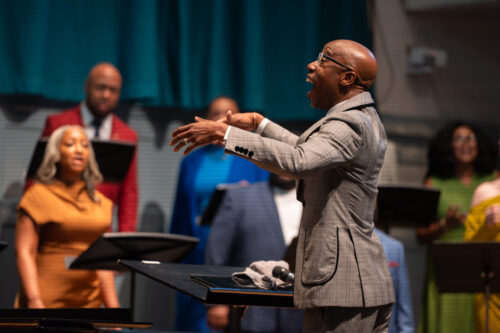
Edinburgh is currently abuzz with the annual melee of the festivals, and some of that buzz was reflected in this year’s opening Usher Hall opening concert; Wynton Marsalis’s jazz symphony All Rise, a piece that required four ensembles and 200 performers. One of those ensembles was the Jason Max Ferdinand Singers, who brought terrific character and blazing conviction to Marsalis’s use of American spirituals and, in their Queen’s Hall morning concert two days later, they got their chance to shine in the spotlight by themselves.
Jason Max Ferdinand himself, who also conducted this concert, founded the ensemble of 26 singers both ‘to promote the choral works of underrepresented composers’ and to ‘champion Black excellence,’ so it’s unsurprising that a lot of their concert involved soulful arrangements of spirituals, repertoire to which they brought not only brilliantly focused singing, but also a whiff of conviction that seemed to go beyond the purely musical. At the keyboard was John Stoddart, who had been JMF’s teacher at university, and the singers performed Stoddart’s Choral Mosaic, four spirituals which, Ferdinand said, had only been put together as a sequence the previous week. They worked together beautifully as a suite, expanding the spirituals into something that was more than the sum of the four parts, working them into something of impressive complexity and musical depth. Stoddart himself later played his own fantasy on Soon I Will Be Done with Rachmaninovian harmonic vigour and Lisztian energy.
They began their recital with a terrifically buoyant take on Lift Every Voice and Sing, one that rang with the optimism you associate with so much Americana, as bright and airy as that country’s boundless skies and endless potential. At nearly 2½ hours the whole concert was a lot to take in at one sitting, and the surfeit began to cloy a bit after a while; but as a celebration of a uniquely American choral tradition, this was impressive to behold.
Choral singing of a very different kind was on offer a couple of evenings later in the grander setting of the Usher Hall. This was the large ensemble of the Edinburgh Festival Chorus, keeping with the 2026 Festival’s theme of the USA by singing a programme of choral music by American composers and conducted by Sofi Jeannin. Jeannin has just stood down from her post as Chief Conductor of the BBC Singers, but she is more familiar to EIF audiences as the conductor at the helm of last year’s epic opening concert, Taverner’s 8-hour Veil of the Temple (which I hated – review here – but that wasn’t her fault).
Fine as the hundred-plus singers of the Edinburgh Festival Chorus are, the BBC Singers they are not, and it perhaps wasn’t surprising that the items that suited their size and composition best were the sacred songs; hymns and spirituals by the likes of Copland, Paulus and, especially, Ames where the chorus created a warm carpet of harmonies against which the melody and the soloist’s line could unfold with unhurried gentleness. That said, they acquitted themselves very well in the spiky harmonies and shifting soundscapes of Nico Muhly’s A Good Understanding and were jolly impressive in Reena Esmail’s challenging but exhilarating When the Violin. Unfortunately, the centrepiece of the programme was a let-down. Joel Thompson’s Seven Last Words of the Unarmed sets the last words of seven black men Americans shot dead by the police. It is a clever idea for a suite but, aside from two gently poignant interludes, the musical ideas on display were pretty anodyne, and the cloudy harmonic textures didn’t flatter the tenors and basses.
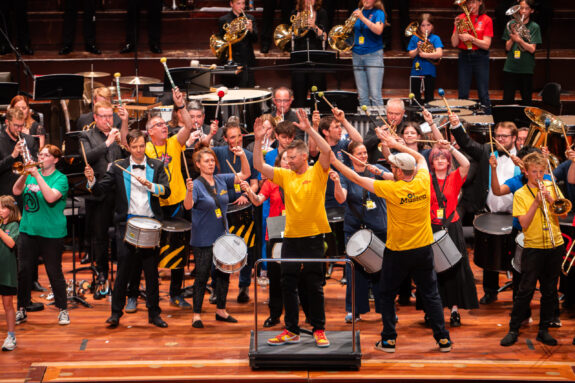
The most expansive, inclusive and downright heartwarming thing of the whole festival so far took place on the Usher Hall stage earlier on Thursday when a group of players from no fewer than seven ensembles joined forces to pay tribute to the late John Wallace. There can be few people involved in Scotland’s music scene over the last few decades who didn’t know Wallace or at least know of him. As a trumpet player he was, among many other roles, principal trumpet of the Philharmonia – for reference, it was he who played the solo trumpet when Kiri Te Kanawa sang Let the Bright Seraphim for Charles and Diana’s wedding – but he was best known in Scotland for his work in music education. Not only was he principal of the Royal Conservatoire of Scotland, but he founded many brass ensembles and was a champion of free music tuition for Scotland’s school children. Wallace died in January 2026, leaving an incalculable legacy to music in Scotland, and this tribute concert gathered together people who had known him personally and many more who had come under his professional influence.
The musical highlight was Elgar Howarth’s arrangement for brass and percussion of Pictures at an Exhibition, which sounded terrific as played by a group of elite professionals, with terrific depth and an exhilarating glow to the top of the trumpet line in the final movements. However, the thing that would doubtless have gladdened Wallace’s heart the most was the massed forces who joined together to play the concert’s other numbers, including two movements from his own brass Symphony.
I couldn’t quite count them from where I was sitting, but there must have been about a hundred brass and percussion players on the stage so, not unreasonably, the first sensation you register is the awesome scale of the noise they made! That was true in the baroque splendour of Wallace’s arrangement of Cesare Bendinelli, and also in his own symphony, the movements from which may have sounded bitty at times; but when you consider that he wrote it over a span of fifty years, you can forgive a few lapses of momentum
The final Lament, Hope and Stomp was written in collaboration with the artists on stage, including youth groups Oi Musica and StAMP (St Andrews Music Participation), and it raised the Usher Hall roof not only with its sheer scale but also with the joyous enthusiasm of its mix of professional and amateur performers. If Wallace could have seen it then he would have seen a palpable demonstration of the fact that the fruits of his labours have lived on in the lives of the many people his work has touched. Which of us could ask more than that?
Simon Thompson
The Edinburgh International Festival runs until 30 August in venues across the city. For information click here.
Featured Image: Brass Fanfare during the John Wallace Tribute © Tommy Ga-Ken Wan
JP for S&H: Thank you for your comment about one of the performers. Your information was noted but you will understand I hope why I am unable to post your thoughts.