 United Kingdom Edinburgh International Festival 2025 [1]: (SRT)

2.8.2025 – John Tavener, The Veil of the Temple: Edinburgh Festival Chorus, Monteverdi Choir, National Youth Choir of Scotland, NYCOS Chamber Choir, Royal Scottish National Orchestra / Sofi Jeannin (conductor). Usher Hall.
2.8.2025 – Colin Currie (marimba), The King’s Singers. Queen’s Hall.
Steve Martland – Street Songs
Stanley Glasser – Lala Mntwana
Thomas Weelkes – Death hath deprived me
Roderick Williams – Death be not proud
Francesca Amewudah-Rivers – Alive
Sir James MacMillan – A Bunch o’Craws
Bryce Dessner –Tromp Miniature
Peter Louis van Dijk – Horizons
Missy Mazzoli – Year of our Burning
‘Survived’ is not a term I customarily use to describe my experience of the Edinburgh International Festival’s opening concert, but there seems no more appropriate word for this year’s. Why? Because it consisted of just one work, but one that lasts for no fewer than eight hours. Making it to the end suddenly feels like quite an achievement!
John Tavener wrote The Veil of the Temple for overnight performance in London’s Temple Church. This year’s EIF opener is only the piece’s second full performance in the UK, for understandable reasons! Typically for Tavener, it is a transcendental, mystical fusion of religions in a quest for the divine that seems to fit nicely enough with the theme of this year’s festival: The Truth We Seek.
As may not surprise you for a piece of eight hours’ length, the piece largely works through repetition, both musically and textually. Tavener composed it in eight cycles which become increasingly elaborate as the work develops, culminating in an eighth cycle where the veil of the temple is rent and we attain the divine, supposedly.
Wonderful idea, you might think, and when the eighth cycle arrives there is a pleasing sense of culmination, with extra musicians added for the final 45 minutes and the sensation of a multiplicity of sounds coming at the audience from every angle. And, in fairness, much of the music is very beautiful, with hymn-like chant that, when you are in the right mood, can become hypnotic and trance-like, and overlapping textures that come close to being hallucinogenic in the overlapping Te re rem prayer or the hymn to Mary Theotokos, the God-bearer.
But, oh my giddy aunt, experiencing it is a trial! It unfolds very slowly, unsurprisingly, and its sheer repetitiveness becomes enervating and attention-sapping by the time you are more than an hour in. The Jesus Prayer again? Another lament outside the gates of Paradise? This was too small an amount of music spread too thinly over too expansive a time. Around about hour five I think I began to hallucinate and had all but lost track of where I was by the time the seventh cycle began. Perhaps that is why my addled brain began to wonder whether the whole audience had been taken for fools. Was the emperor really wearing clothes? Less confident souls than I might wonder why they had not after all been elevated to a higher state of being my Tavener’s spellcasting. Whose fault is that, John: yours or mine?
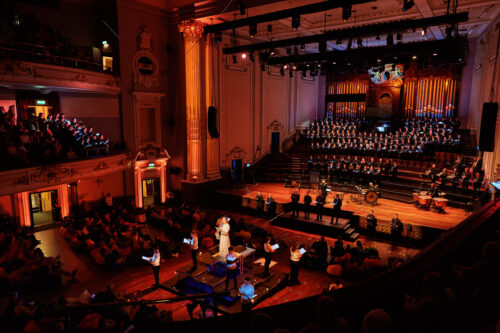
None of this is to criticise the performers, who must have gulped in trepidation when they were told what they would have to perform for this year’s opening. The brunt of the singing was borne by the Monteverdi Choir, who not only sounded fantastic, but who also provided soloists that sang with rock-solid strength and fantastically clear diction. The bigger choruses were sung by the Edinburgh Festival Chorus and the National Youth Choir of Scotland. The grown-ups sounded fine, but the youngsters of NYCOS ran rings around them in terms of both strength and clarity. In fact, the Festival Chorus needs to watch its back because if NYCOS keep sounding this good then they are going to end up being given the opening gig instead in future years.
Hardy souls from the Royal Scottish National Orchestra provided the instrumental contributions, and a special mention goes to the percussionists who were on the stage nearly all night with their gongs and Tibetan singing bowls. The absolute hero of the evening was conductor Sofi Jeannin, whose attention never flagged and who seemed to keep up the focus throughout as the absurd melange unfolded, or so it seemed to my disintegrating brain as the hours crawled by.
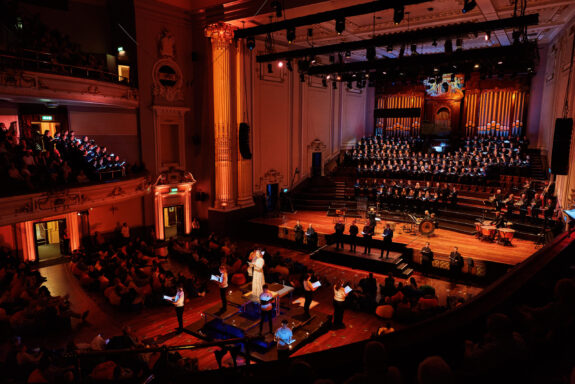
The bigger question here is also the most obvious one, however: why do The Veil of the Temple at all? After all, Tavener wrote it expressly for a sacred space, which the Usher Hall manifestly is not, despite the attempts of director Thomas Guthrie to make it more immersive. So why bother? Don’t tell me they chose it because of the festival’s theme. Almost any work of art could be framed as a search for truth: Beethoven’s Fifth Symphony, Haydn’s Creation, Turangalîla; the list is endless. Did they do it just because they could? If so, then why nor expend some of the festival’s increasingly precious resources on another rarity where the truth/effort/reward ratio is more balanced? I am all for festivals taking risks and doing unusual things, but this felt like a flabby indulgence too far, an eight-hour piece that is five hours too long, and ultimately a poor use of everyone’s time and talent.
One thing’s for sure: this is an opening concert I will always remember. I guess the only way to know for sure whether a piece of mega-music like this is any good is to do it. Well, we know now.
That morning, musical enlightenment of an altogether more digestible kind was being offered in the first of this festival’s Queen’s Hall concerts, as Colin Currie’s marimba rippled gently and hypnotically over Bryce Dessner’s Tromp Miniature in a spellbinding, almost trance-like way. His collaboration with the King’s Singers was one of those festival collaborations that had been many years in the making and centred around a reimagining of Steve Martland’s Street Songs that turned folk songs into something resembling postmodern dance, with angular percussive syncopations in both the marimba and the voice.
Some of the collaborations weren’t quite so successful: Missy Mazzoli’s Year of Our Burning sounded abstract and unwelcoming, a rather forbidding memory of the Covid years, and in Roderick Williams’s homage to Thomas Weelkes the marimba’s tiptoeing through the texture seemed to speak a different language to that of the voices. A new commission from Sir James MacMillan roundly stole the show, mashing up a Scots folk song with an energetically restless marimba line, and even managing to provide comedy at the same time.
Simon Thompson
The Edinburgh International Festival runs at venues across the city until Sunday 24th August. Click here for further details.
Lots of interesting points here on the Tavener, but I don’t agree with your overall conclusion. The EIF achieved something extraordinary by putting this performance on.
Attending it was like going on a pilgrimage, much more so than I realised. It required preparation (food and drink), stamina and the ability to allow the experience to overcome the discomfort, in this case of sitting for long periods, to get to the end. I suspect the beanbag idea didn’t work for this, as how do you sit on one of those for 8 hours and be able to move at the end? For everyone, the physical challenge of remaining comfortable enough to enter ever more deeply into the music with each new Cycle shaping the incredibly sparse opening material into something ever brighter, more intense and complex, was difficult.
I found the opening two cycles just too bare and began to think I wouldn’t make it through. But decided to persevere. I found Cycle 5 the most enjoyable and elevating, and after that I was able to soak up the even longer and more elaborate versions in Cycles 6 & 7 without that inner sense of resistance to the longevity of the piece. I’m still thinking about Cycle 8, which breaks apart the structure of the previous 7 as the Veil of the Temple is torn.
I think it would have helped to suggest standing for certain sections (the most logical would be the gospel incantations and perhaps the St Isaac the Syrian beatitudes), as this would have given permission for everyone to spend some time standing regularly and perhaps move around a bit. It would have created a sense of participation. The organisers had clearly thought a lot about this side of things though, and opening the doors and encouraging people to move during the performance was important.
So was it worth it? For me, absolutely it was, but I recognise I only made it by finding a tucked away seat that allowed me to stand and move around quite often. I think this performance will live with me for many years into the future. As the key material was repeated through the first seven cycles, it was extraordinary how intense and vivid it became. I can’t really think of anything to compare this to. The repetition of the key musical ideas was a liturgical act, but the presentation was always different. The step by step rise in the fundamental tone which set the key of each Cycle, meant each new version was at a higher point in the vocal range, as well as being extended in other ways. Repetition with constant evolution is key to the conception of the piece. It allowed the music to speak more deeply each time. I’m still hearing it.
One final word. Many have praised the conductor, Sofi Jeannin, for her stamina and precision in directing the vast group of musicians in all corners of the Usher Hall. I think this praise, whilst true, understates just how good she was. The real quality she brought was an incredible grasp of the piece as a whole: how it flows, how to pace it, how to make it speak. It’s very difficult to imagine this done better.
Dear Paul,
Thank you for getting in touch, and for leaving such developed and considered comments. It’s true that we don’t agree about the piece, but I’m really pleased that you and so many other people enjoyed it, as that’s the most important thing.
I hope you enjoy the rest of the festival, too.
I read Simon Thompson’s review of The Veil of the Temple, and the comment on it by Paul J with great interest.
After the premiere of the full work, Tavener made an abridged concert version. This is much shorter; it runs for a ‘mere’ 148 minutes! A recording of the concert version (extracted from a recording of the premiere of the complete work) was issued on CD. I reviewed that recording for MusicWeb International ( https://www.musicweb-international.com/classrev/2005/Feb05/Tavener_veil.htm ) I was very enthusiastic, but I doubt I would have had Simon’s stamina and wanted to sit through an eight-hour performance. The concert version would seem to be an ideal compromise for those wanting to experience Tavener’s massive conception, at least in part.
The recording that I reviewed was deleted but in 2014 Signum Classics reissued it as SIGCD367 and so far as I know that release is still available.
It seems that people’s attention spans, and tolerance for slow, repetitive unfoldings vary – perhaps they increase with age? I was in my Upper Circle seat for the entire eight hours (apart from the scheduled breaks), and I didn’t find that it dragged. I am not religious, but nonetheless I understand liturgy – and I also listen to hardcore minimalist music! Like Simon Thompson, I wondered why it should be performed other than as a sacred service – but then I would never have heard it, had it only been so performed. I concur with Paul J’s thoughts, expressed better than I can.