
 United Kingdom BBC Proms 2026 [18] – Canat de Chizy, Shostakovich: Lucy Landymore, Emma Arden, Delia Stevens (percussion), Richard Cartlidge (timpani), BBC Symphony Orchestra / Cristian Măcelaru (conductor). Royal Albert Hall, London, 18.8.2026. (AV-E)
Édith Canat de Chizy – Skyline (UK premiere, 2026)
Shostakovitch – Symphony No.10 in E minor, Op.93 (1953)
The BBC Prom opened with Édith Canat de Chizy’s Skyline (Concerto for three percussionists, timpani and orchestra), receiving its UK premiere. Conceived as a musical vision of the cosmos, Skyline progresses from an initial void towards increasingly teeming and multiplying musical life, with the three percussionists and timpanist spatially dispersed around the orchestra. The world-grounded work, however, seemed stubbornly earthbound, its supposed cosmic vastness nowhere to be seen, smelt or even heard. The opening seemed to start without actually starting, remaining suffocatingly static and mono-chromatically-moored, while the percussion writing felt more concerned with gymnastic performativity and special effects than with creating any genuinely celestial sense of space, mystery or expansion. The scoring often sounded derivative of Varèse, Xenakis, Penderecki, Ligeti, Berio and Boulez, without quite achieving the visceral originality or imaginative force of those composers.
However, percussionists Lucy Landymore, Emma Arden and Delia Stevens, together with timpanist Richard Cartlidge, played with considerable verve, panache and precision throughout. At the back of the stage, one percussionist even whirled a long string of beads above her head like a lasso before letting them fly, their clattering impact as they scattered across the stage prompting laughter from the audience — such stunts are the adolescent antics of ‘contemporary music’ in its perennial determination to épater le bourgeois, when all it really does is bore them. Cristian Măcelaru conducted competently, while the BBC Symphony Orchestra played with its frequent pristine immaculate discipline.
The stark juxtaposition between Canat de Chizy’s writing for timpani and percussion and Shostakovich’s revealed just how extraordinarily inventive the latter was: where Canat de Chizy’s timpani and percussion scoring was preoccupied with gimmicky theatrics, gratuitous virtuosity and meretricious showmanship, Shostakovich transformed the same forces into an integral dramatic language of menace, violence, irony and carnival, achieved with economical expressive power.
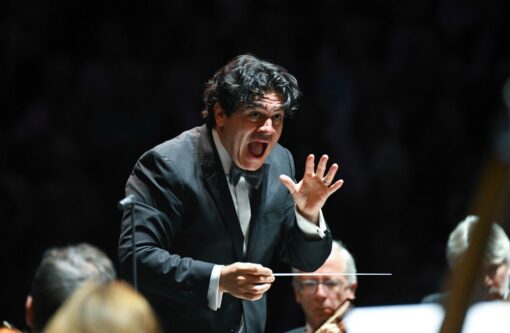
What made this performance of Shostakovich’s Symphony No.10 so refreshing was that Măcelaru resisted the temptation to reproduce the familiar template of previous performances, instead finding a distinctly perspicacious perspective on the work. Rather than the histrionic bombast of many readings, Măcelaru favoured a subtler, more nuanced approach, allowing tension to gather gradually, menace to lurk beneath the surface and violence to emerge with greater impact precisely because it was so carefully contained. Of course, there will be those with firmly entrenched preconceptions about how Shostakovich ‘should’ be played and conducted who might regard Măcelaru’s reading as nothing short of an abomination.
The symphony opened with the Moderato in a markedly reserved and broad-paced manner. Măcelaru allowed the brooding music to breathe with grave patience, its tension latent and subterranean, lurking beneath the surface rather than announcing itself openly. The BBC SO played with remarkable tonal focus and character, the woodwind particularly pointed and expressive, with clarinet and flute lines emerging vividly from the sombre string texture. The tension gradually tightened towards the great central eruption, where timpani, percussion and blazing orchestral forces unleashed a surge of vibrating violence, surfing towards its climax before subsiding into the coda.
Here the sonic texture became increasingly spare and exposed, the pointed, exquisitely articulated piccolo lines piercing the texture above a sustained timpani-roll accompaniment with almost painful clarity, culminating in the mournful final call of the lone piccolo.
The Allegro — the symphony’s brutally concentrated scherzo — was immediate, incisive and menacing, its rhythmic energy biting from the outset. The strings drove the music forward with manic precision while the brass snarled and blazed above incisive timpani and side drum, the percussion cutting through the orchestral mass with a hard, martial brutality. Most strikingly, the bass drum emerged with a presence I had rarely, if ever, heard in recordings, where its all-important contribution is so often buried beneath the orchestral mass. Măcelaru kept the movement taut and fiercely articulated, the BBC SO responding with tremendous precision and bite, every attack sharply etched yet charged with visceral physical force without ever sounding brash.
The Allegretto was one of the most melancholy accounts of this movement I have heard, its strange, nocturnal atmosphere imbued with an almost unbearable poignancy. The strings entered with an air of tentative desolation, while the mournful solo horn, repeatedly sounding its enigmatic motif, seemed to call from some distant, unreachable place. Around it, the woodwind became spectral and half-lit, with clarinet, flute and bassoon emerging in strangely isolated colours, while the DSCH motif seemed to flicker through the orchestral texture like a private musical confession. Măcelaru allowed the meandering and woeful waltz to hover between tenderness and unease, its melancholy never becoming sentimental, but instead acquiring an increasingly haunted and desolate intensity. Towards the close, a strange carnivalesque dance suddenly flickered into life, the percussion lending the music a grotesquely playful edge before the agitation intensified, timpani and side drum driving the rhythmic fabric into a more insistent and menacing frenzy. Then, almost as suddenly, the violence receded: a solo violin emerged with poignant restraint, followed by the spectral flutes and piccolo, whose subdued, exquisitely articulated final utterances of DSCH seemed to dissolve the movement into an icy, haunted stillness. The piccolo playing here was exceptionally poised, its final notes delivered with dewdrop delicacy.
The final Andante–Allegro opened once again in shadow, Măcelaru maintaining considerable coy reserve and allowing the dark introduction to accumulate slowly before the music broke into its more animated Allegro. The woodwind again proved especially characterful, with oboe, flute, piccolo, bassoon and clarinet emerging with vivid individuality before the strings gathered momentum and the brass and percussion drove the music towards its final surge. The BBC SO played with exceptional commitment, Măcelaru balancing the symphony’s darkness, volatility and flashes of sardonic energy with considerable subtlety and nuance. This was emphatically not the raw-brute, angst-ridden Russian tradition of Mravinsky, with its granite-like sonority and almost feral physical force; instead, Măcelaru offered a more refined, psychologically probing and ontologically processioning Shostakovich, allowing menace to lurk beneath the surface, making the vitriolic violence all the more poignant, pungent and potent for being so carefully contained, concentrated and controlled.
The attentive audience was held spellbound throughout this mesmerising account, the tension palpable both on the stage and in the hall. The final release was met with enthusiastic, richly deserved applause, a fitting response to a performance that had sustained such conviction, composure and commitment from beginning to end.
Alexander Verney-Elliott
The bullroarer – a bent tube whirled over the percussionist’s head, not a string of beads – malfunctioned and flew out of the percussionist’s hand, fortunately behind the stage and not into the orchestra where it could have done serious damage. There were audible gasps in the arena – I was there – but nobody was laughing.
Excellent piece of writing you won’t find anywhere in the dreaded ‘MSM’ – I would advise readers to hear the Varese on Sunday night for an example of truly original writing for percussion 100 years ago… (BTW the ‘lasso’ wasn’t intended to let fly!)